
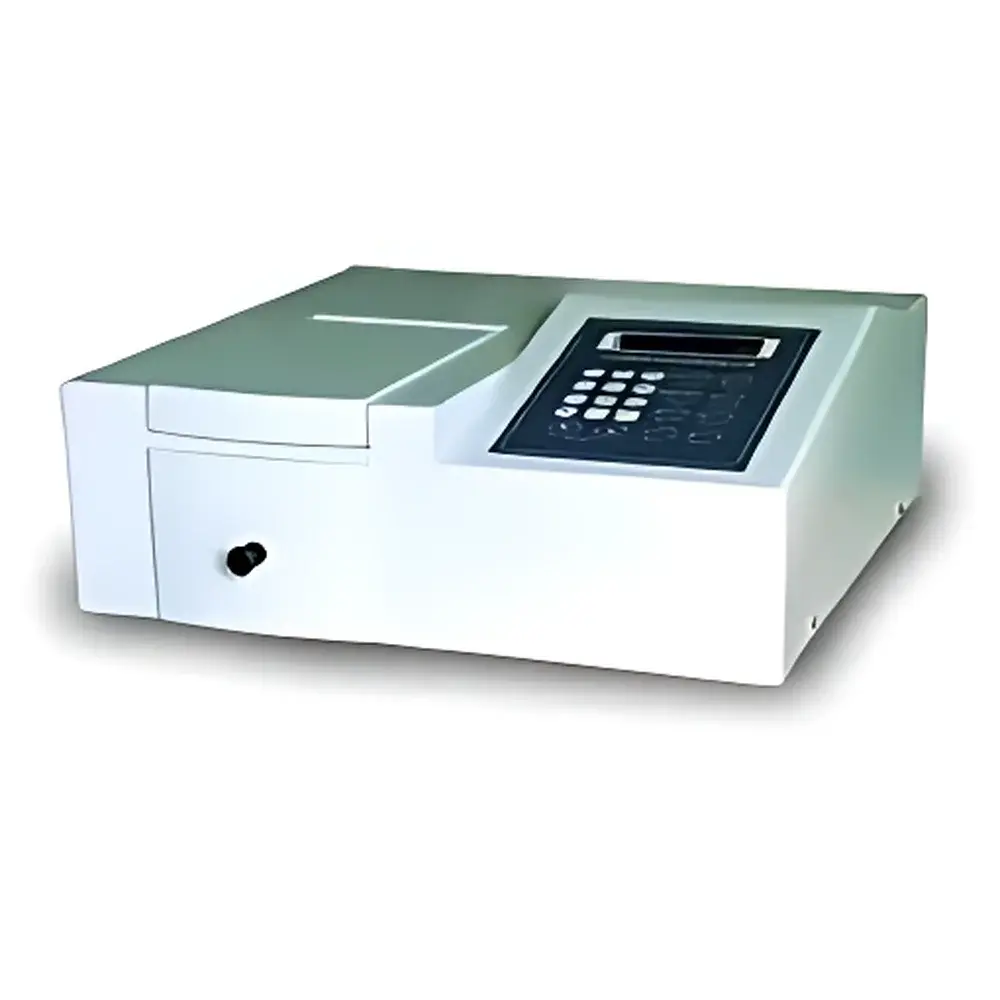
MC016-723PC Visible Spectrophotometer
| Origin | Shanghai, China |
|---|---|
| Manufacturer Type | Authorized Distributor |
| Origin Category | Domestic (China) |
| Model | MC016-723PC |
| Pricing | Upon Request |
| Wavelength Range | 320–1000 nm |
| Wavelength Accuracy | ±1 nm |
| Wavelength Repeatability | 0.5 nm |
| Spectral Bandwidth | 2 nm |
| Transmittance Accuracy | ±0.5%T |
| Transmittance Repeatability | 0.2%T |
| Transmittance Range | 0.0–125%T |
| Absorbance Range | −0.097–2.5 A |
| Concentration Display Range | 0–99999 |
| Stray Light | ≤0.5%T @ 360 nm |
| Photometric Stability | ±0.002 A/h |
| Interface | RS-232 bidirectional serial port |
| Software | SPD application software for Windows |
| Printer Support | Integrated thermal printer |
| Measurement Modes | T (%T), A (Abs), C (Concentration), F (Factor) |
Overview
The MC016-723PC Visible Spectrophotometer is a precision single-beam optical instrument engineered for routine quantitative and qualitative analysis in the visible and near-UV spectral region (320–1000 nm). It operates on the fundamental principle of Beer–Lambert law-based absorption spectroscopy: analytes exhibit wavelength-dependent absorbance proportional to concentration under controlled pathlength and matrix conditions. By establishing a reference baseline—typically solvent, distilled water, or air—at 100% transmittance (0 A), the instrument measures sample transmittance (%T) or absorbance (A) relative to that baseline. Its optimized Czerny–Turner monochromator design incorporates a high-efficiency holographic grating and precision slit mechanism to deliver a nominal 2 nm spectral bandwidth, ensuring adequate resolution for standard colorimetric assays while minimizing stray light (<0.5%T at 360 nm). The optical path is thermally stabilized and mechanically isolated to maintain photometric integrity over extended operation.
Key Features
- Single-beam optical architecture with low-stray-light grating monochromator (2 nm bandwidth) for robust baseline stability and reproducible spectral acquisition.
- Automated wavelength drive with ±1 nm accuracy and 0.5 nm repeatability—validated per ISO 8579-1 and ASTM E275 for spectrophotometer performance verification.
- Dual-mode digital display showing simultaneous %T, A, concentration (C), and factor (F) values—enabling real-time method validation without mode switching delays.
- Integrated RS-232 interface compliant with EIA/TIA-232-F standards, supporting bidirectional communication with Windows-based SPD application software for method storage, data logging, and audit-trail-enabled reporting.
- Onboard thermal printer with non-volatile memory buffer—capable of generating GLP-compliant hardcopy reports including timestamp, operator ID, wavelength, and measurement mode.
- Microprocessor-controlled auto-zero (0%T) and auto-reference (100%T) functions with drift compensation algorithms, reducing manual intervention and operator-induced variability.
Sample Compatibility & Compliance
The MC016-723PC accommodates standard 10 mm rectangular cuvettes (glass, quartz, or plastic) and supports liquid, colloidal, and homogenized suspension samples compatible with common UV-Vis assay protocols. Its optical design excludes deep-UV (<320 nm) operation; therefore, it is not intended for nucleic acid quantification below 260 nm or aromatic compound analysis requiring sub-220 nm excitation. The instrument meets essential requirements of ISO/IEC 17025 for testing laboratories, including documented calibration traceability to NIST-traceable reference standards (e.g., potassium dichromate solution for absorbance verification at 350 nm). All firmware and software modules comply with FDA 21 CFR Part 11 electronic record and signature provisions when used with validated SPD software configurations—including user access control, electronic signatures, and immutable audit trails for all calibration and measurement events.
Software & Data Management
The bundled SPD Windows application provides full instrument control, method development, and data governance capabilities. Users may define multi-point calibration curves (linear, quadratic, or polynomial), assign sample IDs with metadata fields (batch number, analyst, date/time), and export raw or processed data in CSV, TXT, or XML formats for LIMS integration. The software maintains a hierarchical project structure with versioned method templates, enabling laboratory-wide consistency across QC workflows. Audit logs record every parameter change, measurement execution, and calibration event—including timestamps, user credentials, and system state snapshots—satisfying GLP and GMP documentation requirements. Data files are digitally signed and checksum-verified upon save to prevent unauthorized modification.
Applications
This spectrophotometer serves as a foundational tool in quality control and research environments where reliable visible-range absorbance measurements are required. Typical applications include: determination of dye concentrations in textile effluents (ISO 105-X12); enzymatic activity assays (e.g., NADH oxidation at 340 nm); iron(II) quantification via 1,10-phenanthroline complexation (ASTM D1068); protein concentration estimation using Bradford or Lowry methods; nitrate/nitrite analysis in environmental water samples (EPA Method 353.2); and excipient purity verification in pharmaceutical tablet formulations (USP ). Its stability (±0.002 A/h) and repeatability (0.2%T) support ISO 9001-certified production line monitoring in food, chemical, and materials manufacturing facilities.
FAQ
Is the MC016-723PC suitable for UV-range measurements below 320 nm?
No. Its optical components and detector response are optimized for 320–1000 nm; measurements below 320 nm require quartz optics and deuterium lamp sources not included in this configuration.
Does the instrument support compliance with FDA 21 CFR Part 11?
Yes—when operated with validated SPD software, configured user roles, electronic signatures, and enabled audit-trail logging, it fulfills electronic record and signature requirements for regulated environments.
Can custom calibration curves be stored onboard the instrument?
No. Calibration curves must be defined and saved within the SPD software; the instrument itself retains only factory-default wavelength and photometric calibrations.
What cuvette materials are recommended for use with this model?
Standard 10 mm pathlength glass cuvettes are appropriate for visible-range work (≥350 nm); quartz cuvettes are unnecessary and not cost-justified for this instrument’s operational range.
Is preventive maintenance documentation provided?
Yes. The user manual includes scheduled maintenance intervals, optical alignment procedures, lamp replacement guidelines, and performance verification checklists aligned with ISO/IEC 17025 clause 6.4.




