
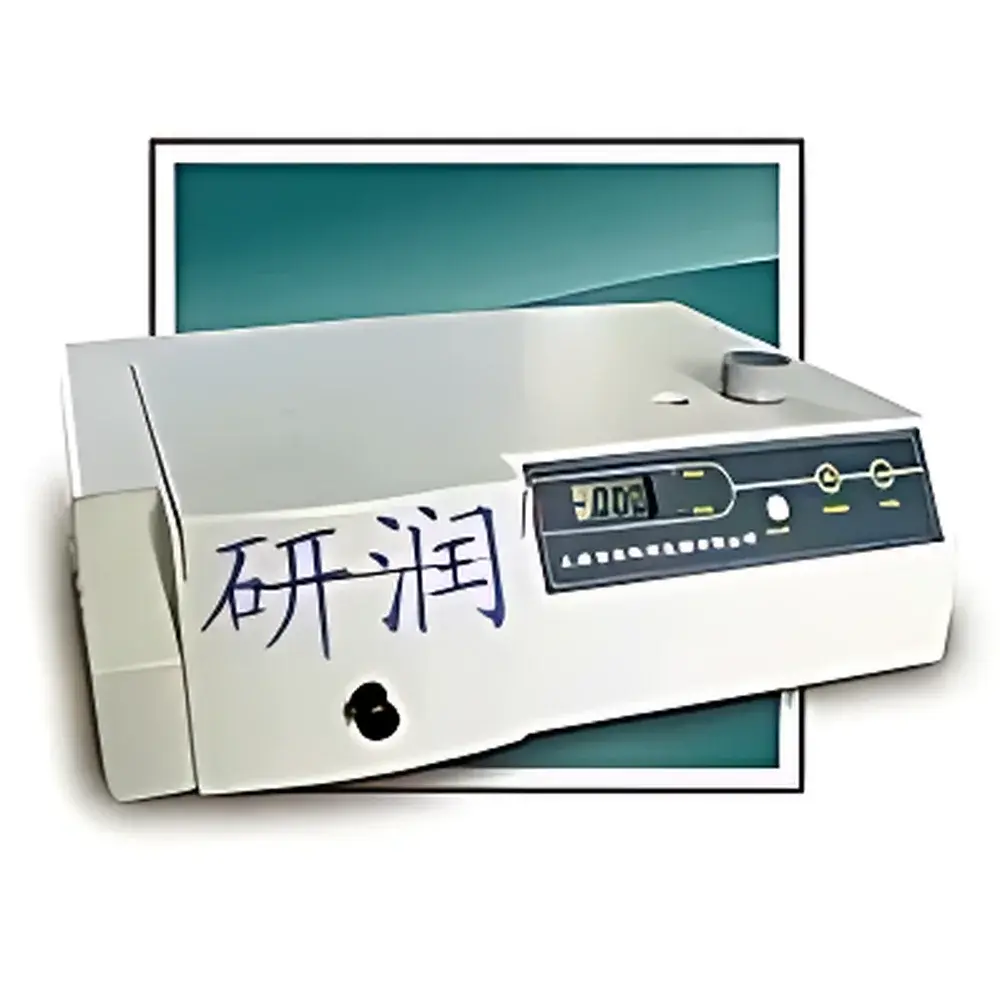
MC016-752 Manual Single-Beam UV-Vis Spectrophotometer
| Origin | Shanghai, China |
|---|---|
| Manufacturer Type | Authorized Distributor |
| Origin Category | Domestic (PRC) |
| Model | MC016-752 |
| Pricing | Available Upon Request |
| Wavelength Drive | Manual |
| Wavelength Range | 200–1000 nm |
| Wavelength Accuracy | ±2 nm |
| Wavelength Repeatability | 1 nm |
| Spectral Bandwidth | 4 nm |
| Transmittance Accuracy | ±0.5%T |
| Transmittance Repeatability | 0.2%T |
| Transmittance Range | 0.0–125%T |
| Absorbance Range | −0.301 to 1.999 A |
| Concentration Display Range | 0–1999 units |
| Stray Light | ≤0.5%T at 220 nm and 360 nm |
| Photometric Stability | ±0.003 A/h |
| Interface | RS-232 bidirectional serial port |
| Printer Support | Yes |
| Software Compatibility | SPD application software for Windows (T/A/C/F modes, kinetic scanning, data logging) |
Overview
The MC016-752 is a manually operated single-beam ultraviolet-visible (UV-Vis) spectrophotometer engineered for routine qualitative and quantitative analysis in academic, industrial, and quality control laboratories. It operates on the fundamental principle of molecular absorption spectroscopy: analytes absorb specific wavelengths within the 200–1000 nm spectral region according to their electronic structure, enabling identification and concentration determination via the Beer–Lambert law. The instrument employs a high-efficiency Czerny–Turner monochromator with a precision holographic grating, delivering low stray light (<0.5%T at 220 nm and 360 nm) and a fixed 4 nm spectral bandwidth—optimized for robustness and reproducibility in standard assay protocols. Its single-beam optical architecture uses a stable tungsten-halogen lamp (visible) and deuterium lamp (UV), with manual wavelength selection via calibrated vernier scale, ensuring mechanical reliability and minimal thermal drift over extended operation.
Key Features
- Optimized single-beam optical path with low-stray-light grating monochromator and dual-lamp source (deuterium + tungsten-halogen) for full 200–1000 nm coverage
- Manual wavelength adjustment with vernier-scale readout and ±2 nm accuracy, supported by 1 nm repeatability for consistent method execution
- Digital LED display showing transmittance (%T), absorbance (A), concentration (C), and factor (F) simultaneously—enabling direct interpretation without external calculation
- Integrated microprocessor control supporting automatic 0%T and 100%T calibration, T/A/C/F measurement modes, and real-time photometric stability monitoring (±0.003 A/h)
- RS-232 bidirectional interface compliant with standard serial communication protocols (EIA-232-D), enabling connection to legacy printers and Windows-based SPD application software
- Robust mechanical design with shock-absorbing base and temperature-stabilized optical bench—suitable for non-climate-controlled lab environments
Sample Compatibility & Compliance
The MC016-752 accommodates standard 10 mm pathlength cuvettes (glass, quartz, or plastic) and supports liquid, solution-phase samples across chemistry, biochemistry, pharmaceutical, and environmental applications. It meets core performance benchmarks referenced in ISO 8577:2018 (spectrophotometer verification), ASTM E275–22 (standard practice for UV-Vis spectrophotometer calibration), and USP (Ultraviolet-Visible Spectrophotometry). While not designed for 21 CFR Part 11–compliant environments out-of-the-box, its RS-232 interface permits integration into validated systems where audit trails and user access controls are implemented at the host software layer. Data generated satisfies GLP documentation requirements when paired with SPD software’s timestamped export functionality and manual operator logs.
Software & Data Management
The optional SPD application software (Windows 10/11 compatible) provides full instrument control via RS-232, supporting three primary operational modes: photometric (T/A), quantitative (C/F with up to 20-point calibration curves), and time-scan (kinetic monitoring at fixed wavelength). All measurements are timestamped and stored in CSV format for traceability; raw absorbance vs. time or wavelength datasets can be exported without proprietary compression. The software includes built-in validation tools—including wavelength accuracy verification using holmium oxide and didymium filters—and supports user-defined report templates aligned with internal QA documentation standards. No cloud dependency or subscription licensing is required; local installation ensures data sovereignty and compatibility with air-gapped laboratory networks.
Applications
- Quantitative analysis of transition metal ions (e.g., Fe²⁺/Fe³⁺, Cu²⁺, Cr⁶⁺) in water and effluent per EPA Method 3500 series
- Protein concentration determination via Bradford or BCA assays (measured at 595 nm or 562 nm)
- Pharmaceutical assay validation of active ingredients (e.g., paracetamol at 243 nm) per USP monographs
- Enzyme kinetics studies (e.g., NADH oxidation at 340 nm) under controlled ambient conditions
- Quality control of dyes, pigments, and food colorants in manufacturing environments
- Teaching laboratories for foundational spectroscopy experiments—calibration, Beer’s law verification, and spectral scanning
FAQ
Is the MC016-752 suitable for GMP-regulated environments?
It supports GMP-aligned workflows when integrated with validated SPD software and documented calibration procedures—but lacks native electronic signature or audit trail features required for full 21 CFR Part 11 compliance.
Can I use quartz cuvettes for measurements below 220 nm?
Yes—quartz cells are mandatory for measurements between 200–220 nm due to UV absorption by standard optical glass.
What is the maximum sample volume required per measurement?
Standard 10 mm pathlength cuvettes require 3.5 mL minimum fill volume; micro-cuvette adapters are not included but may be retrofitted via third-party holders.
Does the instrument include wavelength calibration standards?
No—calibration verification requires separate traceable standards (e.g., holmium oxide filter SRM 2034) per ISO 8577 recommendations.
Is firmware upgrade capability available?
Firmware is embedded and non-upgradable; functional enhancements are delivered exclusively through updated versions of the SPD application software.
Related Products




