
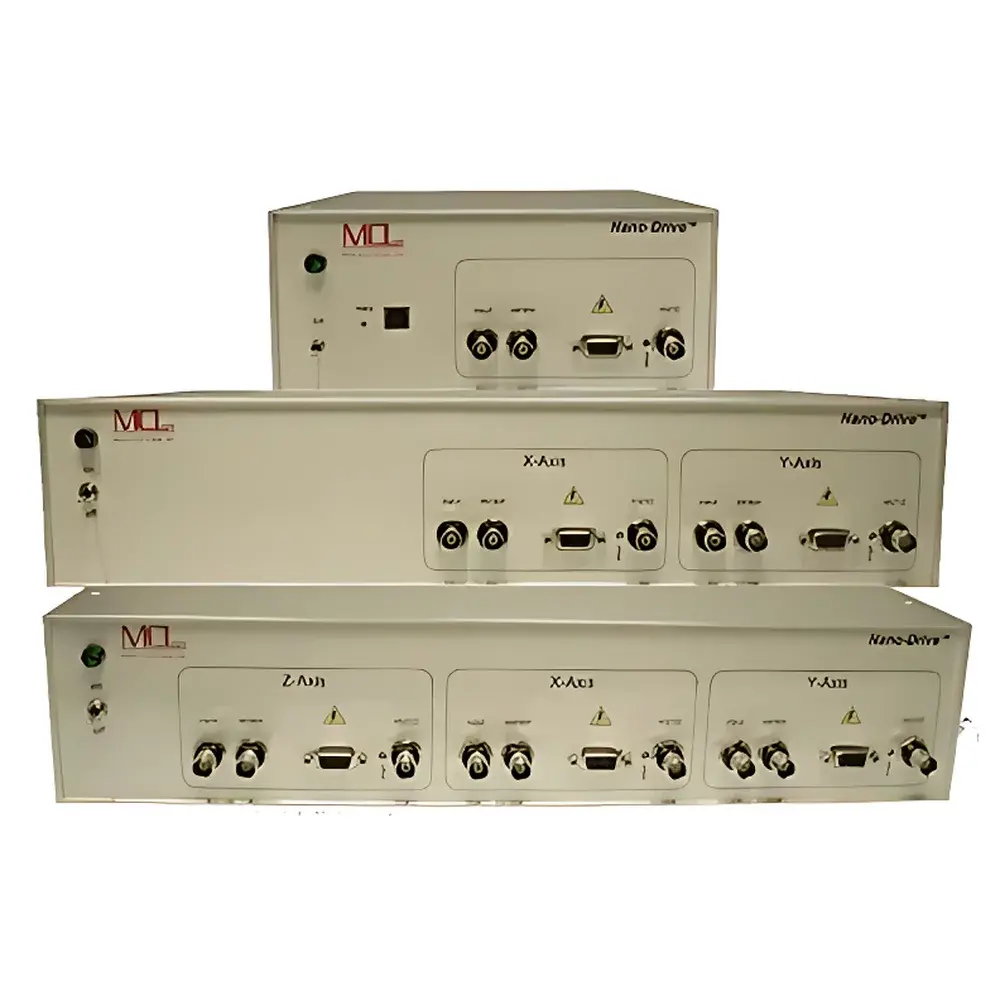
MCL Think Nano Nano-Drive® Series Piezo Motion Controller
| Brand | MCL Think Nano |
|---|---|
| Origin | USA |
| Model | Nano-Drive® Series |
| Type | Motorized Translation Stage Controller |
| Compliance | CE |
| Control Interface | Analog (0–10 V BNC), Optional 16-bit/20-bit USB Digital |
| Feedback | Closed-loop servo with Proportional-Integral (PI) control |
| Bandwidth Selection | Adjustable for stability under high inertial load |
| Form Factor | Benchtop unit or OEM circuit board |
| High-Power Variant | Nano-Drive®85 |
| Software Compatibility | Windows XP/Vista/7 (32/64-bit), LabVIEW-ready, TCSPC synchronization support (ISS option) |
| Regulatory Alignment | Designed for GLP-compliant lab environments |
Overview
The MCL Think Nano Nano-Drive® Series is a precision-engineered family of closed-loop piezoelectric motion controllers designed for sub-nanometer positioning accuracy in optical laboratory and nanoscale research applications. Built upon a robust analog-digital hybrid architecture, each Nano-Drive® controller integrates low-noise, low-drift high-voltage amplifiers with real-time proportional-integral (PI) feedback processing to actively compensate for inherent piezoelectric nonlinearity—specifically hysteresis and creep—common in open-loop nanopositioning systems. The core measurement principle relies on strain gauge or capacitive position sensing coupled with dynamic voltage-to-displacement calibration, enabling true absolute position control across single- and multi-axis configurations. These controllers are not standalone actuators but system-level electronic interfaces optimized for seamless integration with MCL’s nanopositioners—including flexure-guided translation stages, Z-height scanners, and XYθ platforms—ensuring factory-calibrated linearity, thermal drift suppression, and repeatable step-and-settle performance down to <1 nm RMS resolution.
Key Features
- Closed-loop servo architecture with user-selectable PI gain parameters for dynamic response tuning
- Front-panel BNC interfaces for analog position command (standard 0–10 V; optional ±10 V, ±6 V, or ±5 V ranges)
- Dual-mode operation: front-panel toggle switch between open-loop and closed-loop modes (OCL option)
- Real-time monitoring outputs: simultaneous access to sensor feedback signal and high-voltage actuator drive signal (HV/10)
- Configurable bandwidth limiting to enhance stability in high-mass or resonant-load setups
- High-power Nano-Drive®85 variant engineered for sustained scanning at >100 Hz line rates with sub-millisecond step recovery
- OEM-ready form factor: available as fully assembled benchtop unit or bare PCB for embedded integration
- CE-marked design compliant with EN 61326-1 (EMC) and EN 61010-1 (safety) standards
Sample Compatibility & Compliance
Nano-Drive® controllers are compatible with all Mad City Labs nanopositioners rated for ≤150 V drive voltage and equipped with integrated position sensors (capacitive or resistive). Load compatibility is determined empirically during system commissioning: maximum supported inertial mass depends on desired bandwidth, step size, and settling time requirements. Controllers support standard optical microscopy payloads (e.g., objective turrets, sample holders up to 500 g) and advanced configurations such as AFM cantilever scanners, super-resolution STED/PALM stage modules, and cryogenic-compatible positioning assemblies. From a regulatory perspective, the Nano-Drive® Series meets essential requirements for use in ISO/IEC 17025-accredited testing laboratories and supports traceable calibration workflows. When paired with validated software and timestamped logging (via USB interface), the system satisfies documentation prerequisites for GLP and GMP environments—particularly where position repeatability, environmental drift logs, and operator intervention records are auditable.
Software & Data Management
The Nano-Drive® Series supports native Windows driver stacks for both 16-bit and 20-bit USB interfaces (USB16-x and USB20-x), delivering plug-and-play functionality without third-party middleware. The 20-bit interface is required to resolve the full dynamic range of MCL’s highest-resolution nanopositioners (e.g., 0.1 nm effective step size). Included LabVIEW example VIs enable rapid integration into custom automation sequences, while internal waveform generation and position logging buffer up to 10,000 coordinate points—critical for synchronized raster scanning or time-resolved photoluminescence mapping. Synchronization options include the ISS module, which provides TTL-compatible pixel-, line-, and frame-clock outputs for direct interfacing with Becker & Hickl or PicoQuant TCSPC hardware. All digital interfaces support deterministic timing via hardware-triggered start/stop and external clock input. Firmware updates and custom logic implementation (e.g., trajectory pre-compensation, multi-channel phase alignment) are available upon request and subject to NDA-bound development agreements.
Applications
- Confocal and multiphoton microscopy stage control with sub-pixel registration stability
- Atomic force microscopy (AFM) Z-feedback loop augmentation and coarse/fine positioning coordination
- Nanoscale lithography tool positioning where thermal drift compensation and long-term positional hold are critical
- Single-molecule fluorescence tracking requiring real-time drift correction and closed-loop repositioning
- Optical trap calibration and holographic optical tweezers beam steering synchronization
- Interferometric displacement metrology systems requiring traceable, low-noise actuation reference
- OEM integration into commercial biophotonics platforms requiring compact, low-EMI motion control electronics
FAQ
What is the difference between USB16-x and USB20-x interfaces?
The USB16-x provides 16-bit resolution (65,536 discrete steps), sufficient for most optical microscopy applications with ~1–2 nm effective resolution. The USB20-x delivers 20-bit resolution (1,048,576 steps), necessary to exploit the full specification of high-end nanopositioners with <0.5 nm minimum controllable increment.
Can I use the Nano-Drive® with non-MCL nanopositioners?
Yes—provided the external piezo actuator includes a compatible analog position sensor (e.g., capacitive or strain-gauge output) and operates within the Nano-Drive®’s voltage compliance range (±150 V typical). Custom calibration and firmware adaptation may be required.
Is FDA 21 CFR Part 11 compliance supported?
The Nano-Drive® hardware itself does not include electronic signatures or audit trail features. However, when integrated with validated third-party software (e.g., LabVIEW-based acquisition suites with Part 11 extensions), full compliance—including user authentication, change history, and immutable data archiving—is achievable.
What does the AR-10 option enable?
AR-10 configures the analog input range to ±10 V, enabling direct compatibility with Veeco Bioscope/Nanoscope IV controllers when used with the VBOB breakout box. It is mutually exclusive with USB16-x but fully compatible with USB20-x.
Can I retrofit USB connectivity into an older Nano-Drive® unit?
Yes—MCL offers field-upgrade kits for legacy analog-only units. Retrofit requires hardware modification and firmware reflash, performed either by MCL service or certified partners under technical supervision.




