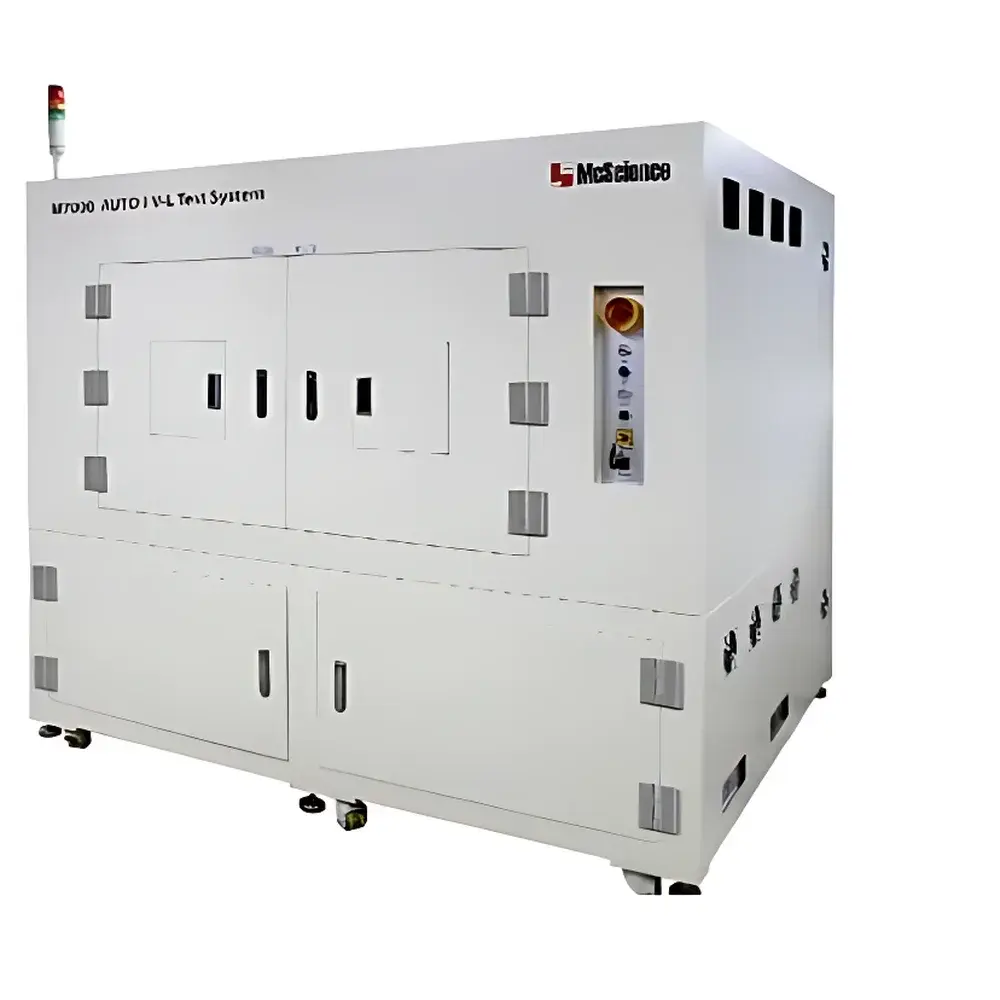
McScience M7000 OLED Optoelectronic Characterization and Lifetime Testing System
| Brand | McScience |
|---|---|
| Origin | South Korea |
| Model | M7000 |
| Category | Imported Semiconductor Inspection Instrument |
| Configuration | Multi-Channel I-V-L & Degradation Monitoring Platform |
| Optical Detection | Integrated Spectrometer and Tristimulus Colorimeter with Motorized XYZ Positioning |
| Thermal Control | Independent Temperature Chamber (−40 °C to +120 °C) |
| Electrical Biasing | Precision Source-Measure Units (SMUs) for DC/Pulsed Operation |
| Measurement Modes | Luminance (cd/m²), Chromaticity (CIE 1931 xy), Spectral Power Distribution (380–780 nm), EQE, Impedance (1 Hz–1 MHz), Viewing Angle (±85°), Transient EL (µs–s resolution) |
| Compliance | ASTM F2699, ISO 13406-2, IEC 62341-6-1, JEDEC JESD22-A108 (HTOL), USP <1058> (Analytical Instrument Qualification) |
Overview
The McScience M7000 OLED Optoelectronic Characterization and Lifetime Testing System is an integrated platform engineered for quantitative, traceable, and time-resolved evaluation of organic light-emitting diode devices across three hierarchical levels: individual emissive pixels (OLED devices), active-matrix backplane-integrated panels (AMOLED panels), and fully assembled display modules. Its core architecture implements synchronized electroluminescent (EL) excitation and optical detection under controlled environmental conditions—enabling simultaneous acquisition of current–voltage–luminance (I-V-L) relationships, spectral evolution, chromaticity drift, and degradation kinetics. The system operates on a dual-axis measurement paradigm: steady-state characterization (e.g., luminous efficacy, CIE coordinates, external quantum efficiency) and accelerated lifetime monitoring (e.g., L50/T70, voltage rise at constant current, spectral shift Δu’v’). All optical subsystems—including fiber-coupled spectrometers (FWHM ≤ 2.5 nm) and calibrated tristimulus colorimeters—are mounted on a high-precision, backlash-free XYZ translation stage (repeatability ±0.5 µm), ensuring pixel-level spatial registration without manual repositioning.
Key Features
- Multi-level compatibility: Configurable test fixtures support bare OLED substrates (glass/foil), TFT-driven AMOLED panels (up to Gen 6 size), and encapsulated modules with FPC or COG interfaces.
- Automated optical alignment: Closed-loop autofocus via confocal displacement sensor and real-time centroid tracking ensure consistent measurement geometry across heterogeneous emission profiles.
- Independent thermal management: Dual-zone Peltier-controlled chamber maintains uniform temperature gradients (±0.3 °C stability) across sample surface; supports JEDEC-compliant high-temperature operating life (HTOL) protocols.
- Transient EL capability: High-speed digitizer (100 MS/s) synchronized with pulsed SMU enables microsecond-resolved electroluminescence decay analysis (Tr-EL), critical for identifying trap-assisted recombination and interface degradation.
- Impedance spectroscopy module: Four-terminal sensing with phase-sensitive detection delivers Nyquist and Bode plots for interfacial charge transport analysis (e.g., hole/electron injection barriers, dielectric relaxation).
- Viewing angle characterization: Rotatable goniometer (±85°, 0.1° step resolution) coupled with angular luminance mapping satisfies ISO 13406-2 requirements for luminance uniformity and contrast ratio assessment.
Sample Compatibility & Compliance
The M7000 accommodates rigid and flexible OLED structures fabricated on glass, polyimide, or thin-metal substrates, with active area dimensions ranging from 0.1 mm² to 370 × 470 mm². It supports both bottom- and top-emission architectures and integrates native drivers for common TFT addressing schemes (e.g., 2T1C, 3T1C). From a regulatory standpoint, the system’s data acquisition firmware adheres to ALCOA+ principles (Attributable, Legible, Contemporaneous, Original, Accurate, Complete, Consistent, Enduring, Available) and supports audit trails compliant with FDA 21 CFR Part 11 and EU Annex 11. Calibration certificates are traceable to NIST and KRISS standards; spectral irradiance measurements conform to CIE S 026/E:2018 and IEC 62341-6-1 for OLED luminance reporting.
Software & Data Management
Control and analysis are unified within McScience’s proprietary OLEDMaster Suite v4.x—a Windows-based application built on .NET Framework with deterministic real-time task scheduling. The software provides scriptable test sequences (Python API), multi-parameter correlation matrices (e.g., luminance vs. impedance phase angle), and automated pass/fail decision logic per user-defined specification limits. Raw datasets (including time-stamped spectral cubes, I-V sweeps, and transient waveforms) are stored in HDF5 format with embedded metadata (sample ID, ambient RH/T, bias history). Export options include CSV, MATLAB .mat, and PDF reports compliant with GLP/GMP documentation requirements. Remote monitoring and secure data export are enabled via TLS 1.2–encrypted HTTPS interface.
Applications
- Material development: Quantifying operational stability of novel emitters (TADF, hyperfluorescence), host–dopant energy transfer efficiency, and interfacial dipole effects via bias-dependent EL spectra.
- Process optimization: Correlating encapsulation quality (water vapor transmission rate) with luminance decay kinetics under controlled humidity (5–95% RH).
- Reliability qualification: Executing accelerated aging tests per JEDEC JESD22-A108 (HTOL), IEC 62341-6-2 (bend fatigue), and MIL-STD-810G (thermal shock).
- Quality control: Batch screening of panel uniformity (Δu’v’, luminance mura index), pixel defect mapping, and driver IC performance validation under dynamic grayscale patterns.
- Failure analysis: Isolating root causes of luminance loss—whether due to cathode oxidation (via impedance phase shift), triplet–polaron annihilation (via Tr-EL lifetime shortening), or microcrack propagation (via angular luminance asymmetry).
FAQ
Does the M7000 support pulsed driving modes for evaluating burn-in behavior?
Yes—the integrated SMUs deliver programmable pulse widths (10 µs to 10 s), duty cycles (0.1–99.9%), and rise/fall times (<1 µs), enabling stress protocols that replicate real-world video content drive conditions.
Can the system perform in-situ measurements during thin-film encapsulation deposition?
No—the M7000 is designed for post-fabrication characterization. In-situ optical monitoring during deposition requires vacuum-compatible ellipsometry or reflectometry add-ons not included in standard configuration.
Is third-party calibration service available for the spectrometer and colorimeter modules?
Yes—McScience offers biannual factory recalibration with NIST-traceable reference standards (e.g., NIST SRM 2035 for spectral irradiance, CIE Standard Illuminant A for chromaticity).
What level of software validation support is provided for regulated environments?
The OLEDMaster Suite includes IQ/OQ documentation templates, installation verification checklists, and a full 21 CFR Part 11 compliance package (electronic signature workflows, role-based access control, immutable audit logs).
How is positional repeatability maintained over extended lifetime testing campaigns (>1000 hours)?
The XYZ stage employs recirculating ball screws with preloaded linear guides and real-time position feedback via optical encoders (1 µm resolution); mechanical drift is compensated automatically every 24 hours using a fiducial marker-based self-alignment routine.