
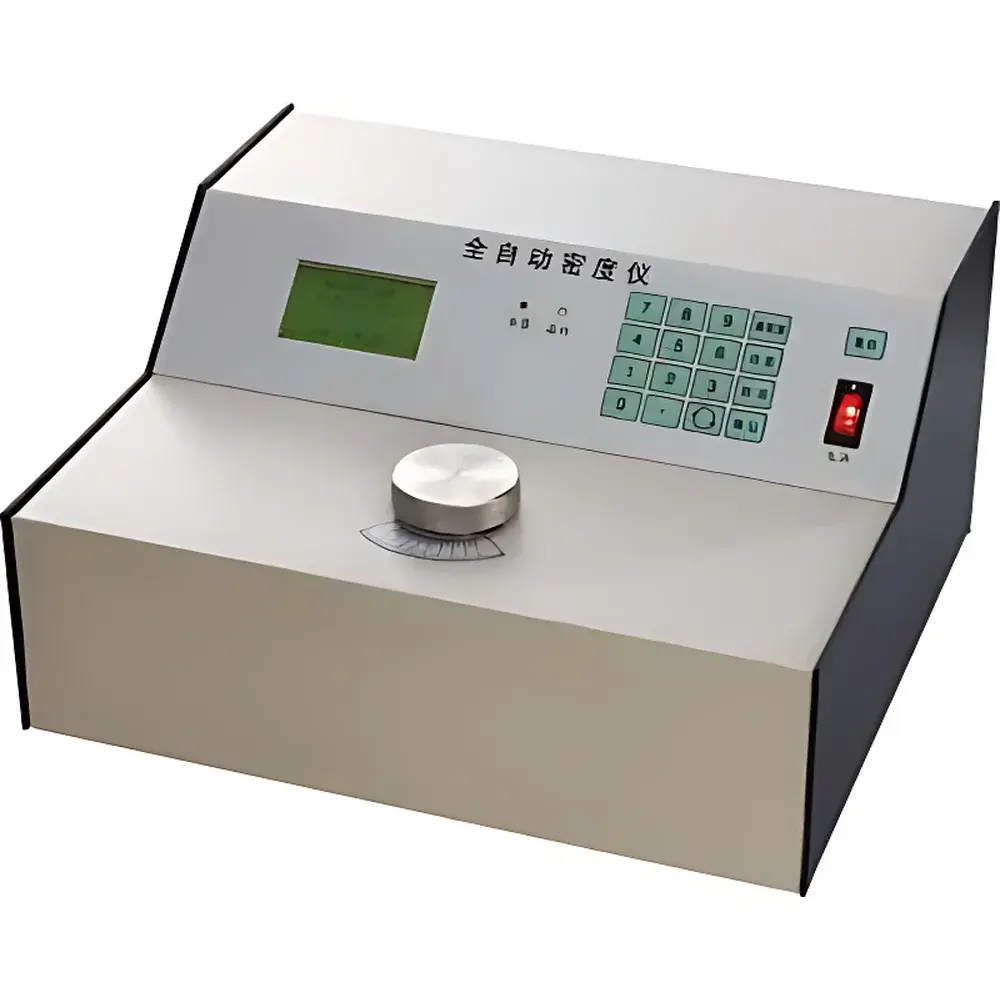
MDZ-II Automatic Gas Pycnometer
| Origin | Hunan, China |
|---|---|
| Manufacturer Type | Authorized Distributor |
| Origin Category | Domestic (China) |
| Model | MDZ-II |
| Pricing | Available Upon Request |
| Maximum Sample Volume | 40 cm³ |
| Accuracy | ±0.15% |
| Repeatability | ±0.05% |
| Density Resolution | 0.0001 g/cm³ |
| Carrier Gas | High-Purity Helium or Nitrogen |
| Operating Pressure | ~1.25 atm |
| Dimensions | 385 × 335 × 200 mm |
Overview
The MDZ-II Automatic Gas Pycnometer is a precision volumetric density analyzer engineered for true density determination of solid and non-volatile liquid materials using gas displacement pycnometry—a technique grounded in Boyle’s law and ideal gas behavior. Unlike liquid immersion methods, this instrument employs inert carrier gas (helium or nitrogen) to penetrate micro-pores, surface irregularities, and interstitial voids inaccessible to liquids, thereby yielding highly accurate measurements of skeletal (true) volume. The system operates via dual-chamber differential pressure measurement: a calibrated reference chamber and a sample chamber of known internal geometry. Upon sealing the sample chamber, the instrument executes controlled gas transfer between chambers while continuously monitoring transient pressure equilibration. Using thermally stabilized pressure transducers and temperature-compensated algorithms, the MDZ-II calculates sample volume from the pressure ratio, enabling true density derivation as ρ = m/V, where mass (m) is input manually or via integrated balance interface and volume (V) is determined with traceable metrological rigor.
Key Features
- High-accuracy gas displacement methodology compliant with ASTM D5550 and ISO 12154 standards for true density of solids
- Non-destructive analysis—samples remain physically and chemically unaltered post-measurement, supporting downstream characterization (e.g., BET surface area, XRD, SEM)
- Automated sequence control via embedded microprocessor: full cycle (purge, fill, equilibrate, calculate, report) completed in 3–8 minutes
- Dual-chamber design with temperature-stabilized pressure sensors (±0.01% FS) and active thermal drift compensation
- Self-diagnostic firmware with real-time error logging, sensor calibration status alerts, and hardware fault detection
- User-guided touchscreen interface with step-by-step operational prompts, multilingual support (English, Chinese, Spanish), and password-protected method editing
- Modular gas handling: compatible with standard helium or nitrogen supply lines; includes integrated pressure regulator, filter, and leak-check routine
Sample Compatibility & Compliance
The MDZ-II accommodates powders, granules, monolithic solids, foams, ceramics, catalysts, pharmaceutical excipients, and non-volatile liquids—including slurries (e.g., coal-water slurry, ceramic slips) when pre-conditioned to remove entrapped air. It excludes volatile, reactive, or moisture-sensitive samples unless preconditioned under inert atmosphere. Instrument design conforms to IEC 61000-6-3 (EMC) and IEC 61010-1 (safety). Data integrity meets GLP/GMP requirements through audit-trail-enabled software (optional), supporting 21 CFR Part 11 compliance when paired with validated LIMS integration. Calibration verification follows NIST-traceable reference standards (e.g., fused quartz, sapphire spheres) and is documented per ISO/IEC 17025 procedures.
Software & Data Management
The MDZ-II runs on embedded Linux-based firmware with local data storage (SD card, 8 GB) and USB export capability. Measurement reports include raw pressure-time curves, calculated volume, density, uncertainty budget (based on ISO/IEC Guide 98-3), and operator metadata. Optional PC software provides advanced features: batch processing, statistical trend analysis (X̄-R charts), customizable report templates (PDF/CSV), and secure network upload to enterprise LIMS or ELN systems. All data entries are timestamped, user-ID logged, and immutable post-generation—enabling full traceability required for regulatory submissions (FDA, EMA, CNAS).
Applications
This pycnometer serves critical quality control and R&D functions across multiple sectors: coal and coke density grading per ASTM D3176; electrode material characterization in battery manufacturing; porosity assessment of refractory bricks and insulating ceramics; bulk density validation of pharmaceutical granules (USP <616>); catalyst support density profiling for petrochemical process modeling; and quality assurance of construction materials including cement clinker and lightweight aggregates. Its ability to resolve density differences below 0.0001 g/cm³ makes it suitable for detecting subtle compositional variations in alloy powders, mineral concentrates, and polymer composites.
FAQ
What gases are recommended for operation, and why is helium preferred over nitrogen?
Helium is recommended due to its small molecular size and high diffusion rate, enabling deeper penetration into sub-nanometer pores and improved accuracy for ultra-fine powders. Nitrogen may be used for cost-sensitive applications where pore accessibility is less critical.
Can the MDZ-II measure open-cell versus closed-cell porosity?
No—it determines total skeletal volume only. Open/closed porosity requires complementary techniques such as mercury intrusion porosimetry or Archimedes’ principle with vacuum saturation.
Is sample preparation required before testing?
Yes. Powders must be degassed under vacuum (optional accessory) to remove adsorbed moisture and air; solids should be cleaned of surface contaminants. No grinding or drying is needed unless specified by application standards.
How is instrument calibration verified?
Calibration is verified using certified reference materials (CRMs) with known true density (e.g., NIST SRM 1921a). Daily system checks include zero-pressure drift test and reference volume verification via standard sphere insertion.
Does the MDZ-II support automated sample changers or robotic integration?
Not natively—but the RS-232 and Ethernet interfaces enable third-party automation via SCPI command set and Modbus TCP protocol for integration into high-throughput lab automation platforms.



