
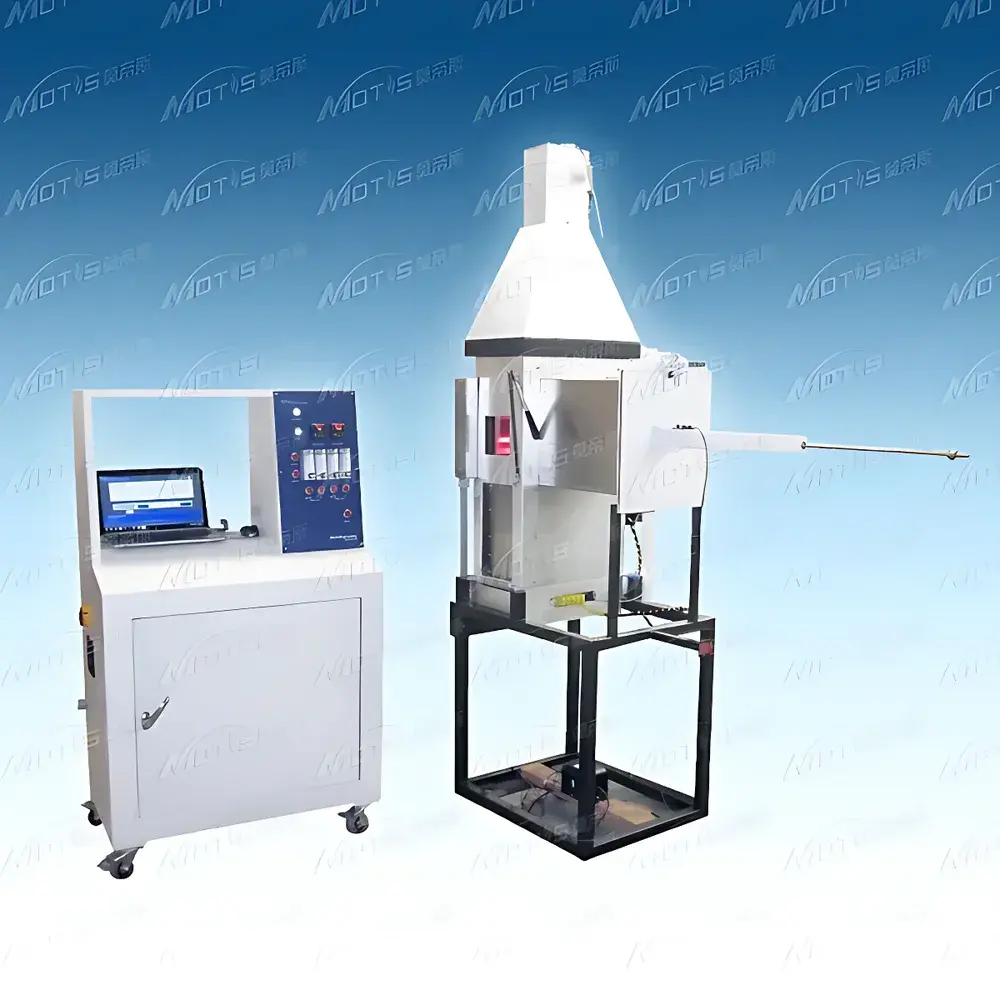
MEI OSU Heat Release Rate Calorimeter ME1200-1
| Brand | MEI / Marlin Engineering |
|---|---|
| Origin | USA |
| Model | ME1200-1 |
| Compliance | FAR 25 Appendix F Part IV, Airbus AITM 2.0006, Boeing BSS 7322 |
| Radiant Flux | 35 kW/m² |
| Heating Source | Four glow bars |
| Temperature Control | Dual independent PID controllers |
| Sample Introduction | Pneumatic actuated pusher with shielded access door |
| Burner Configuration | Fixed upper burner + movable lower burner |
| Calibration System | Movable T-type calibration burner with mass flow controller |
| Heat Flux Measurement | Water-cooled thermopile with active cooling circuit |
| Airflow Control | Regulated isothermal and isovolumetric supply via orifice flow meter |
| Data Acquisition | Integrated DAQ system with ASTM/ISO-compliant heat release rate test software |
Overview
The MEI OSU Heat Release Rate Calorimeter ME1200-1 is a precision-engineered fire testing instrument originally developed at The Ohio State University in 1972 and subsequently adopted as the standard test apparatus by the U.S. Federal Aviation Administration (FAA) for aircraft material flammability assessment. It operates on the principle of oxygen consumption calorimetry—measuring the rate of heat release (HRR) by quantifying the depletion of oxygen in the combustion effluent stream, based on the fundamental thermochemical relationship that approximately 13.1 kJ of heat is released per gram of oxygen consumed. This method provides high reproducibility and traceable quantitative data essential for regulatory compliance, material screening, and fire model input generation. The ME1200-1 is specifically designed to meet the stringent requirements of aerospace certification standards including FAR Part 25 Appendix F Part IV, Airbus AITM 2.0006, and Boeing BSS 7322, making it a critical tool for Tier 1 suppliers, FAA-designated testing laboratories, and aviation OEMs conducting vertical flame propagation and heat release characterization.
Key Features
- Stainless steel test chamber with high-temperature borosilicate observation window enabling real-time visual monitoring under radiant exposure up to 35 kW/m²
- Four independently controlled glow bar heaters delivering uniform and stable radiant flux; calibrated and verified per ASTM E1354 and ISO 5660-1 protocols
- Dual-channel PID temperature control system for precise regulation of both glow bar surface temperature and chamber ambient conditions
- Pneumatically actuated sample introduction mechanism with integrated shielded access door minimizing air intrusion and thermal disturbance during specimen loading
- Dual-burner configuration: fixed upper burner for pilot ignition and adjustable lower burner for controlled flame impingement and afterflame assessment
- Movable T-type calibration burner assembly with integrated mass flow controller, enabling in-situ thermopile calibration prior to each test sequence
- Water-cooled thermopile sensor mounted directly opposite the specimen surface, actively cooled to maintain operational stability during prolonged high-flux exposure
- Orifice-type flow meter coupled with pressure transducers for accurate volumetric airflow measurement into the test chamber, supporting isovolumetric condition verification
- Thermally regulated air supply system maintaining constant inlet temperature and flow velocity to ensure repeatable boundary layer development
- Real-time data acquisition system compliant with ASTM E1354 Annex A1, logging O₂, CO₂, CO, smoke obscuration, mass loss, and HRR at ≥1 Hz sampling resolution
Sample Compatibility & Compliance
The ME1200-1 accommodates flat, rigid specimens up to 100 mm × 100 mm × 50 mm (L × W × H), including composites, laminates, foams, textiles, and coated substrates used in aircraft interior components (e.g., seat cushions, sidewall panels, ceiling liners, insulation blankets). Specimen mounting fixtures conform to FAR 25.853(a) dimensional tolerances and thermal anchoring requirements. All hardware, firmware, and software are validated for conformance with FAA Advisory Circular AC 20-135B, EN 45545-2 (railway equivalence), and ISO/IEC 17025:2017 laboratory accreditation criteria. Instrument design supports full audit trail capability for GLP/GMP environments, with optional 21 CFR Part 11–compliant electronic signature modules available upon request.
Software & Data Management
The embedded test software provides automated execution of standardized test sequences—including pre-test calibration, baseline stabilization, ignition timing synchronization, and post-test purge cycles—while recording synchronized time-series data across all analog and digital channels. Raw signals undergo real-time stoichiometric correction using dynamic O₂/N₂ ratio compensation algorithms. Export formats include CSV, XML, and ASTM E1354–formatted ASCII files compatible with Fire Dynamics Simulator (FDS), CFAST, and other computational fluid dynamics platforms. Data integrity safeguards include cyclic redundancy checks (CRC), write-once storage mode, and user-access-level permissions aligned with ISO/IEC 27001 information security frameworks.
Applications
- Aircraft interior material qualification per FAR 25.853 and related airworthiness directives
- Development and validation of low-HRR polymer formulations for cabin applications
- Comparative fire performance benchmarking of alternative sustainable materials (bio-based composites, recycled thermoplastics)
- Supporting NFPA 286 room-corner test correlation studies and cone calorimeter–based fire growth index (FGI) derivation
- Research into flame inhibition mechanisms and condensed-phase vs. gas-phase fire retardancy efficacy
- Third-party certification testing for EASA Part 21G and Transport Canada TP 11428 compliance submissions
FAQ
What standards does the ME1200-1 directly support?
It is configured and validated for FAR Part 25 Appendix F Part IV, Airbus AITM 2.0006, and Boeing BSS 7322, with full traceability to ASTM E1354 and ISO 5660-1 calibration methodologies.
Is the system suitable for GMP-regulated testing environments?
Yes—when equipped with optional audit trail and electronic signature modules, it meets 21 CFR Part 11 requirements for data integrity and operator accountability.
Can the instrument be integrated into an existing fire lab LIMS?
Yes—the DAQ system supports OPC UA and Modbus TCP protocols for seamless integration with laboratory information management systems.
What maintenance intervals are recommended for the water-cooled thermopile?
Coolant circuit inspection and deionized water replacement are required every 12 months; thermopile calibration verification is recommended before each daily test session.
Does the system include reference material certification?
Each unit ships with NIST-traceable calibration certificates for thermopile sensitivity, gas analyzers, and mass flow controllers, valid for 12 months from commissioning date.
Related Products



