
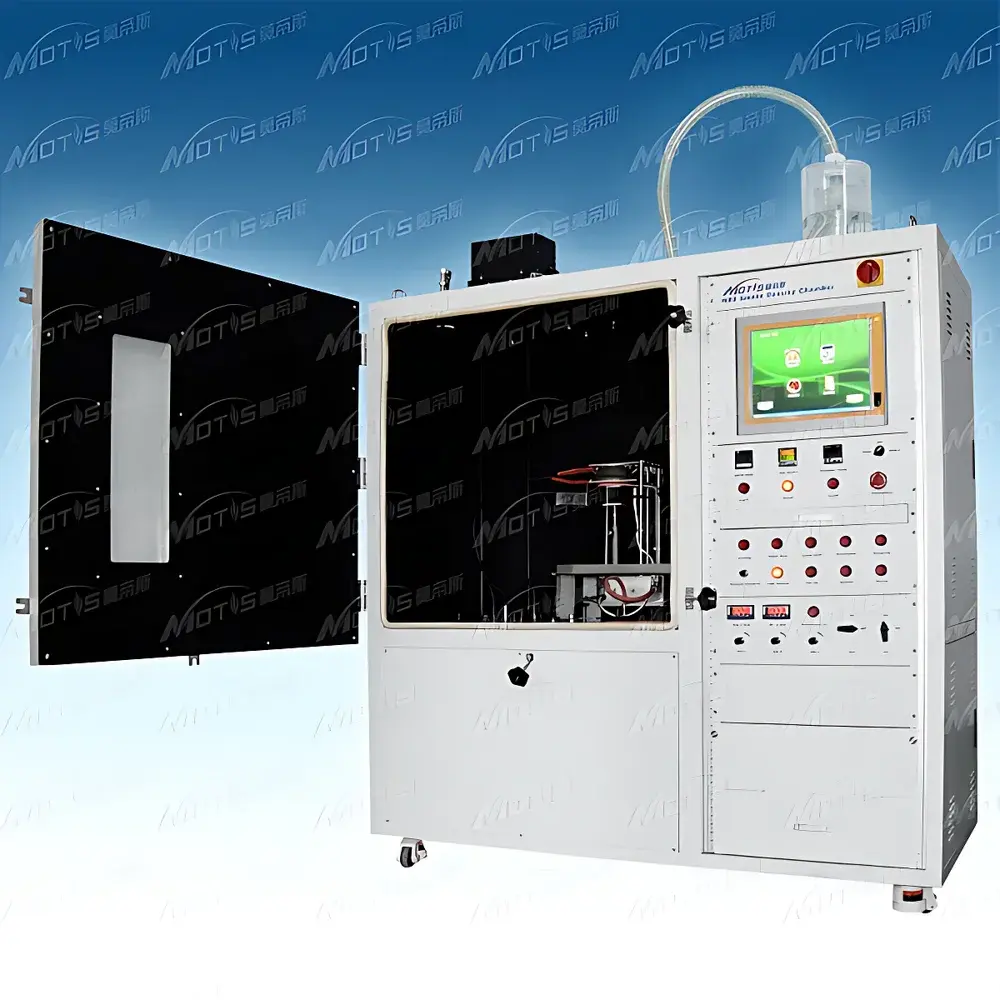
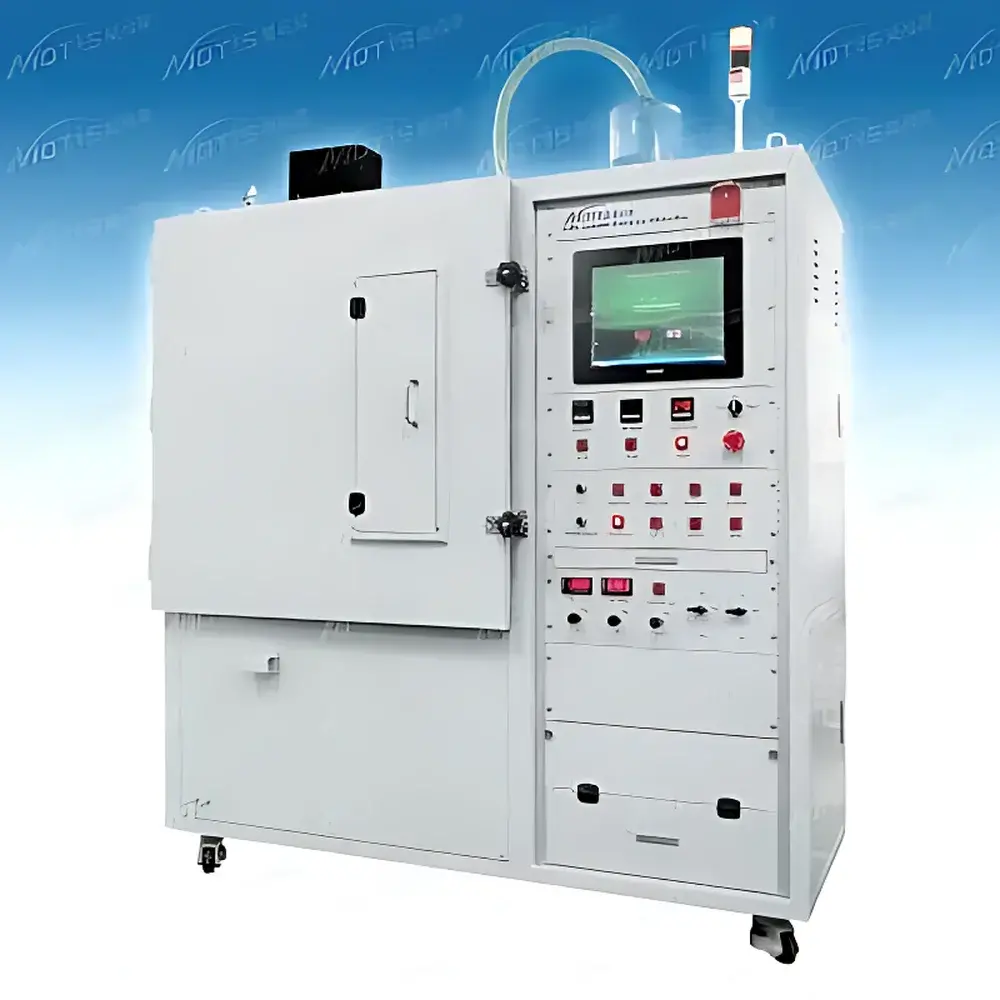
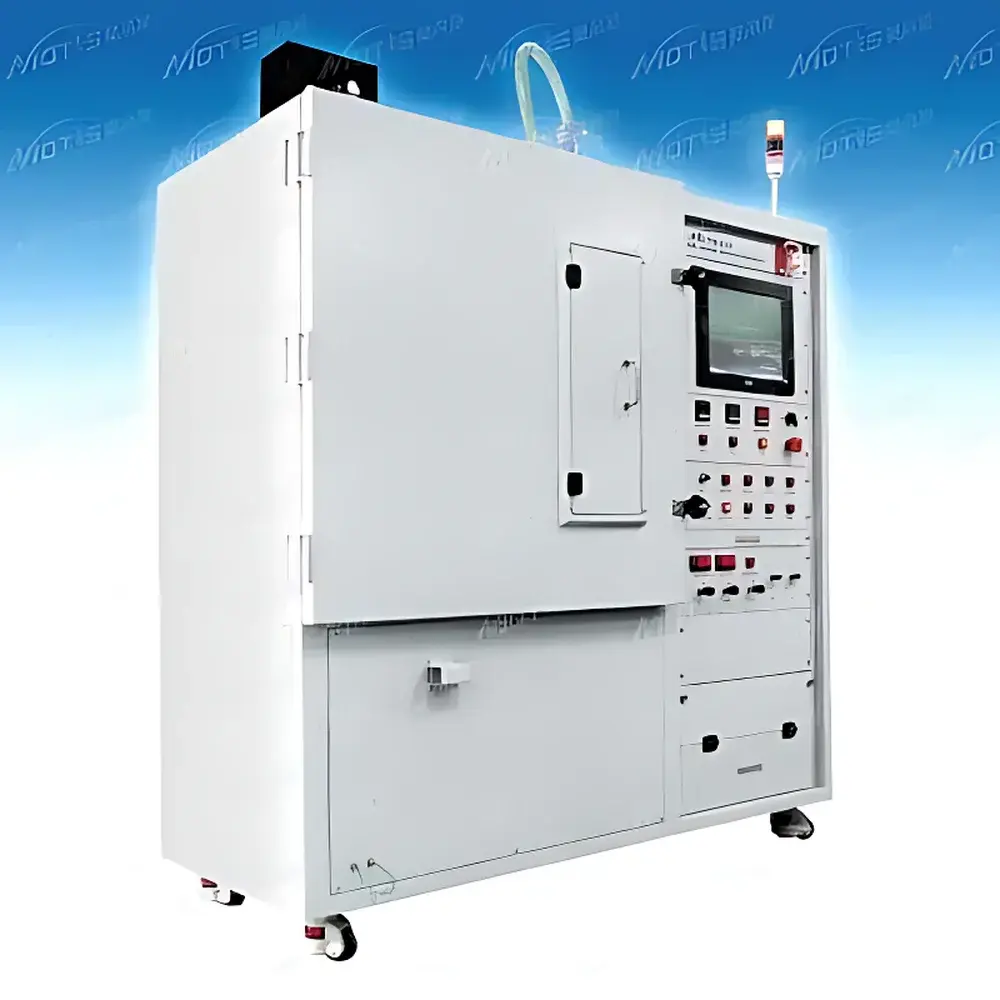
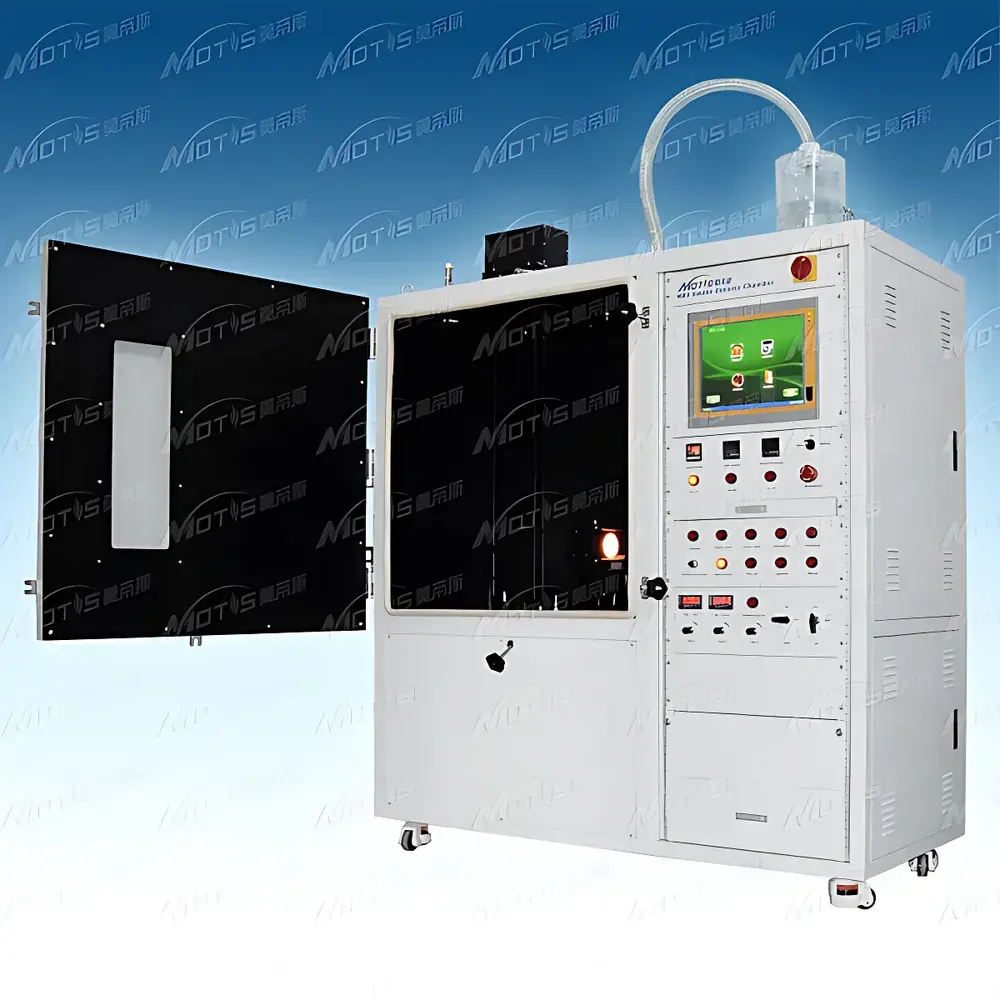
MOTIS SDB NBS Smoke Density Chamber
| Brand | MOTIS |
|---|---|
| Origin | Jiangsu, China |
| Model | SDB |
| Chamber Internal Dimensions | 914 mm × 914 mm × 610 mm |
| Optical System | Side-window photomultiplier tube (PMT), S-4 spectral response, transmittance resolution: 0.0001% |
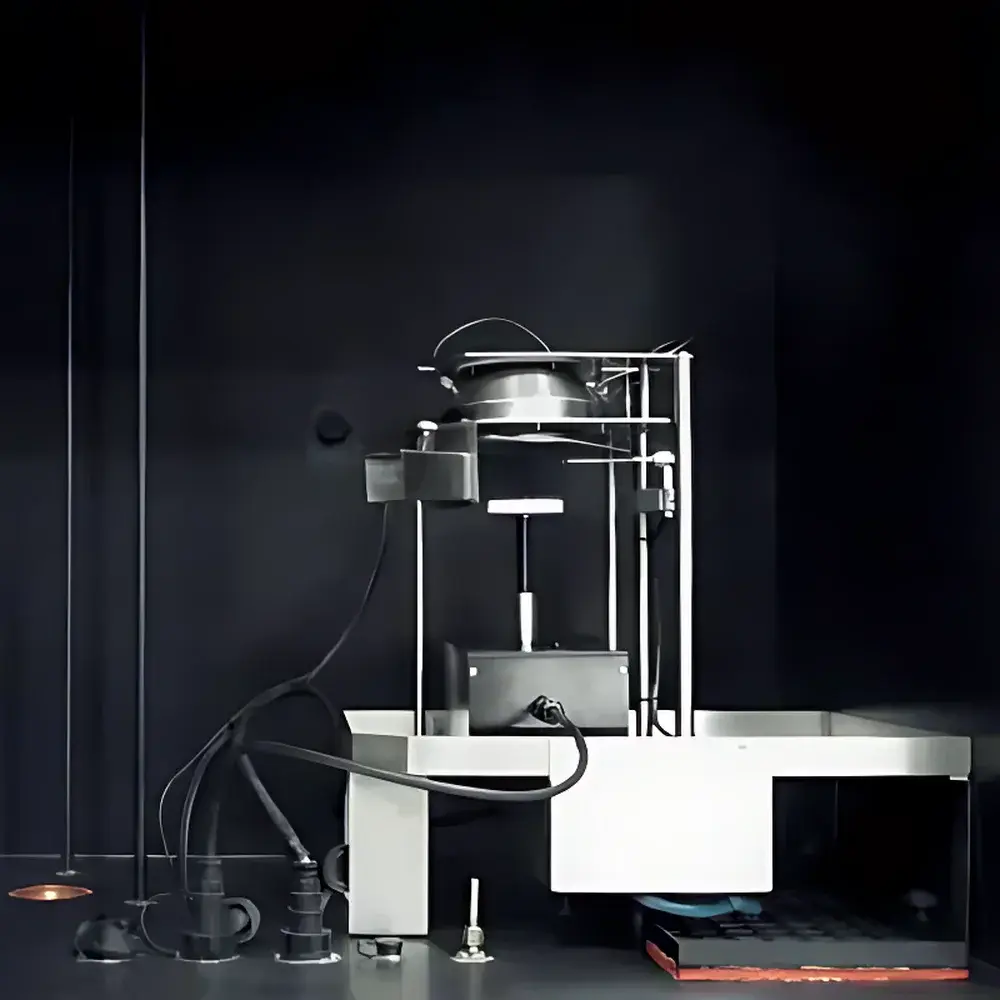
| Radiation Sources | ASTM E662 radiant panel (25 kW/m²) and ISO 5659-2 conical heater (50 kW/m²) |
| Flame Sources | ASTM E662 pilot flame burner, ISO 5659-2 burner, NES 711 burner with mixing fan |
| Temperature Control | External auxiliary heating jacket for chamber thermal stabilization |
| Pressure Regulation | Top-mounted pressure relief port linked to calibrated volume bottle |
| Safety Features | Explosion-resistant aluminum foil lining, automatic pneumatic actuators for top/bottom access, full-front opening door |
| Cooling | Integrated recirculating water chiller with NIST-traceable water-cooled heat flux meter (50 kW/m² range) |
| Mass Loss Measurement | Built-in balance (0–2000 g, ±0.1 g) for MOD testing and thermogravimetric analysis |
| Calibration & Compliance | Compliant with ASTM E662, ISO 5659-2, NES 711 |
Overview
The MOTIS SDB NBS Smoke Density Chamber is a precision-engineered instrument designed for quantitative measurement of specific optical density (Ds) of smoke generated during controlled combustion of solid materials. Its operational foundation lies in the Beer–Lambert law—governing the exponential attenuation of collimated visible light (white-light incandescent source, 2856 K color temperature) as it traverses a smoke-laden test chamber. By continuously monitoring transmitted light intensity via a side-window photomultiplier tube (PMT) with S-4 spectral response and 0.0001% transmittance resolution, the system calculates smoke density in real time according to standardized extinction coefficients. The chamber conforms structurally and functionally to the core requirements of ASTM E662 (Standard Test Method for Specific Optical Density of Smoke Generated by Solid Materials), ISO 5659-2 (Plastics — Smoke Generation — Part 2: Determination of Optical Density by a Single-Chamber Test), and NES 711 (Naval Engineering Standard for Fire Test Methods). It supports both radiant and flaming exposure modes, enabling comparative evaluation of material performance under diverse fire scenarios relevant to rail transit interiors, marine non-metallic components, aerospace cabin materials, and low-smoke halogen-free cable sheaths.
Key Features
- Monolithic stainless-steel chamber with internal and external PTFE coating—resistant to corrosive combustion byproducts including HCl, HF, SO₂, and NOₓ.
- Full-front hinged door design for unobstructed specimen loading, optical window cleaning, and rapid accessory exchange (e.g., radiation panels, burners, fans).
- Dual-certified thermal exposure systems: ASTM E662 radiant panel (25 kW/m², air-cooled copper calorimeter backside cooling) and ISO 5659-2 conical heater (50 kW/m², water-cooled NIST-traceable heat flux meter).
- Triple-standard flame sources: ASTM E662 pilot flame burner, ISO 5659-2 burner, and NES 711 burner integrated with axial mixing fan to ensure homogeneous smoke dispersion.
- Automated optical dark box housing a motorized wheel mechanism that dynamically selects among Clear, Filter, and Dark reference states—enabling continuous baseline correction and dynamic range extension without manual intervention.
- Integrated recirculating chiller eliminates dependency on external cooling water infrastructure while maintaining stable thermal conditions for heat flux meters and chamber walls.
- Pneumatically actuated top and bottom access ports synchronized with test sequence logic for safe, repeatable gas sampling and pressure equalization.
- Onboard analytical balance (0–2000 g, ±0.1 g) enables concurrent mass loss tracking for Modified Optical Density (MOD) calculations and thermogravimetric profiling per ASTM E1354 or ISO 5660-1.
Sample Compatibility & Compliance
The SDB chamber accommodates flat, rigid specimens up to 100 mm × 100 mm × 50 mm (thickness variable per standard), including polymeric composites, elastomers, foams, laminates, and coated textiles. Specimen holders are configurable for vertical or horizontal orientation per test protocol. All hardware interfaces—including radiation source connectors, burner mounts, and gas sampling ports—utilize MIL-DTL-38999-series aviation-grade quick-disconnect couplings to ensure mechanical repeatability and minimize alignment drift across standards. The system is validated for GLP-compliant operation: audit trails record all parameter changes, user logins, calibration events, and raw optical data streams. Firmware supports 21 CFR Part 11–compliant electronic signatures when paired with validated LIMS integration. Traceability documentation includes NIST-maintained calibration certificates for the water-cooled heat flux meter and PMT gain calibration curves.
Software & Data Management
The embedded industrial touchscreen PC runs proprietary SmokeTest™ v4.2 software, compliant with IEC 62443-3-3 security architecture. Real-time Ds(t) curves are plotted against time (0–30 min), with automated calculation of peak smoke density (Dsmax), specific optical density at 4 min (Ds4min), and area-under-curve (AUC) metrics. Raw PMT voltage signals, thermocouple readings (chamber wall, specimen backface), mass loss data, and heat flux values are logged at 10 Hz with IEEE 1588 timestamp synchronization. Export formats include CSV, PDF (with digital signature), and XML for laboratory information management systems (LIMS). Software modules support method templates preconfigured for ASTM E662 (flaming/non-flaming), ISO 5659-2 (radiant/forced-flame), and NES 711 (vertical flame + fan agitation), each enforcing mandatory dwell times, ramp rates, and pass/fail thresholds defined in the respective standard annexes.
Applications
- Fire safety qualification of interior materials for high-speed rail rolling stock (EN 45545-2 R22/R23 compliance verification).
- Regulatory submission testing for marine non-structural components under IMO FTP Code Annex 1, Part 5.
- Development and screening of low-smoke, zero-halogen (LSZH) insulation compounds for aerospace wiring (SAE AS4373, Boeing BSS 7239).
- Comparative ranking of intumescent coatings and fire-retardant additives using normalized Ds4min values.
- Correlation studies between smoke density, CO yield, and FTIR-quantified toxicant profiles (HCN, acrolein, formaldehyde) via optional gas sampling interface.
- Thermo-oxidative stability assessment of polymer blends through synchronized mass loss and optical density kinetics.
FAQ
What standards does the SDB chamber natively support without hardware modification?
ASTM E662 (2023 edition), ISO 5659-2 (2017), and NES 711 (Issue 4) are fully supported via interchangeable radiation panels, burners, and firmware method templates.
Is the photomultiplier tube calibrated traceable to NIST?
Yes—the PMT gain curve and linearity are verified annually using NIST-traceable neutral density filters and calibrated tungsten-halogen reference sources.
Can the chamber integrate with third-party gas analyzers?
Yes—standardized 6-mm Swagelok ports and analog/digital I/O interfaces allow direct connection to Dräger tubes, electrochemical sensors, or FTIR spectrometers with configurable trigger synchronization.
How is pressure equilibrium maintained during rapid smoke generation?
A top-mounted pressure relief port connects to a calibrated volumetric bottle (10 L), enabling passive pressure compensation within ±50 Pa during dynamic smoke events.
Does the system support remote diagnostics and firmware updates?
Yes—secure TLS 1.3-enabled web interface allows authenticated remote monitoring, log retrieval, and over-the-air firmware patches signed with SHA-256 cryptographic keys.



