
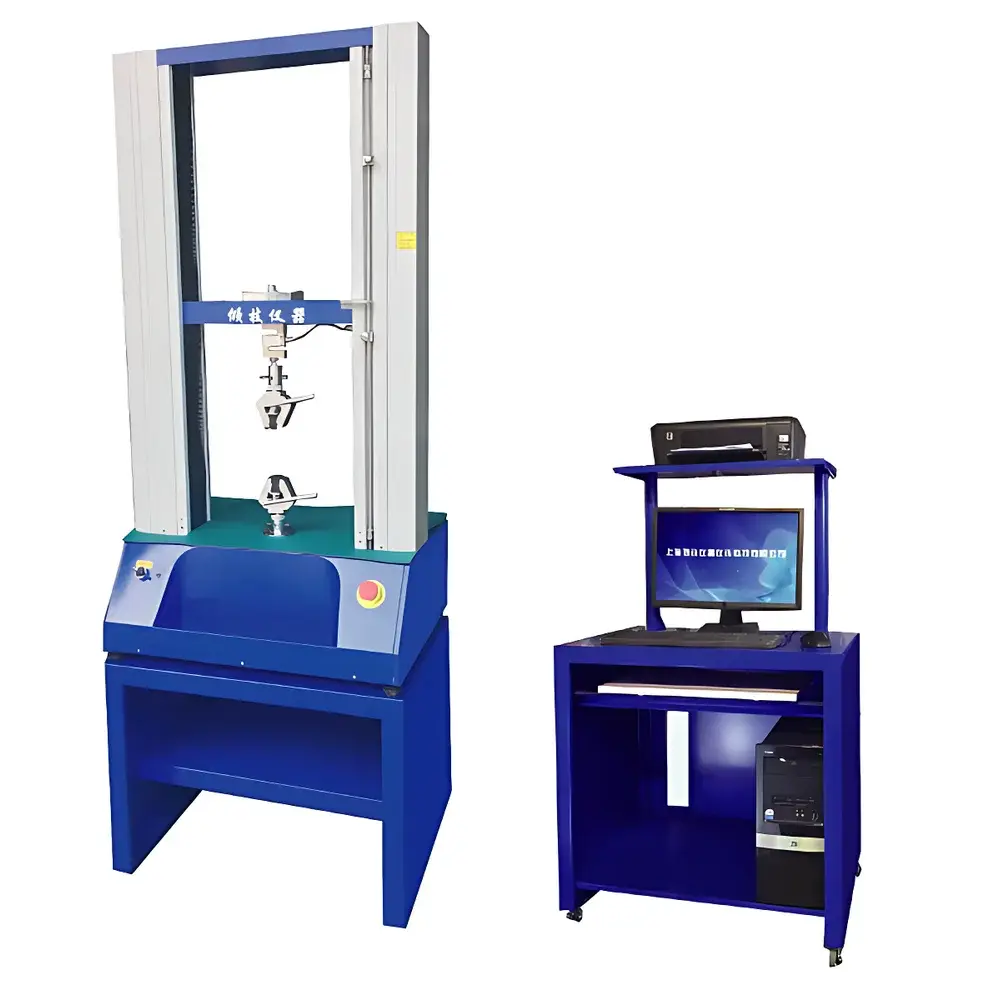
QJ211S Ceramic Tile Flexural Strength Tester
| Origin | Shanghai, China |
|---|---|
| Manufacturer Type | Authorized Distributor |
| Origin Category | Domestic (China) |
| Model | QJ211S |
| Price | USD 7,700 (FOB Shanghai) |
| Max Test Load | 10 kN |
| Loading Speed Range | 0.02–100% of full scale |
| Force Indication Error | ±0.5% of reading |
Overview
The QJ211S Ceramic Tile Flexural Strength Tester is a precision universal testing machine engineered for static mechanical property evaluation of brittle and semi-brittle ceramic materials—including architectural ceramic tiles, dental porcelain, technical ceramics, and refractory substrates. It operates on the principle of controlled quasi-static loading in three-point and four-point bending configurations per ISO 10545-4, ASTM C67, EN 14411, and GB/T 3810.4. The system integrates a high-rigidity dual-column frame, servo-controlled electromechanical actuation, and a full-closed-loop digital control architecture to deliver repeatable flexural strength (MOR), modulus of rupture, fracture toughness estimation, compressive yield, and tensile response data under standardized test conditions. Designed for compliance-driven quality assurance labs, R&D centers, and third-party certification bodies, the QJ211S supports both manual operation via its 7-inch LCD interface and fully automated execution through Windows-based software with real-time force–displacement–strain synchronization.
Key Features
- High-accuracy load measurement using calibrated U.S.-sourced strain-gauge load cells with 500,000-count resolution—no internal range switching required across the full 10 kN capacity
- Dual-mode speed control: rapid positioning (up to 300 mm/min) and precision testing (0.01–300 mm/min), with speed accuracy maintained at ±0.5% of setpoint
- Triple closed-loop control: simultaneous regulation of force, displacement, and strain—enabling advanced protocols such as constant stress-rate bending or displacement-controlled fracture initiation
- Integrated safety architecture: electronic travel limits, automatic overload cutoff at 110% of rated load, software-based fault diagnostics, and programmable emergency stop logic
- Modular fixture system: standard three-point bending fixtures compliant with ISO 10545-4 (span length 100 mm, support roller Ø10 mm); optional four-point, compression platens, and custom jaw sets available upon request
- Robust mechanical design: 145 kg cast-iron base with reinforced crosshead; effective test width 320 mm; vertical travel up to 800 mm (adjustable)
Sample Compatibility & Compliance
The QJ211S accommodates standard ceramic tile specimens measuring 100 × 100 mm (minimum) up to 300 × 300 mm (maximum), including glazed, unglazed, porcelain stoneware, and extruded ceramic bodies. It meets metrological requirements for Class 0.5 accuracy per ISO 7500-1 and JJG 475–2008. All test routines are traceable to national standards and support audit-ready documentation for GLP/GMP environments. The system is pre-configured for mandatory ceramic tile testing standards including ISO 10545-4 (flexural strength), ISO 10545-6 (modulus of elasticity), ASTM C67 (absorption and flexure), EN 14411 (classification and conformity), and GB/T 3810.4–2016 (Chinese national standard for ceramic tile bending tests). Calibration certificates include NIST-traceable reference load verification.
Software & Data Management
The proprietary Windows-based test software provides full 21 CFR Part 11-compliant functionality, including user role management, electronic signatures, audit trail logging, and immutable raw data archiving. Real-time plotting displays synchronized force–displacement–strain curves with adjustable time-base scaling, overlay capability, and dynamic curve navigation (zoom, pan, traverse, derivative calculation). Test reports are auto-generated in PDF/Excel formats and include specimen ID, environmental conditions (optional humidity/temperature input), statistical summaries (mean, SD, CV%), pass/fail status against limit thresholds, and graphical representation of failure mode. Data export supports CSV, XML, and ASTM E1434-compliant binary formats for LIMS integration.
Applications
- Quality control of production batches in ceramic tile manufacturing facilities
- Development and validation of new glaze formulations and body compositions
- Failure analysis of in-service tile cracking or spalling incidents
- Comparative assessment of thermal shock resistance via post-quench flexural retention testing
- Supporting CE marking and CCC certification submissions for construction materials
- Academic research on microstructure–mechanical property relationships in sintered oxides
FAQ
What standards does the QJ211S directly support out-of-the-box?
ISO 10545-4, ASTM C67, EN 14411, GB/T 3810.4, JIS A 1409, and DIN 51130 are preloaded in the software test method library with default parameters and reporting templates.
Can the system perform cyclic or fatigue testing?
No—the QJ211S is optimized for static monotonic loading only. For fatigue applications, consider the QJ212F series with servo-hydraulic actuation and waveform generation capability.
Is calibration documentation included with shipment?
Yes—a factory calibration certificate with uncertainty budget and traceability statement to CNAS-accredited reference standards is provided prior to delivery.
What maintenance is required during routine operation?
Monthly visual inspection of load cell cables and guide rails; biannual lubrication of lead screws; annual verification of force transducer linearity and displacement encoder accuracy using certified reference artifacts.
Does the system support remote diagnostics or firmware updates?
Yes—via secure HTTPS-enabled web interface; remote access requires prior authorization and encrypted session keys compliant with IEC 62443-3-3.



