
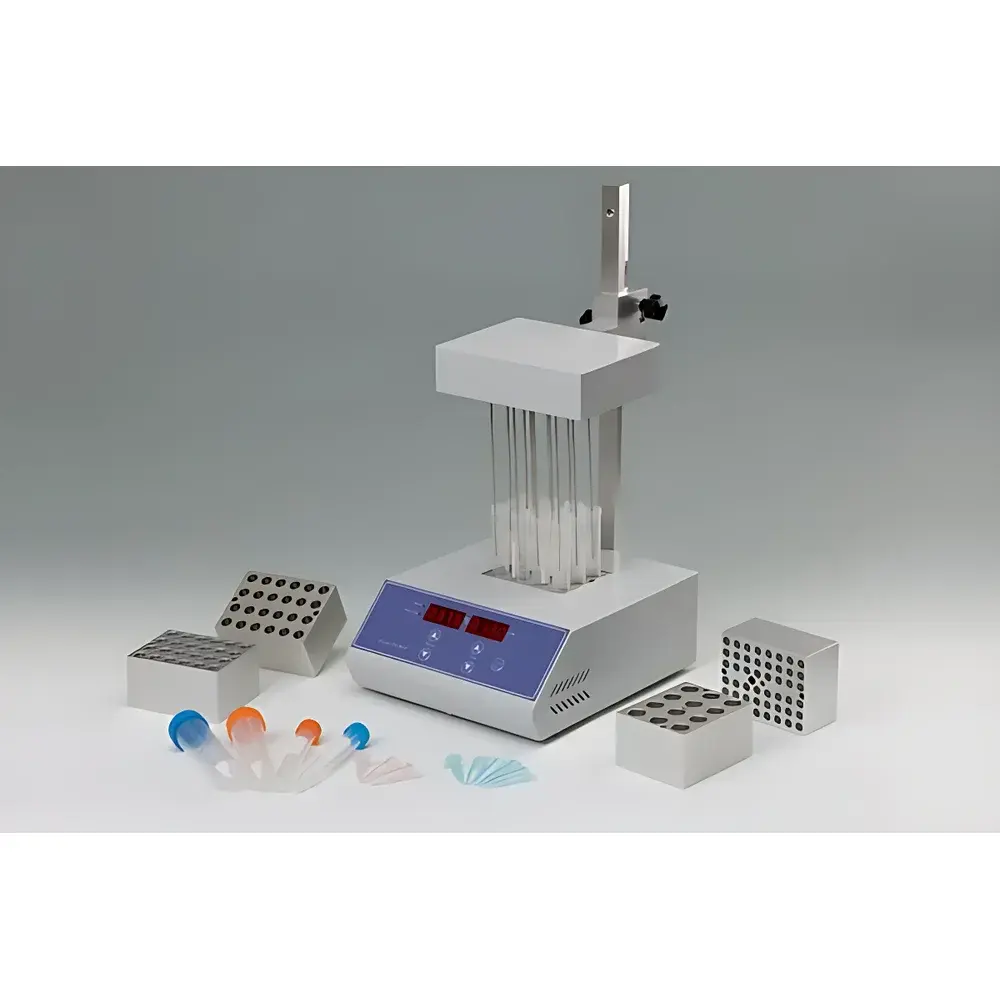
MENTS MD200-1 Dry-Block Nitrogen Evaporator
| Brand | MENTS |
|---|---|
| Origin | Beijing, China |
| Manufacturer | MENTS |
| Model | MD200-1 |
| Heating Method | Dry-block heating |
| Temperature Range | Ambient +5°C to 160°C |
| Temperature Uniformity | ±0.5°C |
| Temperature Accuracy | ±0.5°C (@40°C), ±1.0°C (@120°C) |
| Display Resolution | 0.1°C |
| Gas Flow Rate | Up to 15 L/min |
| Sample Capacity | 12 positions |
| Heating Power | 300 W |
| Timing Range | 1–99 h 59 min |
| Ramp Time | ≤15 min (25°C to 160°C) |
| Max Vertical Travel | 200 mm |
| Dimensions (L×W×H) | 260 × 220 × 450 mm |
| Weight | 7 kg |
| Input Voltage | 220 V, 50/60 Hz |
| Pressure Rating | 0.02 MPa (≤16 needles), 0.05 MPa (>16 needles) |
Overview
The MENTS MD200-1 Dry-Block Nitrogen Evaporator is an engineered solution for controlled, solvent-free concentration of multiple liquid samples in analytical, pharmaceutical, environmental, and food testing laboratories. Unlike water-bath nitrogen evaporators, this system employs a high-purity aluminum dry-block heating module as its thermal medium—eliminating risks associated with water contamination, corrosion, and inconsistent heat transfer. It operates on the principle of gentle, directed inert gas (typically high-purity nitrogen) flow across the surface of heated samples, accelerating solvent evaporation while minimizing analyte degradation, oxidation, or foaming. The instrument integrates a microprocessor-based PID temperature control algorithm, enabling stable thermal regulation across its full operating range (ambient +5°C to 160°C), with digital setpoint adjustment and real-time display at 0.1°C resolution. Its compact footprint (260 × 220 × 450 mm) and lightweight design (7 kg) support flexible benchtop deployment in regulated and non-regulated lab environments.
Key Features
- Dry-block heating architecture using aerospace-grade aluminum alloy for rapid thermal response, exceptional uniformity (±0.5°C), and long-term stability without fluid maintenance.
- Independent gas needle channels—each pneumatically isolated—to prevent cross-contamination between samples during parallel processing.
- Modular, tool-free interchangeable sample blocks compatible with standard tube formats including 1.5 mL and 2.0 mL centrifuge tubes, 10–40 mm diameter glass/test tubes, and custom configurations (BK01–BK13 series).
- Precise gas flow management: digitally adjustable pressure control with dual-rated operation (0.02 MPa for ≤16 needles; 0.05 MPa for >16 needles) and maximum flow capacity of 15 L/min.
- Vertical height adjustment mechanism with 200 mm travel range, enabling precise alignment of gas nozzles relative to sample meniscus—critical for reproducible evaporation kinetics.
- Programmable timer (1–99 h 59 min) with auto-shutdown functionality, supporting unattended overnight operation under validated protocols.
- Front-panel LCD interface with intuitive navigation, real-time temperature feedback, and built-in calibration offset function for traceable temperature verification.
Sample Compatibility & Compliance
The MD200-1 accommodates a broad spectrum of sample containers via standardized and customizable aluminum blocks—supporting common vial/tube geometries used in HPLC, GC, LC-MS, ELISA, and residue analysis workflows. Its dry-heating design complies with ISO/IEC 17025 requirements for equipment suitability in accredited testing laboratories, and its sealed thermal block minimizes exposure to ambient particulates—enhancing integrity in cleanroom-adjacent applications. While not intrinsically certified for GMP or FDA 21 CFR Part 11 compliance, the device supports audit-ready operation when integrated into documented SOPs: temperature logs can be manually recorded, and optional external data loggers (e.g., calibrated thermocouple arrays) may be deployed for IQ/OQ validation per ASTM E2500 or USP . All electrical components meet IEC 61010-1 safety standards for laboratory equipment.
Software & Data Management
The MD200-1 operates as a standalone instrument with embedded firmware—no proprietary software or driver installation required. Temperature setpoints, timing parameters, and calibration offsets are stored in non-volatile memory and persist through power cycles. For laboratories requiring electronic record retention, the unit’s analog temperature output (0–5 V or 4–20 mA, optional add-on) interfaces seamlessly with third-party SCADA systems, LIMS platforms, or validated data acquisition hardware. When paired with external calibrated sensors and timestamped logging, the system supports GLP-compliant documentation of critical process parameters—including ramp profiles, dwell times, and final endpoint temperatures—enabling full traceability in QA/QC reporting.
Applications
- Routine concentration of pesticide residues, veterinary drug metabolites, and mycotoxins prior to GC or LC-MS/MS analysis (per EPA Method 525.3, EN 15662).
- Preparative cleanup in food safety labs: reduction of extract volumes following QuEChERS or solid-phase extraction (SPE).
- Pharmaceutical stability studies requiring low-temperature solvent removal from thermolabile APIs.
- Environmental monitoring workflows involving PAHs, PCBs, and hydrocarbon fractions extracted from soil, sediment, or water matrices.
- Forensic toxicology sample prep where cross-contamination avoidance is mandatory across casework batches.
- Academic research settings requiring reproducible, multi-sample evaporation without bath-mediated variability.
FAQ
What is the recommended nitrogen purity for optimal performance?
High-purity nitrogen (≥99.999%) is advised to minimize moisture and oxygen ingress, particularly for oxidation-sensitive analytes such as catecholamines or unsaturated fatty acids.
Can the MD200-1 be used with compressed air instead of nitrogen?
Yes—though air introduces oxidative risk and potential moisture carryover; use only with desiccated, oil-free air sources and validate method robustness accordingly.
Is temperature calibration traceable to NIST standards?
The unit includes a user-accessible calibration offset function; full traceability requires external NIST-traceable reference thermometers (e.g., PRT or thermistor probes) per ISO/IEC 17025 Clause 6.5.
How often should the gas distribution manifold be inspected?
Inspect quarterly for needle tip wear, clogging, or seal integrity—especially when processing viscous or particulate-laden extracts; cleaning with ultrasonic acetone is recommended.
Does the MD200-1 support remote monitoring or Ethernet connectivity?
No native network interface is provided; integration with building management or lab automation systems requires external analog/digital I/O modules and protocol translation hardware.
Related Products



