
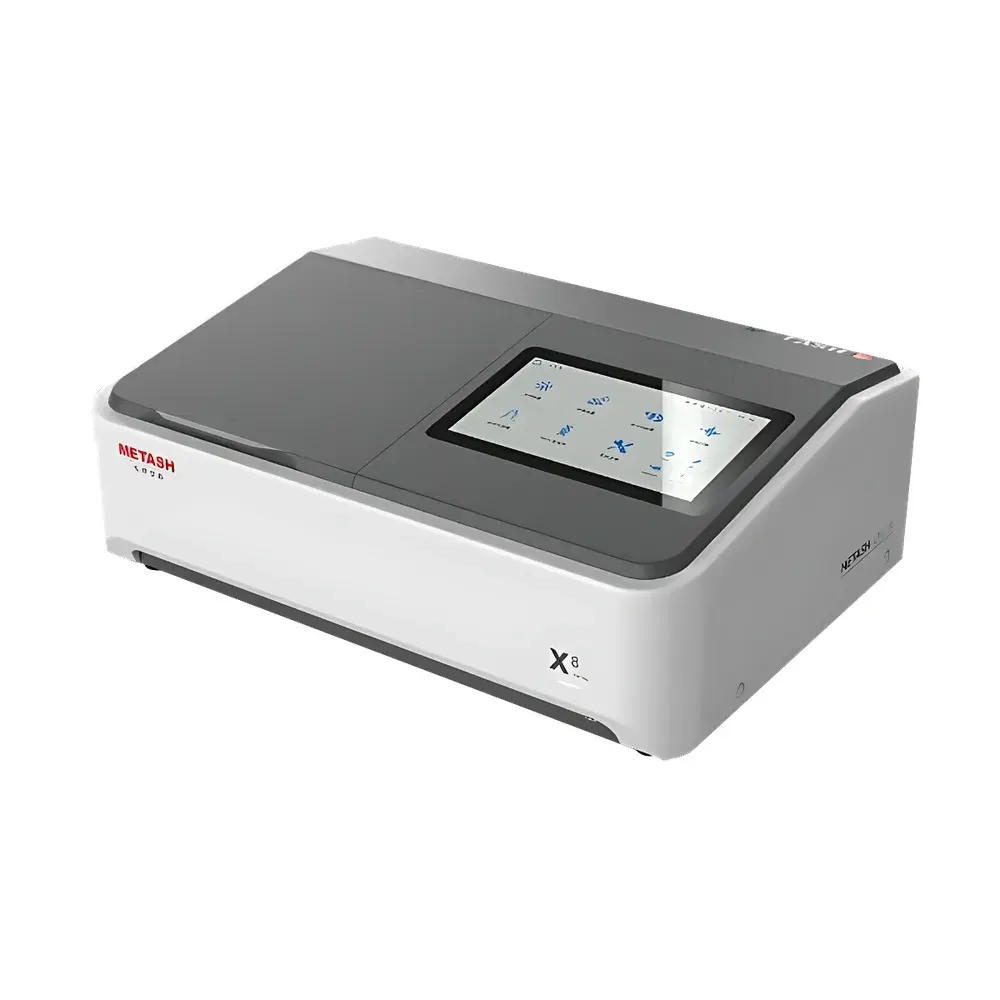
Metash X-8D Dual-Beam UV-Vis Spectrophotometer
| Brand | Metash Instruments |
|---|---|
| Origin | Shanghai, China |
| Manufacturer Type | Direct Manufacturer |
| Model | X-8D |
| Optical System | Dual-Beam |
| Detector Type | Photocell |
| Wavelength Range | 190–1100 nm |
| Automation Level | Automatic Wavelength Scanning |
| Spectral Bandwidth | 1.8 nm |
| Wavelength Accuracy | ±0.3 nm |
| Wavelength Repeatability | ≤0.1 nm |
| Stray Light | ≤0.03%T |
| Photometric Accuracy | ±0.3%T (0–100%T) |
| Photometric Repeatability | ≤0.1%T (0–100%T) |
| Noise Level | ≤0.3%T |
| Display | 10-inch HD True-Color Touchscreen |
| Data Output | USB, U-disk, Bluetooth (optional), A4 Inkjet Printer (HP 1100/1200 series compatible) |
Overview
The Metash X-8D is a high-performance dual-beam ultraviolet-visible (UV-Vis) spectrophotometer engineered for precision absorbance, transmittance, and reflectance measurements across a broad spectral range of 190–1100 nm. Its dual-beam optical architecture continuously compares sample and reference beam intensities in real time, effectively compensating for source drift, detector instability, and environmental fluctuations—thereby delivering exceptional baseline stability and measurement reproducibility over extended operation periods. The instrument employs a thermally stabilized, imported long-life deuterium lamp (for UV) and tungsten-halogen lamp (for visible/NIR), ensuring consistent spectral output and extended operational lifetime. All optical components are mounted on a rigid, 20 mm thick machined aluminum baseplate with suspended optical bench design—mechanically isolating the light path from chassis deformation and external vibration, a critical feature for laboratories requiring long-term calibration integrity and regulatory compliance.
Key Features
- Dual-beam optical system with real-time reference compensation for enhanced photometric stability and reduced baseline drift
- 10-inch high-resolution true-color capacitive touchscreen interface with intuitive icon-driven navigation and multi-touch gesture support
- Integrated suspension-mounted optical platform fixed to a precision-machined 20 mm aluminum base—eliminating mechanical coupling between optical alignment and structural frame
- Fixed spectral bandwidth of 1.8 nm, optimized for resolution/sensitivity balance in routine QC and research applications
- Wavelength accuracy of ±0.3 nm and repeatability ≤0.1 nm—validated per ISO 8579 and ASTM E275 standards
- Stray light performance ≤0.03%T at 220 nm and 340 nm, meeting stringent requirements for low-absorbance quantitation (e.g., nucleic acid purity assessment)
- Photometric accuracy ±0.3%T and repeatability ≤0.1%T across full 0–100%T range, traceable to NIST-traceable neutral density filters
- Onboard data storage capacity equivalent to standard PC-based systems; direct export to USB flash drives without host dependency
Sample Compatibility & Compliance
The X-8D supports standard 10 mm pathlength cuvettes (quartz, glass, or plastic), and accommodates optional accessories including automated multicell changers (6–8 positions), micro-volume adapters (down to 50 µL), temperature-controlled Peltier cells (±0.1 °C stability), integrating spheres (for diffuse reflectance/transmission), rotating solid-sample holders, and specular reflectance attachments. All hardware and firmware comply with electromagnetic compatibility (EMC) directives (IEC 61326-1) and electrical safety standards (IEC 61010-1). The system architecture and software design align with Good Laboratory Practice (GLP) and Good Manufacturing Practice (GMP) frameworks, supporting audit-ready operations through mandatory user authentication, immutable electronic logbooks, and full data traceability—including timestamped method parameters, operator ID, instrument configuration, and raw spectral files.
Software & Data Management
The included MetaSpectra Pro software operates in both standalone and PC-connected modes. When interfaced via USB, it extends core functionality to include advanced spectral processing (baseline correction, peak integration, derivative spectroscopy), kinetic curve modeling (zero-, first-, second-order rate fitting), DNA/protein concentration calculation using built-in extinction coefficients (e.g., A260/A280 ratio analysis), and customizable report generation compliant with FDA 21 CFR Part 11 requirements—including electronic signatures, audit trails, and role-based access control. All spectral data are saved in vendor-neutral .CSV and .JDX formats, enabling interoperability with third-party analytical platforms (e.g., MATLAB, Origin, ChemStation).
Applications
The X-8D serves as a primary analytical tool in pharmaceutical quality control (assay validation, excipient interference screening, dissolution testing), environmental water analysis (nitrate, phosphate, COD estimation), food and beverage QA (colorimetric assays, antioxidant capacity), academic teaching labs (Beer–Lambert law verification, enzyme kinetics), and life science research (protein quantification, oligonucleotide purity, nanoparticle plasmon resonance characterization). Its robustness and dual-mode operation make it suitable for both regulated environments requiring documented workflows and flexible R&D settings demanding rapid method development.
FAQ
Is the X-8D compliant with FDA 21 CFR Part 11 for electronic records and signatures?
Yes—the MetaSpectra Pro software includes configurable user roles, electronic signature capture, tamper-evident audit trails, and secure data archiving aligned with Part 11 Annex 11 expectations.
Can the instrument perform kinetic measurements without a PC connection?
Yes—time-scan mode is fully functional on the embedded touchscreen interface, supporting up to 10,000 data points per run with real-time curve visualization and export.
What wavelength calibration standards are recommended for routine verification?
Holmium oxide (Ho₂O₃) solution for 241.5, 279.4, 287.5, 333.7, 360.9, 418.5, 460.0, 485.8, 536.2 nm peaks; didymium filter for 528.7, 573.0, 586.1, 640.8, 649.1, 687.2, 740.0, 749.9, 761.0, 800.0 nm; and NIST-traceable neutral density filters for photometric validation.
Does the system support custom method creation and password-protected method locking?
Yes—users can define and save complete measurement protocols (wavelength range, scan speed, slit width, averaging cycles) with optional password protection to prevent unauthorized modification.
Is thermal stabilization of the optical bench required during operation?
No—the suspended optical assembly is passively stabilized by its massive aluminum base and does not require active cooling or temperature control for routine ambient-lab use (15–30 °C, <70% RH non-condensing).






