
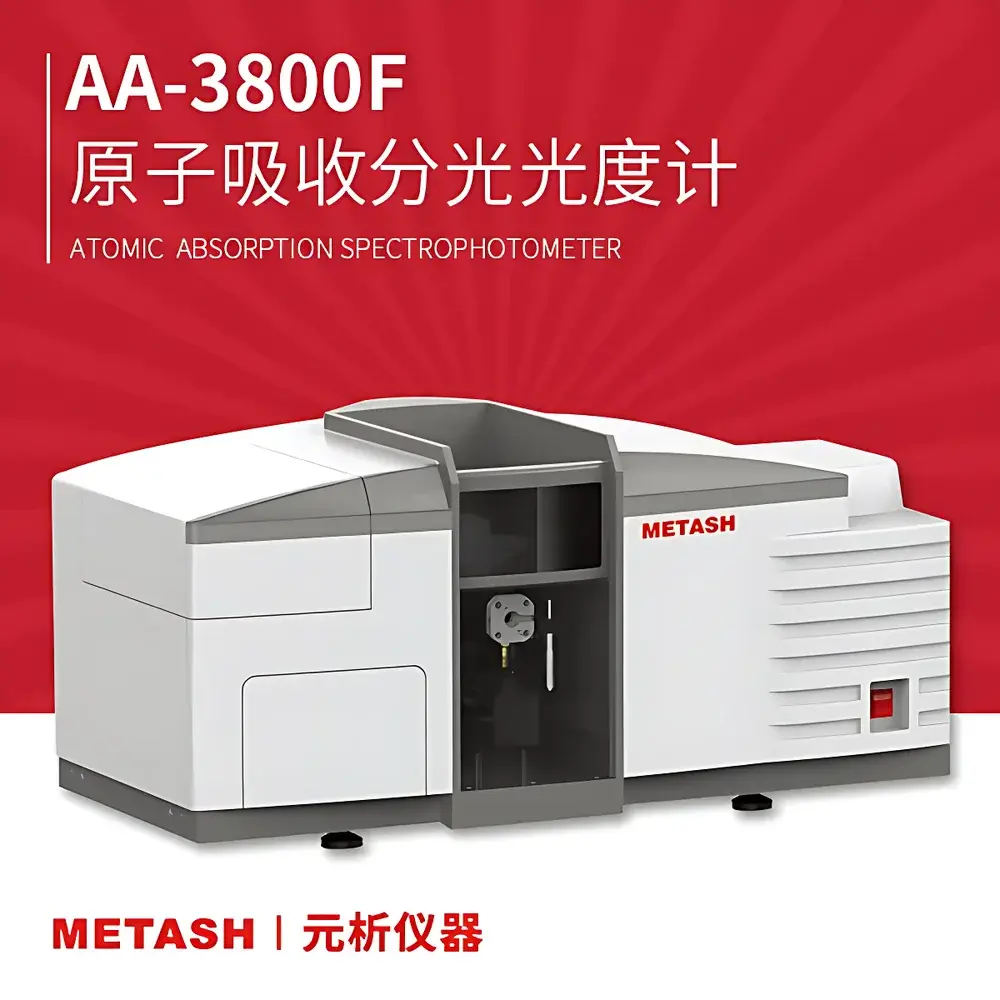
Metash AA-3800F Flame Atomic Absorption Spectrometer
| Brand | Metash Instruments |
|---|---|
| Origin | Shanghai, China |
| Manufacturer Type | Original Equipment Manufacturer (OEM) |
| Instrument Type | Flame AAS |
| Monochromator | Plane Grating |
| Optical System | Single-Beam |
| Detector | Photomultiplier Tube (PMT) |
| Background Correction | D₂ Lamp + Self-Absorption Method |
| Spectral Resolution | 0.1 nm |
| Sensitivity (Cu) | 0.02 µg/mL per 1% absorption |
| Detection Limit (Cu) | 0.002 µg/mL |
| Precision (RSD) | ≤1.0% |
| Wavelength Range | 190–900 nm |
| Grating Grooves | 1800 lines/mm |
| Spectral Bandwidths | 0.2 / 0.4 / 1.0 / 2.0 nm (auto-switchable) |
| Wavelength Accuracy | ±0.1 nm |
| Wavelength Repeatability | 0.1 nm |
| Baseline Drift | 0.003 A/30 min |
| Background Correction Capacity (D₂) | >30× at 1 A |
Overview
The Metash AA-3800F Flame Atomic Absorption Spectrometer is a benchtop analytical instrument engineered for precise, reproducible quantification of trace metallic elements in liquid samples via flame atomic absorption spectroscopy (FAAS). Operating on the fundamental principle of Beer-Lambert law, the system atomizes sample solutions in an air-acetylene flame, generating ground-state free atoms that absorb characteristic radiation from hollow cathode lamps (HCLs). The AA-3800F employs a single-beam optical architecture with a high-efficiency plane grating monochromator (1800 grooves/mm) and a low-noise photomultiplier tube detector to isolate and measure absorbance at defined wavelengths (190–900 nm). Designed for routine laboratory environments—including QC labs in pharmaceutical manufacturing, environmental monitoring agencies, geological survey units, and cosmetic safety testing facilities—the instrument delivers robust performance under GLP-compliant workflows and supports regulatory alignment with ISO/IEC 17025, USP , and EPA Method 7000B.
Key Features
- Eight-lamp turret with automatic lamp selection and alignment—enabling rapid multi-element analysis without manual intervention.
- Intelligent wavelength scanning and peak search algorithms ensure accurate spectral line identification and optimal slit positioning.
- Four-step auto-adjustable spectral bandwidth (0.2/0.4/1.0/2.0 nm) dynamically optimized per element to balance sensitivity and selectivity.
- Dual-mode background correction: deuterium (D₂) lamp correction for broadband absorption and self-absorption (SA) correction for structured background—both implemented with real-time energy balancing via a semi-transparent mirror assembly.
- Integrated flame safety suite: acetylene leak detection, continuous flame status monitoring, automatic gas cutoff upon flame extinction, and emergency power disconnection during abnormal thermal or electrical events.
- Automated parameter optimization: auto-tuning of photomultiplier high voltage, lamp current, and burner head position reduces method development time and operator dependency.
- Compact footprint and modular design facilitate integration with optional accessories—including autosamplers, hydride generation systems (for As, Se, Sb, Bi), and graphite furnace upgrade paths.
Sample Compatibility & Compliance
The AA-3800F is validated for aqueous and acid-digested samples compliant with ASTM D1688 (copper in water), ISO 11885 (water quality—determination of selected elements by FAAS), and GB/T 5750.6–2023 (Chinese standard for drinking water metal analysis). It accommodates standard 16-mm borosilicate glass tubes and integrates seamlessly with certified reference materials (CRMs) from NIST, BAM, and LGC. All calibration protocols support linear and quadratic regression models with forced zero-intercept options. Instrument qualification documentation includes IQ/OQ templates aligned with FDA 21 CFR Part 11 requirements for audit trail generation, electronic signature support, and data integrity controls when paired with compliant LIMS or standalone software.
Software & Data Management
The embedded control software provides full method setup, sequence programming, real-time signal visualization, and compliance-ready reporting. Raw absorbance, peak height/area integration, and background-subtracted results are stored in vendor-neutral CSV and XML formats. Audit trails record all user actions—including parameter changes, calibration events, and data exports—with timestamps and operator IDs. Software supports configurable report templates compliant with ISO/IEC 17025 clause 7.8.2 (reporting of results) and enables export of uncertainty budgets per GUM (JCGM 100:2008) guidelines. Remote diagnostics and firmware updates are supported via secure HTTPS-based communication.
Applications
- Environmental: Quantification of Pb, Cd, Cr, Ni, Zn, and Cu in wastewater, soil leachates, and ambient air particulate filters.
- Pharmaceutical: Elemental impurity screening per ICH Q3D guidelines—especially for catalyst residues (Pd, Pt, Rh) and elemental contaminants (As, Hg, Cd) in APIs and excipients.
- Cosmetics: Heavy metal verification in pigments, preservatives, and raw materials per EU Cosmetics Regulation (EC) No 1223/2009 Annex II.
- Geological: Major and trace element profiling in rock digests and mineral concentrates using standardized fusion or acid digestion protocols.
- Food Safety: Monitoring of toxic metals (e.g., As in rice, Pb in honey) per Codex Alimentarius standards and national food surveillance programs.
FAQ
What types of samples can be analyzed directly on the AA-3800F without derivatization?
Aqueous solutions, dilute acid digests (e.g., 2–5% HNO₃), and stabilized organometallic extracts compatible with air-acetylene flame conditions.
Is the AA-3800F compliant with 21 CFR Part 11 for regulated laboratories?
Yes—when operated with the optional validated software package, it provides electronic signatures, audit trails, and role-based access control meeting Part 11 Subpart B requirements.
Can the instrument perform both flame and hydride generation analysis?
The base AA-3800F supports flame AAS; hydride generation functionality requires the optional HG-3800 accessory module, which interfaces via standardized pneumatic and optical coupling.
What maintenance intervals are recommended for the burner head and nebulizer?
Nebulizer cleaning is advised after every 100 analyses or when signal drift exceeds 2%; burner head inspection and alignment should occur quarterly or after 500 flame hours.
Does the system support external LIMS connectivity?
Yes—via ASTM E1384-compliant HL7 or direct ODBC/JDBC drivers for bidirectional data exchange with major LIMS platforms including Thermo Fisher SampleManager, LabVantage, and STARLIMS.




