
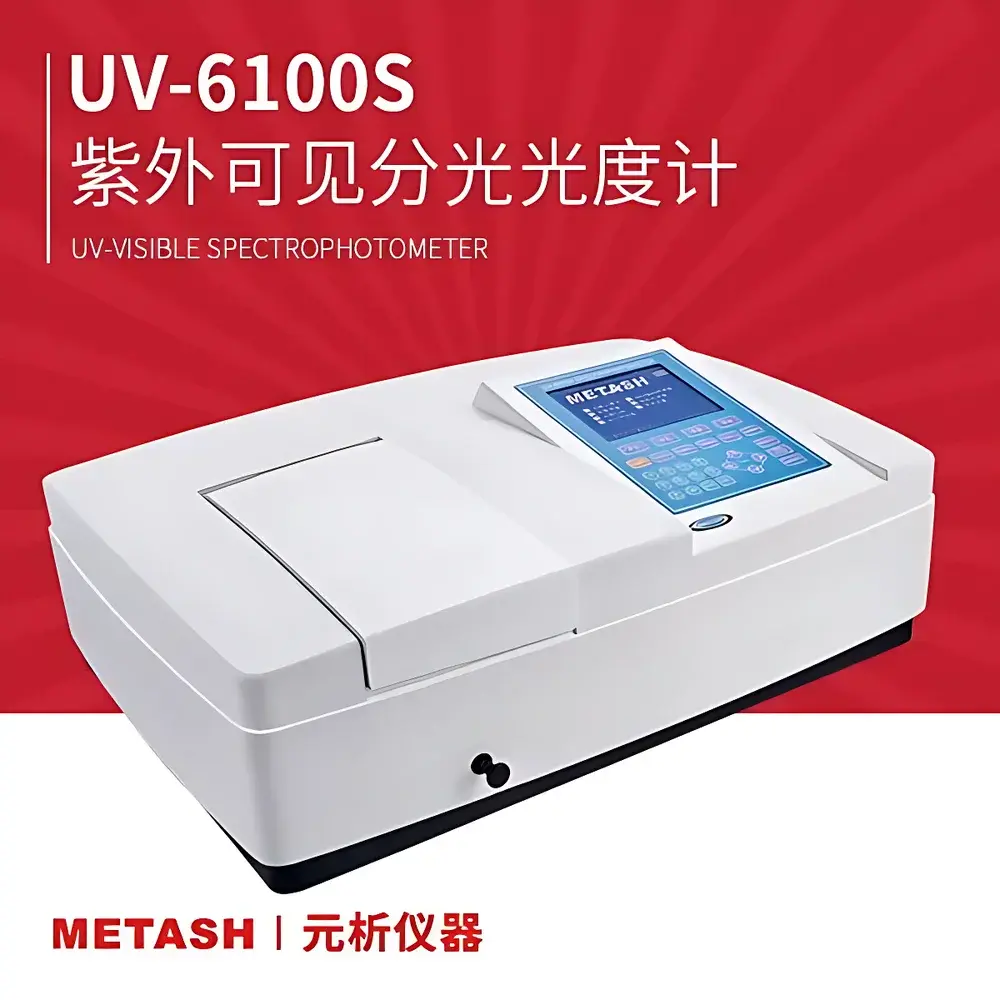
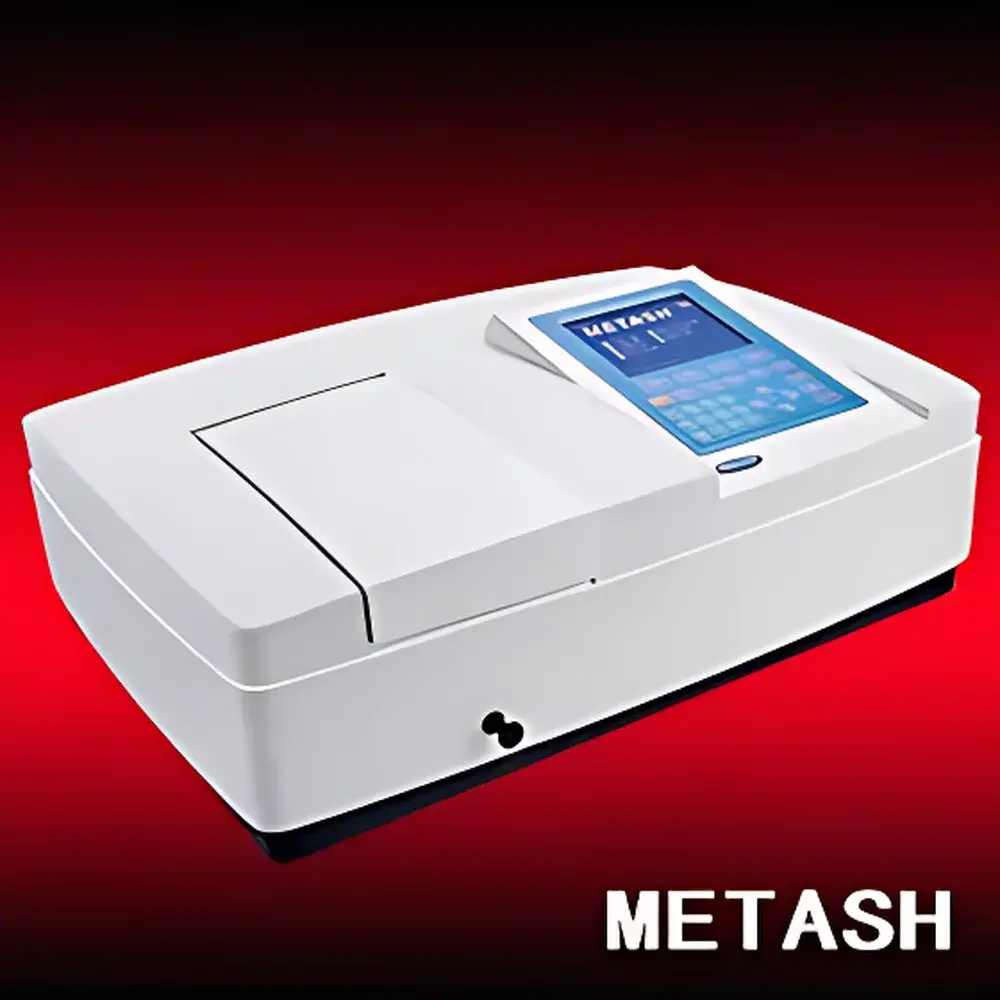
Metash UV-6100S Dual-Beam UV-Vis Spectrophotometer
| Brand | Metash Instruments |
|---|---|
| Origin | Shanghai, China |
| Manufacturer Type | Original Equipment Manufacturer (OEM) |
| Product Category | Domestic |
| Model | UV-6100S |
| Optical System | Dual-Beam Ratio-Monitoring |
| Detector Type | Silicon Photocell |
| Wavelength Range | 190–1100 nm |
| Wavelength Accuracy | ±0.1 nm at 656.1 nm, ±0.3 nm across full range |
| Wavelength Repeatability | ≤0.1 nm |
| Spectral Bandwidth | 0.5 / 1.0 / 2.0 / 4.0 / 5.0 nm (selectable) |
| Stray Light | ≤0.05% T |
| Display | 6-inch full-color LED LCD |
| Data Interface | USB port for PC connectivity |
| Software | GLP/GMP-compliant analytical suite with audit trail, user management, and report generation |
Overview
The Metash UV-6100S is a high-performance dual-beam ratio-monitoring ultraviolet-visible spectrophotometer engineered for precision absorbance, transmittance, and reflectance measurements across the 190–1100 nm spectral range. Its optical architecture employs a true dual-beam configuration with real-time reference beam monitoring, enabling continuous compensation for source intensity drift—critical for long-duration kinetic assays, stability-indicating methods, and regulatory-compliant routine analysis. The instrument utilizes a combination of a deuterium lamp (UV) and tungsten-halogen lamp (visible/NIR), both sourced from internationally certified suppliers to ensure consistent output and extended service life. All optical components—including collimating mirrors, diffraction grating, and beam splitters—are mounted on a rigid 16 mm-thick aerospace-grade aluminum optical baseplate. This suspended optical assembly decouples the light path from mechanical vibrations and chassis deformation, directly contributing to measurement reproducibility and baseline stability over time.
Key Features
- Dual-beam ratio-monitoring optical system with dynamic reference channel correction for enhanced photometric stability and reduced baseline drift
- Five selectable spectral bandwidths (0.5, 1.0, 2.0, 4.0, and 5.0 nm) to balance resolution and signal-to-noise ratio per application requirement
- 6-inch full-color LED LCD display with intuitive icon-driven interface—enabling standalone operation without external PC
- Integrated functionality including photometric mode, quantitative analysis (single/multi-point calibration), full-spectrum scanning, kinetic time-course profiling, DNA/protein A260/A280 ratio calculation, multi-wavelength quantitation, and customizable report printing
- Modular accessory support: compatible with automatic 8-cell rotating sample holders, micro-volume cuvette adapters (down to 50 µL), Peltier-controlled temperature-regulated autosamplers, and specular/diffuse reflectance accessories
- Optical components sourced from Tier-1 international suppliers to minimize stray light (≤0.05% T at 220 nm) and maximize long-term wavelength fidelity
Sample Compatibility & Compliance
The UV-6100S accommodates standard 10 mm pathlength quartz, glass, or plastic cuvettes, as well as specialized formats including microcells, flow cells, and solid-sample reflectance stages. Its wavelength accuracy (±0.1 nm at Hg 656.1 nm line; ±0.3 nm across full range) and repeatability (≤0.1 nm) meet or exceed requirements defined in ASTM E275, ISO 6223, and USP . The instrument’s firmware and bundled software are designed in alignment with Good Laboratory Practice (GLP) and Good Manufacturing Practice (GMP) frameworks: user access levels are role-based, all data modifications are logged with timestamped audit trails, raw spectra and processed results are stored with immutable metadata (operator ID, date/time, method parameters), and electronic records comply with FDA 21 CFR Part 11 principles when deployed with validated PC configurations.
Software & Data Management
The included PC-based analytical software provides a comprehensive, menu-driven environment supporting method development, data acquisition, post-run processing, and regulatory reporting. It supports batch processing of spectral libraries, derivative spectroscopy, peak identification and integration, and customizable calibration curve fitting (linear, quadratic, cubic, and non-linear models). All data files are saved in vendor-neutral .csv and proprietary binary formats with embedded metadata. The software enforces secure user authentication, session locking after inactivity, and encrypted local database storage. Export options include PDF reports with embedded spectra, Excel-compatible tables, and image exports in PNG/TIFF formats—fully traceable to original acquisition conditions.
Applications
The UV-6100S serves core analytical workflows across pharmaceutical QC (e.g., assay of active pharmaceutical ingredients per USP monographs), environmental testing (nitrate/nitrite, phosphate, COD determination), food and beverage quality control (colorimetric enzyme assays, preservative quantification), biochemical research (nucleic acid purity assessment, protein concentration via Bradford/Lowry/Biuret), and academic teaching laboratories. Its variable slit width enables optimization for high-resolution identification of overlapping chromophores, while its kinetic module supports enzymatic reaction monitoring at fixed or scanned wavelengths with configurable time intervals from 0.1 s to 999 min.
FAQ
Is the UV-6100S compliant with 21 CFR Part 11 for electronic records and signatures?
Yes—the software architecture includes electronic signature capture, audit trail generation, and role-based access controls required for Part 11 compliance when deployed in validated environments.
What is the minimum sample volume supported with optional accessories?
Using the micro-cuvette adapter, the instrument supports volumes as low as 50 µL in standard 10 mm pathlength microcells.
Can the UV-6100S perform simultaneous multi-wavelength measurements?
It does not acquire multiple wavelengths simultaneously; however, it executes rapid sequential wavelength sampling (≤0.1 s/point) during scanning or multi-point quantitation, effectively approximating concurrent measurement for most kinetic applications.
Are calibration certificates available for wavelength and photometric accuracy?
Factory calibration reports traceable to NIST standards are provided with each unit; optional annual recalibration services with certified documentation are available through Metash’s authorized service network.
Does the instrument support method transfer between different UV-Vis platforms?
Method parameters—including slit width, scan speed, integration time, and baseline correction settings—are exportable/importable as XML templates, facilitating cross-platform method harmonization within laboratory networks.






