
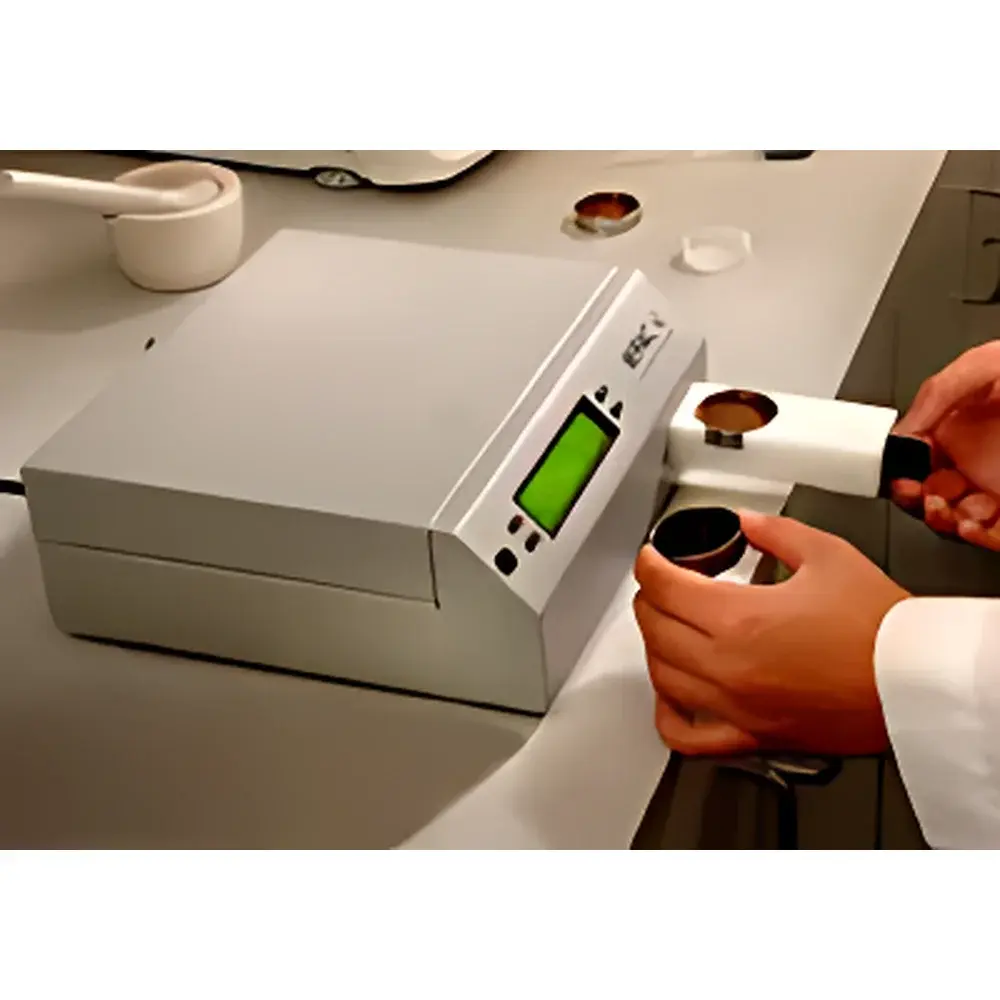
METER WP4C Dew Point PotentiaMeter
| Brand | METER |
|---|---|
| Origin | USA |
| Model | WP4C |
| Instrument Type | Water Potential Meter |
| Measurement Principle | Dew Point Hygrometry |
| Range | 0 to –300 MPa |
| Accuracy | ±0.05 MPa (0 to –5 MPa), ±1% (–5 to –300 MPa) |
| Temperature Range | 15–40 °C |
| Resolution | 0.1 °C |
| Temp. Accuracy | ±0.2 °C |
| Measurement Time | 10–20 min (Precision Mode), <5 min (Rapid Mode) |
| Sample Chamber Volume | 7 mL (recommended), 15 mL (max) |
| Dimensions | 24.1 × 22.9 × 8.9 cm |
| Weight | 3.2 kg |
| Display | 20×2 LCD with backlight |
| Sensors | Chilled-mirror dew point sensor + infrared temperature sensor |
| Power | 110–220 V AC, 50/60 Hz |
| Interface | RS-232A (ASCII, 9600 baud, 8N1), USB adapter included |
| Compliance | ISO 9001:2015, CE (EN ISO/IEC 17050:2010), ASTM D6836-07 |
Overview
The METER WP4C Dew Point PotentiaMeter is a high-precision, benchtop water potential analyzer engineered for rigorous environmental and plant-soil science applications. It operates on the fundamental thermodynamic principle that the water potential (Ψ) of a sample is directly related to the vapor pressure of water in equilibrium with that sample at a given temperature. By precisely measuring the dew point temperature of the headspace air above a sealed sample, the WP4C calculates water potential using the Clausius–Clapeyron relation and calibrated vapor pressure–temperature functions. This chilled-mirror dew point methodology—now widely recognized as the reference standard for water potential measurement—ensures traceable, physically grounded results without reliance on empirical correlations or assumptions about sample matrix effects. The instrument is designed for use in controlled laboratory environments where reproducibility, long-term stability, and compliance with international test standards are essential.
Key Features
- Dew point measurement core: Integrated chilled-mirror sensor with active thermal control ensures rapid condensation detection and minimizes hysteresis; validated against NIST-traceable humidity standards.
- Nickel-Teflon® coated sample chamber: Hydrophobic interior surface reduces adsorptive water retention, accelerating equilibration time—particularly critical for low-water-potential soils and organic matrices.
- Dual-sensor temperature monitoring: Simultaneous measurement of sample surface temperature (via infrared) and chamber ambient temperature enables real-time correction of vapor pressure calculations per ISO 25239 and ASTM D6836-07 protocols.
- Two operational modes: Rapid Mode delivers preliminary readings in under 5 minutes for screening; Precision Mode enforces dynamic equilibrium verification—monitoring dew point drift over time before finalizing output—to guarantee data integrity for publication-grade studies.
- User-accessible calibration: Supports in-lab calibration using saturated salt solutions (e.g., LiCl, MgCl₂, NaCl) with built-in algorithmic compensation for solution-specific activity coefficients, achieving ≤±0.05 MPa uncertainty in the critical –0.1 to –5 MPa range.
- Robust mechanical architecture: Powder-coated aluminum chassis provides EMI shielding and thermal mass stability; compact footprint (24.1 × 22.9 × 8.9 cm) suits shared lab benches and growth chamber interfaces.
Sample Compatibility & Compliance
The WP4C accepts any porous or semi-porous material capable of establishing vapor-phase equilibrium within its 7 mL nominal sample chamber—including mineral soils, plant tissues (leaves, roots, seeds), hydrogels, compost amendments, construction materials (brick, concrete), and even biological exoskeletons. Its non-destructive, closed-system design eliminates evaporation artifacts and avoids contact-based errors common in tensiometric or thermocouple psychrometer methods. The instrument complies with ISO 9001:2015 quality management requirements and bears CE marking per EN ISO/IEC 17050:2010. It is explicitly referenced in ASTM D6836-07 (“Standard Test Method for Determination of Water Potential of Soils Using a Dew Point Potentiometer”), making it suitable for regulatory reporting, GLP-compliant soil–water characterization, and peer-reviewed ecophysiological research.
Software & Data Management
Data acquisition and export are handled via ASCII-formatted RS-232 serial communication (9600 baud, 8N1), with included USB-to-RS-232 cable enabling direct connection to Windows- or macOS-based workstations. Output includes timestamped water potential (MPa), dew point temperature (°C), sample temperature (°C), and instrument status flags. While the WP4C does not embed onboard storage or graphical software, its protocol is fully compatible with third-party data logging platforms (e.g., LabVIEW, Python serial libraries, MATLAB) and supports automated batch processing in QA/QC workflows. Audit trails—essential for FDA 21 CFR Part 11–aligned environments—can be implemented externally through timestamped log files and version-controlled calibration records.
Applications
- Quantifying soil–water characteristic curves (SWCC) across matric and osmotic ranges, especially for unsaturated zone modeling and irrigation scheduling.
- Assessing seed viability and germination thresholds by tracking water potential depression during imbibition and pre-germinative metabolism.
- Monitoring water status gradients in rhizosphere and mulch layers to evaluate root–soil hydraulic coupling under drought stress.
- Validating moisture release behavior of engineered growing media, biochar-amended substrates, and municipal compost blends.
- Supporting bioremediation studies by correlating microbial activity rates with pore-water potential in contaminated sediments.
- Calibrating and validating field-deployable water potential sensors (e.g., TEROS 21, MPS-6) under controlled bench conditions.
FAQ
What is the difference between the WP4C and its predecessor, the WP4-T?
The WP4C introduces an improved chilled-mirror sensor with enhanced thermal stability, Nickel-Teflon® chamber coating for faster equilibration, dual-temperature sensing (IR + ambient), and refined equilibrium-detection algorithms that enforce stricter convergence criteria before reporting results.
Can the WP4C measure frozen or highly saline samples?
No. The dew point method assumes liquid-phase equilibrium. Samples below 0 °C or with freezing-point depression exceeding instrument resolution will yield unreliable values; likewise, volatile solutes (e.g., ethanol, glycerol) interfere with dew point interpretation and are outside scope.
Is regular calibration required?
Yes. METER recommends quarterly calibration using certified saturated salt standards, especially when operating across wide temperature ranges or after extended storage. Calibration drift is typically <0.02 MPa/year under stable lab conditions.
Does the WP4C meet FDA or USDA regulatory requirements for agricultural testing?
While not a regulated device per se, its adherence to ASTM D6836-07 and ISO 9001:2015, combined with full traceability of calibration inputs, satisfies documentation requirements for USDA NRCS soil surveys and FDA-regulated seed certification programs requiring water potential validation.







