
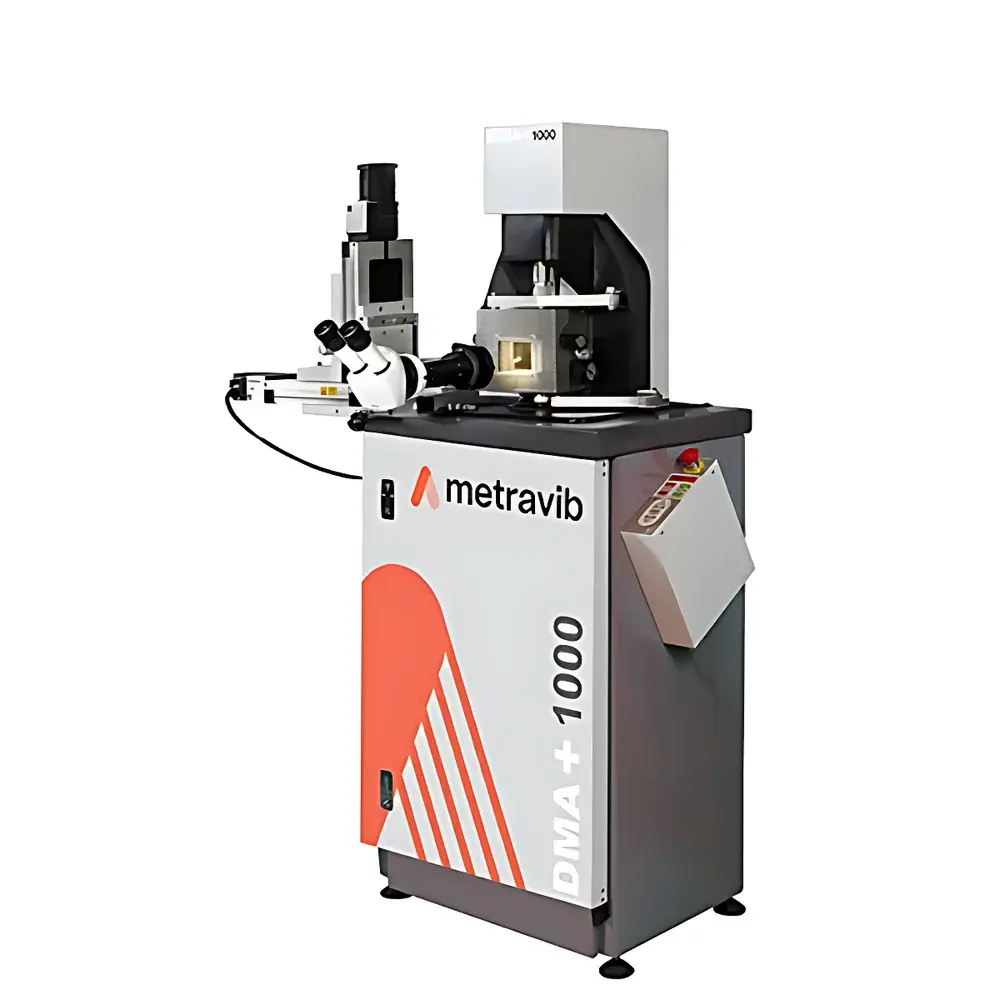
Metravib DMA+NG Dynamic Crack Growth Testing System for Elastomers
| Brand | Metravib |
|---|---|
| Origin | France |
| Model | DMA+NG |
| Instrument Type | Dynamic Mechanical Analyzer (DMA/DMTA) with Integrated Crack Growth Module |
| Temperature Range | −150 °C to 500 °C |
| Temperature Accuracy | ±0.1 °C |
| Force Range | 0.1–500 N |
| Displacement Range | 0.1–6000 µm |
| Frequency Range | 10⁻⁵–200 Hz |
| Crack Measurement Channels | 2 or 4 simultaneous crack tip tracking positions |
| In-situ Initial Crack Generation | Yes, inside climate-controlled chamber |
| Chamber Oxygen Control | 10 ppm–20% O₂ adjustable |
Overview
The Metravib DMA+NG Dynamic Crack Growth Testing System is a purpose-engineered extension of the Metravib DMA platform—specifically co-developed with Michelin and the French Rubber Characterization Center (LRCCP)—to quantify crack initiation and propagation kinetics in elastomeric materials under controlled thermomechanical conditions. Unlike conventional high-speed imaging or ultrasonic surface wave techniques—which suffer from limited spatial resolution, signal attenuation in heterogeneous rubber compounds, and susceptibility to environmental noise—the DMA+NG integrates real-time crack-tip displacement sensing directly into the dynamic mechanical test environment. It operates on the principle of controlled cyclic loading (sinusoidal or stepped) applied to pre-notched specimens while simultaneously monitoring crack length evolution via optical or capacitive displacement transducers positioned at multiple locations along the crack front. This enables quantitative determination of fracture parameters such as crack growth rate (da/dN), threshold stress intensity factor (ΔKth), and fatigue resistance across wide temperature and frequency domains—critical for predicting service life in dynamic applications like tire treads, engine mounts, and vibration isolators.
Key Features
- Integrated dual- or quad-channel crack length monitoring synchronized with DMA force/displacement acquisition
- In-chamber automated initial crack generation using precision micro-notchers or laser-assisted pre-cracking—ensuring reproducible starter flaws without specimen removal
- Hermetically sealed thermal chamber with programmable oxygen partial pressure control (10 ppm–20% O₂), enabling oxidation-accelerated or inert-atmosphere crack growth studies
- Full compatibility with Metravib’s DMA+300, DMA+1000, and DMA+2000 base systems—including hardware synchronization, shared temperature ramping, and unified data timestamping
- High-resolution displacement measurement down to 0.1 µm over 6 mm range, calibrated traceably to NIST standards
- Force actuation stability ≤0.5% full scale across the 0.1–500 N range, supporting both low-strain fatigue and high-load tear resistance protocols
Sample Compatibility & Compliance
The DMA+NG accommodates standard ASTM D6048 (rubber tear resistance), ISO 6943 (crack growth in vulcanized rubber), and ISO 13477 (fatigue crack propagation in elastomers) specimen geometries—including trouser tear, pure shear, and compact tension (CT) configurations. Specimen mounting fixtures are designed for minimal constraint-induced artifacts and thermal gradient uniformity. The system complies with ISO/IEC 17025 calibration traceability requirements; temperature sensors are certified per IEC 60751 Class A, and force transducers meet ISO 376 Class 0.5 accuracy. For regulated environments, optional audit trail logging, electronic signatures, and 21 CFR Part 11–compliant software modules are available to support GLP/GMP-compliant R&D and quality assurance workflows.
Software & Data Management
Control and analysis are performed via Metravib’s proprietary VIB’SYS software suite, which provides synchronized acquisition of mechanical response (storage/loss moduli, tan δ), crack length vs. cycle count, and temperature history. Built-in fracture mechanics calculators compute ΔK, da/dN, and Paris law coefficients (C, m) directly from raw time-series data. All datasets are stored in HDF5 format with embedded metadata (operator ID, calibration status, atmospheric conditions), ensuring FAIR (Findable, Accessible, Interoperable, Reusable) data principles. Export options include CSV, MATLAB .mat, and ASTM E1942-compliant XML for third-party statistical modeling or integration into LIMS platforms.
Applications
- Tire compound development: Correlating tread compound formulation (filler type, crosslink density, antioxidant package) with crack nucleation delay and propagation resistance under simulated road-contact thermal cycling
- Rubber-to-metal bonding integrity assessment: Quantifying interfacial crack growth rates at adhesive interfaces under dynamic shear and thermal shock
- Aging studies: Measuring oxidative degradation effects on fatigue threshold by varying O₂ concentration during prolonged cyclic loading
- Multi-material elastomer composites: Mapping anisotropic crack path deviation in fiber-reinforced or layered rubber systems
- Validation of finite element models: Providing experimental da/dN–ΔK datasets for calibrating cohesive zone models in structural simulation tools
FAQ
What specimen geometries are supported for crack growth testing?
Standard geometries include ASTM D6048 trouser tear, ISO 6943 pure shear, and custom-designed compact tension (CT) specimens with starter notches. Fixtures accommodate thicknesses from 1 mm to 12 mm.
Can the system operate under inert gas or vacuum conditions?
Yes—the chamber supports continuous N₂ or Ar purging down to <10 ppm O₂; vacuum operation up to 10⁻² mbar is achievable with optional vacuum pump interface.
Is compliance with FDA 21 CFR Part 11 mandatory for pharmaceutical-grade elastomer testing?
While not required for research use, Part 11–compliant configuration—including role-based access control, electronic signatures, and immutable audit trails—is available for QC labs conducting extractables/leachables or container-closure integrity studies.
How is crack length measured optically without interfering with DMA motion?
A non-contact digital image correlation (DIC) module or miniature capacitive probe array is mounted on the chamber viewport or specimen stage, with sub-pixel registration algorithms compensating for stage vibration and thermal drift.
Does the system support variable-amplitude or block-loading fatigue profiles?
Yes—VIB’SYS allows user-defined load histories including staircase, spectrum, and Gaussian random profiles, all synchronized with real-time crack length feedback for closed-loop testing.



