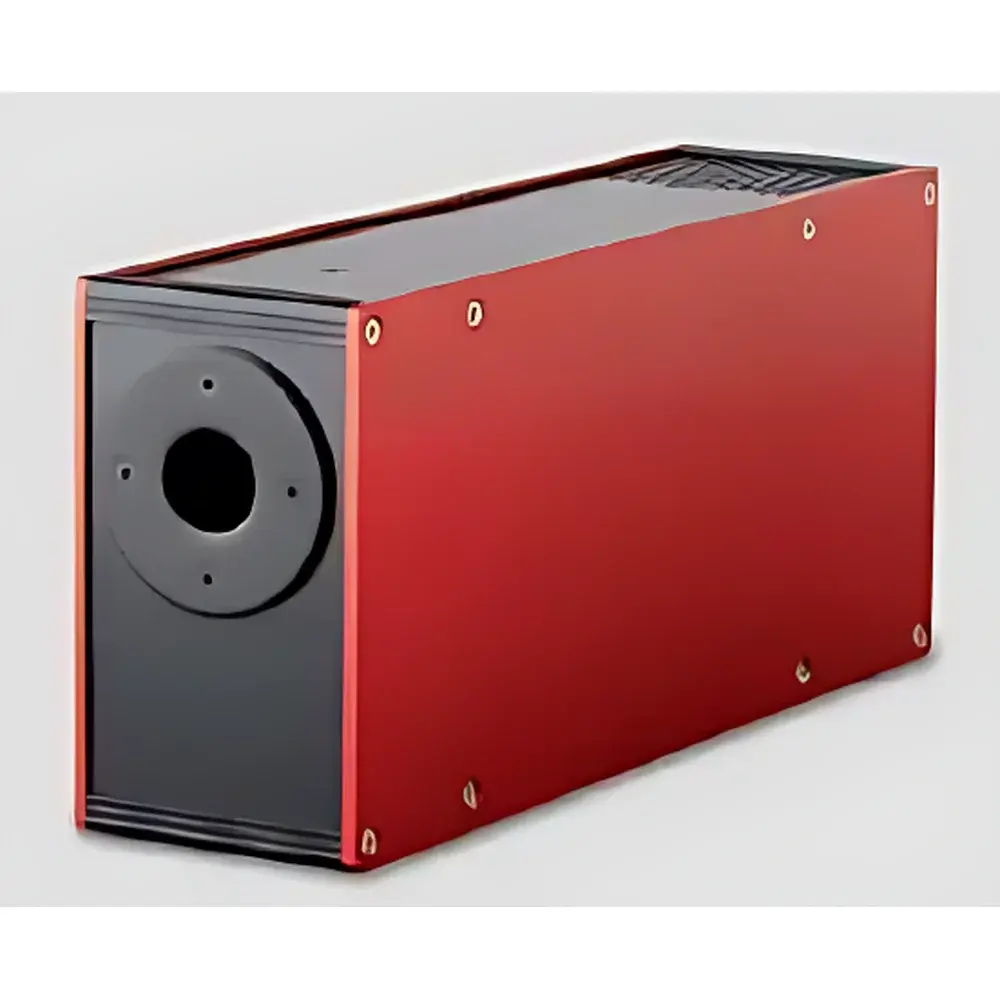
Metrolux ML 7400 CO₂ Laser Beam Profiling Camera
| Brand | Metrolux |
|---|---|
| Origin | Germany |
| Model | ML 7400 |
| Spectral Range | 8–30 µm |
| Clear Aperture | 21 mm² |
| Sensor Dynamic Range | 50:1 |
| Sensor Resolution | 100 µm |
| Intensity Range | 20–1000 W/cm² |
| Damage Threshold | 2000 W/cm² |
| CW Input Power Limit | 200 W (unattenuated), 250 W (60 s with optional attenuation) |
| Response Time (50%) | 67 ms |
| Camera Resolution | 752 × 582 pixels |
| Frame Rate | up to 25 fps |
| Interface | IEEE 1394 (FireWire) |
| Dimensions | 267 × 125 × 71 mm³ |
| Weight | 1.7 kg |
| Power Supply | 230 V, 50 Hz, 300 W |
| Max Housing Temperature | 50 °C |
Overview
The Metrolux ML 7400 CO₂ Laser Beam Profiling Camera is a purpose-engineered diagnostic instrument designed for quantitative spatial and temporal characterization of high-power infrared laser beams operating in the 8–30 µm spectral band—primarily targeting industrial and scientific CO₂ lasers (9.3 µm and 10.6 µm). Unlike visible-light or near-IR beam profilers, the ML 7400 employs an integrated infrared-to-visible image converter coupled with a high-sensitivity monochrome CCD camera, enabling direct, non-contact, real-time beam profiling without reliance on pyroelectric arrays or scanning slits. Its optical architecture is based on thermal upconversion: incident mid-IR photons excite a phosphor layer, generating visible light that is then captured by the camera sensor. This principle ensures intrinsic linearity across its operational intensity range (20–1000 W/cm²) and eliminates saturation artifacts common in semiconductor-based IR detectors under high fluence conditions. The system is engineered for integration into laser manufacturing cells, alignment stations, and quality assurance workflows where ISO-compliant beam parameter measurement—such as beam width (D4σ, knife-edge), ellipticity, centroid position, and M² estimation—is required under continuous-wave (CW) or single-pulse operation.
Key Features
- Real-time beam profiling of both CW and pulsed CO₂ lasers at frame rates up to 25 fps, supporting single-shot capture of pulses as short as tens of microseconds.
- No external attenuation required for intensities up to 1000 W/cm²—enabled by a robust IR converter with a damage threshold of 2000 W/cm² and thermally stabilized housing (max. 50 °C surface temperature).
- High spatial fidelity with 100 µm sensor resolution and 752 × 582 pixel imaging area, delivering sub-millimeter beam structure definition across the full 21 mm² clear aperture.
- Compliance with ISO 11146-1:2021 and ISO 13694:2022 standards for laser beam width, divergence, and propagation parameter measurement—validated via traceable calibration protocols.
- Integrated FireWire (IEEE 1394) interface ensures deterministic data transfer latency and compatibility with Windows-based industrial control systems and LabVIEW environments.
- User-configurable ROI selection, exposure time adjustment, and background subtraction routines support application-specific optimization without firmware modification.
Sample Compatibility & Compliance
The ML 7400 is optimized for collimated or moderately focused CO₂ laser beams delivered via ZnSe or GaAs output optics. It accommodates beam diameters from 0.5 mm to >15 mm (within the 21 mm² aperture), and supports both Gaussian and multimode transverse profiles typical of sealed-tube and RF-excited CO₂ sources. The system meets CE marking requirements for electromagnetic compatibility (EN 61326-1) and safety (EN 60825-1:2014+A1:2020). Its measurement methodology aligns with ISO/IEC 17025:2017 technical competence criteria when operated within validated environmental conditions (ambient temperature 15–30 °C, relative humidity <70%, non-condensing). No consumables or recalibration intervals are specified; long-term stability is maintained through passive thermal management and factory-traceable gain/offset mapping.
Software & Data Management
The ML 7400 operates with Metrolux BeamStudio v4.x—a dedicated, installable Windows application supporting real-time visualization, statistical analysis (beam stability over time), and export of raw TIFF/CSV datasets. All measurements include embedded metadata: timestamp (UTC), exposure duration, ambient temperature, and user-defined experiment ID. Audit trail functionality records operator login, parameter changes, and report generation events—enabling compliance with FDA 21 CFR Part 11 requirements when configured with electronic signature modules. Data files are structured for seamless import into MATLAB, Python (NumPy/PIL), or third-party metrology platforms such as Thorlabs BeamGage or Ophir StarLab. Firmware updates are distributed via signed binary packages with SHA-256 verification.
Applications
- Process validation of CO₂ laser cutting and welding systems—monitoring focal spot consistency, mode instability, and thermal lensing effects during multi-hour production runs.
- Alignment verification of multi-kilowatt laser delivery arms in automotive and aerospace sheet metal fabrication lines.
- R&D characterization of novel waveguide CO₂ lasers and optically pumped far-IR sources emitting beyond 10.6 µm.
- Quality control of ZnSe focusing lenses and beam expanders via M² and BPP (beam parameter product) evaluation per ISO 11146.
- Failure mode analysis in medical CO₂ laser systems (e.g., dermatology and surgery devices), including pulse-to-pulse energy distribution and hot-spot detection.
FAQ
Does the ML 7400 require water cooling or forced air ventilation?
No—the system relies on passive conduction and natural convection; its maximum housing temperature is specified at 50 °C under continuous 200 W CW exposure.
Can it measure pulsed CO₂ lasers with repetition rates above 1 kHz?
Yes, provided pulse energy remains within the 20–1000 W/cm² intensity range and the camera’s 67 ms response time allows sufficient signal integration; frame-rate limiting applies only to sustained video capture, not single-shot acquisition.
Is NIST-traceable calibration available?
Metrolux provides factory calibration certificates referencing PTB (Physikalisch-Technische Bundesanstalt) standards for spatial scale and irradiance linearity; custom NIST-traceable recalibration services are offered annually upon request.
What is the minimum detectable beam power density?
The lower limit is defined by the converter’s signal-to-noise ratio at 20 W/cm² under standard ambient conditions (23 °C, 50% RH); performance degrades below this threshold due to thermal background noise.
Is the FireWire interface compatible with modern Windows 10/11 systems lacking native IEEE 1394 ports?
Yes—USB 3.0-to-FireWire adapters certified for isochronous video streaming (e.g., StarTech ICUSB13942) maintain full 25 fps throughput and timing integrity when used with appropriate drivers.