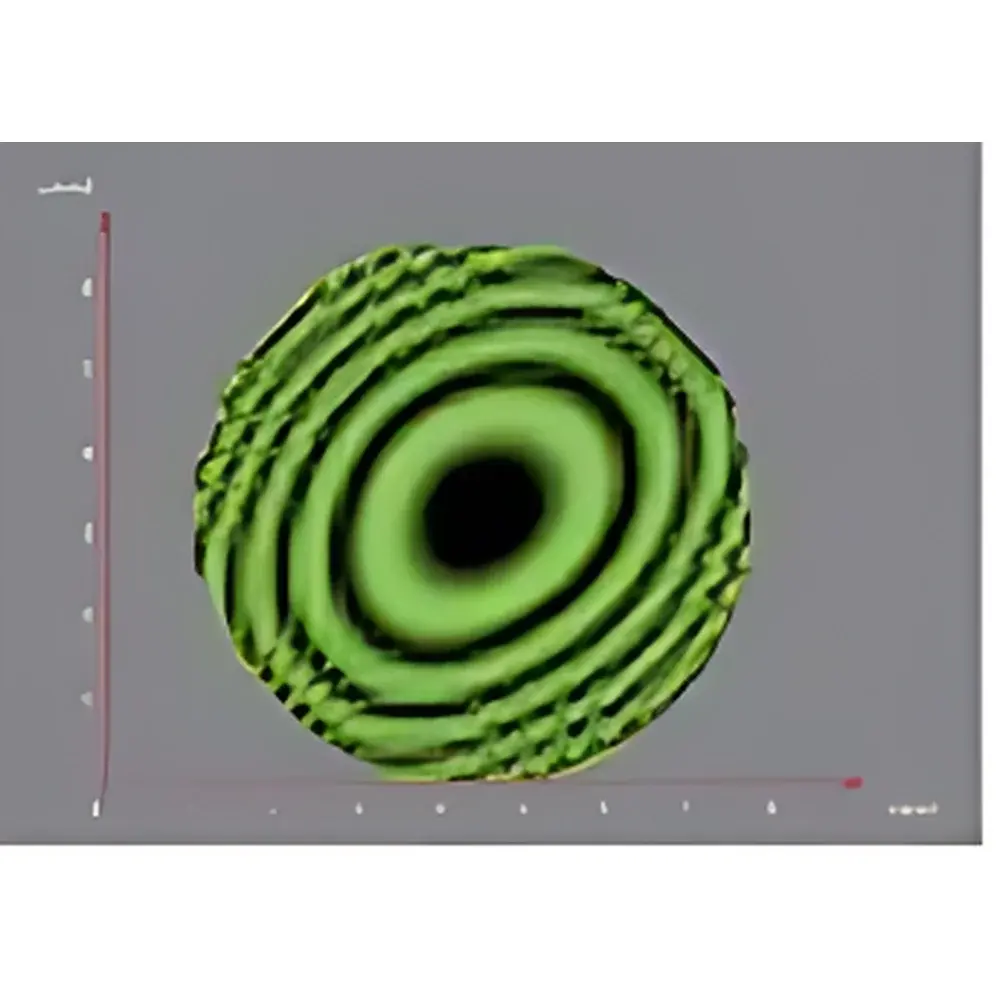
Metrolux ML4560 Wavefront Sensor
| Brand | Metrolux |
|---|---|
| Origin | Germany |
| Model | ML4560 Wavefront Sensor |
| Sensor Head Compatibility | ML4010 |
| Detector | 2/3" CCD, 12-bit dynamic range |
| Pixel Array | 1392 × 1040 |
| Wavelength Range | 350–1100 nm (standard), 190–350 nm (with optional converter) |
| Pupil Size | 8.97 × 6.71 mm |
| Max Frame Rate | 15 fps |
| Spatial Resolution | 200 µm |
| Sub-aperture Count | 45 × 34 |
| Tilt Dynamic Range | ±1.6° (730 λ) |
| Focus Dynamic Range | 72 mm (370 λ) |
| Wavefront Accuracy | <50 nm RMS |
| System Accuracy | 10 nm RMS |
| Repeatability | 100 nm RMS |
| Wavefront Reconstruction Accuracy | <16 µrad |
| Curvature Accuracy | 5 × 10⁻⁴ /m |
Overview
The Metrolux ML4560 Wavefront Sensor is a high-precision, Hartmann–Shack-based optical metrology instrument engineered for quantitative wavefront characterization in research, industrial laser development, and adaptive optics integration. It operates on the principle of localized spot displacement measurement across a micro-lens array, enabling real-time reconstruction of phase aberrations with sub-wavelength resolution. Designed for rigorous optical alignment, beam quality assessment, and system-level performance validation, the ML4560 delivers traceable, repeatable wavefront data compliant with ISO 10110-5, ISO 13694, and ISO 11146 standards for laser beam diagnostics. Its modular architecture supports both continuous-wave and pulsed laser sources—including Q-switched and ultrafast systems—via hardware-synchronized triggering and automatic exposure control.
Key Features
- Hartmann–Shack sensor head (ML4010) with 2/3″ 12-bit CCD detector and 1392 × 1040 pixel resolution for high-fidelity spot centroid detection
- Configurable wavelength coverage: 350–1100 nm standard; extended UV range (190–350 nm) available with optional quartz or fused silica converter optics
- Optimized pupil sampling: 45 × 34 sub-apertures over an 8.97 × 6.71 mm active aperture, supporting spatial resolution down to 200 µm
- Real-time wavefront computation at up to 15 frames per second, with on-the-fly Zernike polynomial decomposition (up to 36 terms)
- Automated gain, shutter, and background subtraction algorithms minimizing operator dependency and environmental drift effects
- Hardware-triggered synchronization with pulsed lasers (TTL input), ensuring temporal fidelity for transient beam analysis
- Integrated noise-reduction protocols including frame averaging, dark-frame compensation, and Poisson-weighted centroid fitting
Sample Compatibility & Compliance
The ML4560 accommodates collimated or converging beams with diameters up to 8 mm, making it suitable for characterizing laser resonators, fiber-coupled sources, free-space optical trains, and EUV-compatible beamlines (with appropriate vacuum feedthroughs and coatings). It meets mechanical and electrical safety requirements per IEC 61000-6-3 (EMC) and IEC 61010-1 (lab equipment safety). Data acquisition and reporting workflows support GLP/GMP-aligned documentation practices, including audit-trail-enabled session logging, user authentication, and timestamped metadata embedding—facilitating compliance with FDA 21 CFR Part 11 where electronic records are required.
Software & Data Management
The raylux software suite (v.ML1205) provides a deterministic, scriptable interface for wavefront analysis and system integration. It enables export of raw centroid coordinates, reconstructed phase maps (in FITS and HDF5 formats), and Zernike coefficient time-series. All numerical outputs include uncertainty propagation based on shot-noise limits and calibration residuals. The GUI supports multi-angle 2D/3D wavefront visualization with arbitrary zoom, rotation, and elevation control; progression plots track tilt, defocus, astigmatism, and higher-order modes over time. Beam parameter analysis includes M² calculation per ISO 11146-1/-2, near-field/far-field divergence mapping, and intensity-weighted beam radius evaluation. Configuration profiles—including ROI definition, normalization settings, and display presets—can be saved, versioned, and recalled as XML templates.
Applications
- Quantitative verification of adaptive optics correction loops in astronomical instrumentation and ophthalmic aberrometry
- End-to-end beam quality validation for high-power industrial lasers (e.g., CO₂, fiber, and disk lasers) prior to delivery optics
- In-process monitoring of optical component fabrication (e.g., aspheric lens polishing, mirror figuring) via interferometric reference comparison
- Characterization of ultrafast amplifier chains, including spectral phase retrieval when combined with FROG or SPIDER setups
- Alignment and stability assessment of free-space quantum communication links and gravitational wave detector interferometers
- Validation of computational imaging systems and phase-retrieval algorithms under controlled aberration conditions
FAQ
What is the maximum supported beam diameter for accurate wavefront reconstruction?
The ML4560 is optimized for beams up to 8 mm in diameter when fully filling the 8.97 × 6.71 mm pupil; larger beams require relay imaging optics calibrated per ISO 10110-5 Annex B.
Can the system measure wavefronts under vacuum or inert gas environments?
Yes—sensor heads can be integrated into vacuum chambers (down to 10⁻⁶ mbar) using CF-flanged housings and UV-grade fused silica windows; optional purge ports support nitrogen or argon purging for UV applications.
Is Zernike polynomial fitting limited to low-order aberrations?
No—the raylux software computes up to 36 Zernike terms (n ≤ 8) with orthogonal weighting; higher-order fits are possible via custom MATLAB or Python API extensions using exported phase data.
How is calibration traceability maintained across instrument lifetime?
Each unit ships with NIST-traceable flatness and curvature calibration certificates; annual recalibration services include reference sphere testing, lenslet array alignment verification, and centroid algorithm validation against programmable phase plates.
Does the system support third-party automation via API?
Yes—raylux exposes a COM/ActiveX interface for Windows and a TCP/IP socket protocol for cross-platform integration; Python bindings and LabVIEW VIs are provided in the SDK package.