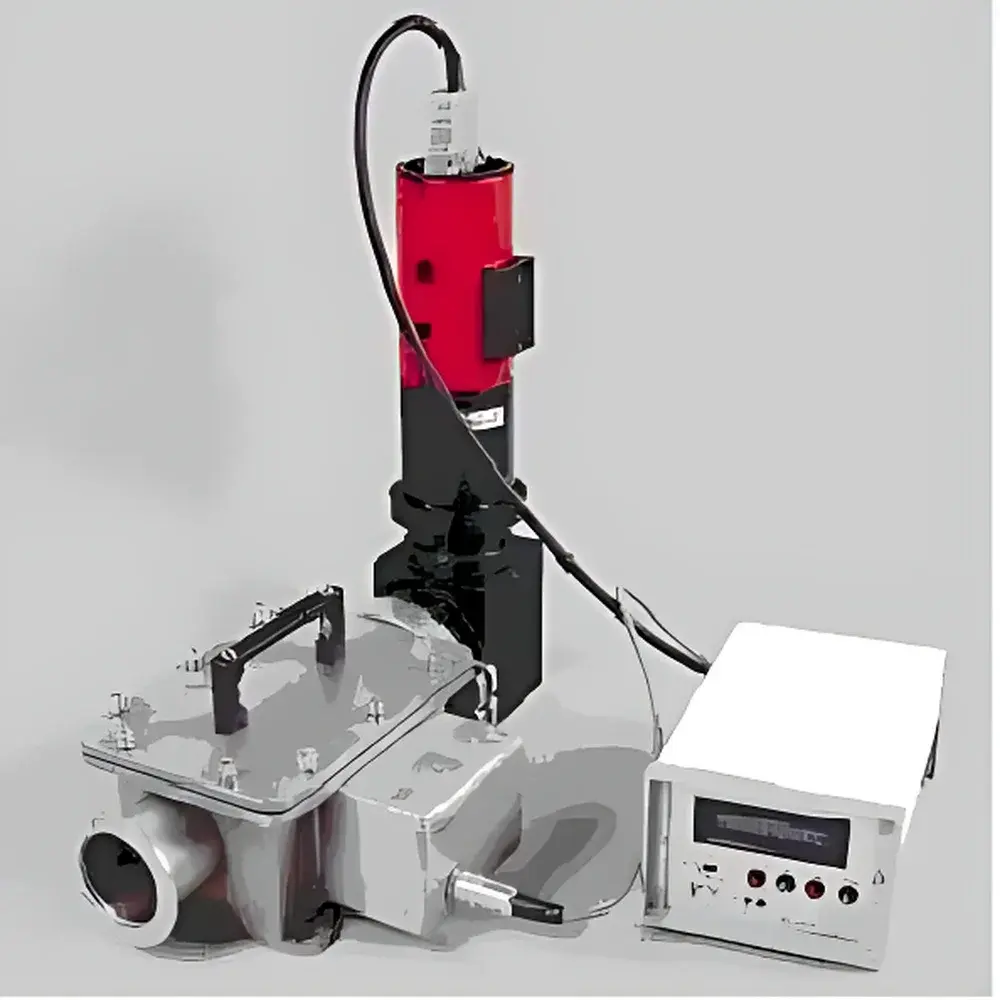
Metrolux ML52xx Series UV Laser Beam Profiler
| Brand | Metrolux |
|---|---|
| Origin | Germany |
| Distribution Type | Authorized Distributor |
| Import Status | Imported |
| Pricing | Available Upon Request |
| Wavelength Range | 153–355 nm |
| Damage Threshold | Up to 15 J/cm² |
| Pulse Detection Rate | Up to 1 kHz (single-shot) |
| Active Area Homogeneity | >98% |
| Frame Latency | Low (sub-100 ms) |
| Supported Cameras | ML3720 (1/2" CCD, 782 × 582), ML3743 (2/3" CCD, 1392 × 1040) |
| Software | beamlux II Advanced (ML1201) |
| Optical Magnifications | 1×, 10×, 20×, 40× (model-dependent) |
| Max. Measurable Beam Size | Up to 200 mm (custom configurations available) |
Overview
The Metrolux ML52xx Series UV Laser Beam Profiler is a high-precision, camera-based beam characterization system engineered for quantitative spatial analysis of pulsed ultraviolet laser sources. It operates on the principle of direct UV-to-visible photon conversion via proprietary phosphor-coated imaging sensors, enabling non-invasive, real-time profiling of short-wavelength laser beams without optical attenuation or thermal distortion. Designed specifically for industrial and scientific applications involving excimer lasers (e.g., ArF at 193 nm, KrF at 248 nm, XeCl at 308 nm) and harmonic outputs from Nd:YAG systems (e.g., 5th harmonic at 213 nm, 4th at 266 nm, 3rd at 355 nm), this profiler delivers traceable, repeatable measurements under demanding production and R&D conditions. Its architecture complies with fundamental metrological requirements for laser diagnostics, supporting ISO 11146-1:2019 (laser beam widths, divergence, and propagation parameters) and ASTM E1423-22 (standard guide for laser beam parameter measurement). The system is calibrated per manufacturer specifications using NIST-traceable reference sources and is suitable for integration into GLP- and GMP-regulated environments where audit-ready documentation and measurement integrity are critical.
Key Features
- UV-optimized imaging path with high-transmission, low-fluorescence optics and >98% active-area uniformity for accurate intensity distribution mapping
- Dual-sensor compatibility: supports both ML3720 (782 × 582 pixels, 1/2″ format) and ML3743 (1392 × 1040 pixels, 2/3″ format) CCD cameras for resolution scalability
- Pulse-resolved acquisition at up to 1 kHz frame rate — enabled by ultra-low latency phosphor decay and synchronized trigger input (TTL or optical)
- Damage-resistant converter surface rated to 15 J/cm² (10 ns pulse, 20 Hz rep rate), validated per ISO 21254-1 for laser-induced damage threshold (LIDT)
- Modular magnification options (1×, 10×, 20×, 40×) via interchangeable ML52xx objective modules, allowing beam size adaptation from sub-millimeter to ≥200 mm (custom)
- Real-time beam evaluation with <100 ms processing latency — enabling closed-loop feedback in laser alignment, homogenizer tuning, and mask illumination optimization
- Multi-camera synchronization support: up to three independent ML52xx units can be triggered simultaneously for co-registered near-field/far-field or raw/processed plane analysis
Sample Compatibility & Compliance
The ML52xx series is validated for stable operation with pulsed UV sources emitting in the 153–355 nm range, including ArF (193 nm), KrF (248 nm), XeCl (308 nm), XeF (351 nm), and harmonic generations from Nd:YAG (213 nm, 266 nm, 355 nm). It accommodates beam diameters from 200 mm (with custom optical extensions), and supports both Gaussian and top-hat spatial profiles typical in lithography, micromachining, and medical laser systems. All hardware and firmware comply with CE marking requirements (EMC Directive 2014/30/EU, RoHS 2011/65/EU), and software design adheres to FDA 21 CFR Part 11 principles for electronic records and signatures when deployed in regulated manufacturing settings.
Software & Data Management
The beamlux II Advanced software suite (ML1201) provides full control, analysis, and reporting functionality. It includes ISO 11146-compliant beam width (D4σ, knife-edge, 1/e²), centroid position, ellipticity, M² estimation (when paired with optional beam propagation stage), and temporal pulse train correlation. Data export supports CSV, TIFF, HDF5, and MATLAB-compatible formats. Audit trails record all user actions, parameter changes, and calibration events. Role-based access control, electronic signature workflows, and automated report generation (PDF/HTML) are available for quality assurance documentation. Remote operation via TCP/IP enables centralized monitoring across networked cleanroom or production-floor installations.
Applications
- Lithography tool qualification and maintenance (excimer illumination uniformity verification)
- UV laser scribing and ablation process development (beam shape stability vs. pulse count)
- Medical laser system validation (e.g., ophthalmic excimer platforms per IEC 60601-2-22)
- Optical component testing (homogenizers, diffractive optics, beam expanders)
- Research in ultrafast UV science requiring single-pulse spatial fidelity
- Automated inline QC stations integrated with PLC-controlled laser workcells
FAQ
What UV wavelengths does the ML52xx support?
The system is optimized for 153–355 nm, covering ArF (193 nm), KrF (248 nm), XeCl (308 nm), XeF (351 nm), and Nd:YAG harmonics (213 nm, 266 nm, 355 nm).
Can it measure single-shot pulses?
Yes — with appropriate triggering and camera selection, it captures individual pulses at up to 1 kHz repetition rates.
Is calibration traceable to national standards?
Factory calibration uses NIST-traceable UV radiometric sources; on-site recalibration services include uncertainty budgets compliant with ISO/IEC 17025.
How is data security ensured in regulated environments?
beamlux II Advanced supports 21 CFR Part 11 compliance features including audit trail logging, electronic signatures, and secure user authentication.
Are custom beam size configurations available?
Yes — optical paths supporting up to 200 mm beam diameter are offered as configurable options upon technical review.