
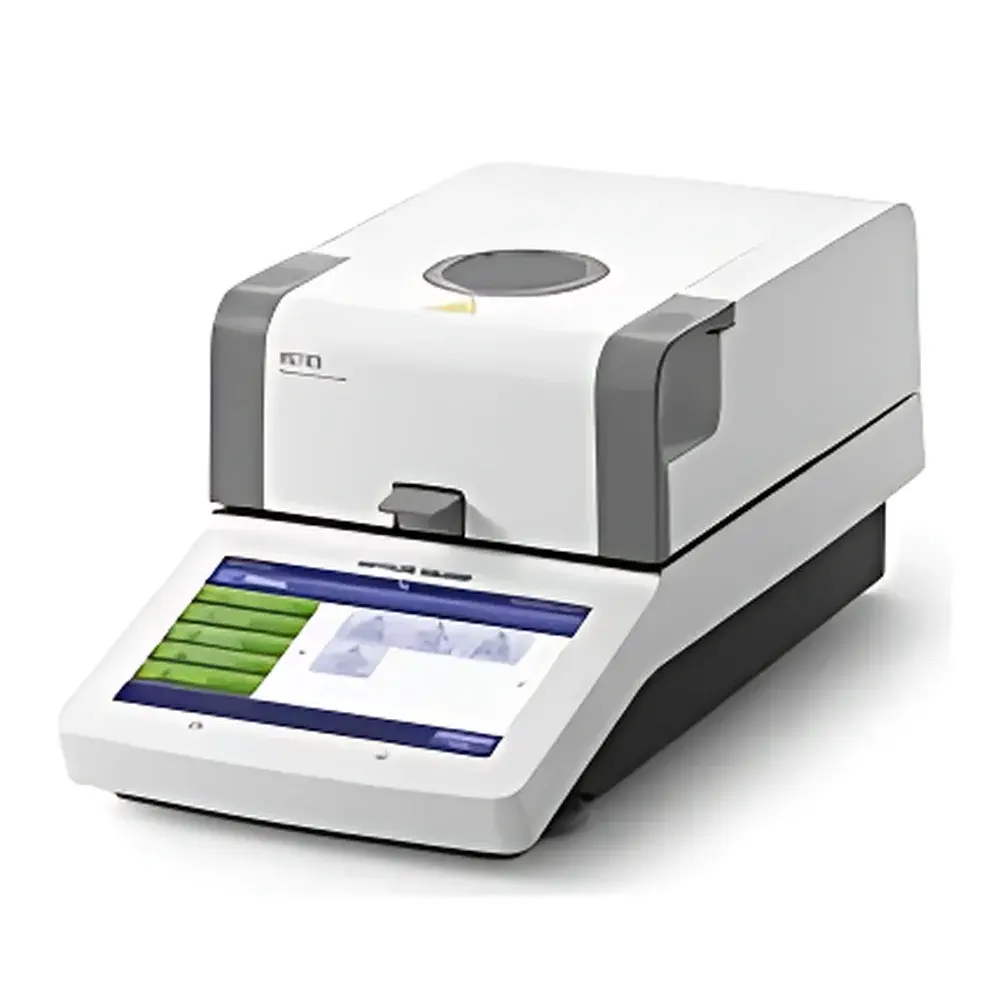
METTLER TOLEDO HC103 Classic Series Infrared Moisture Analyzer
| Brand | METTLER TOLEDO |
|---|---|
| Origin | Switzerland |
| Model | HC103 |
| Readability | 0.01% MC |
| Repeatability (sd), 2 g sample | 0.1% MC |
| Repeatability (sd), 10 g sample | 0.015% MC |
| Moisture Content Range | 1–100% MC |
| Maximum Sample Weight | 101 g |
| Minimum Sample Weight | 0.1 g |
| Drying Temperature Range | 40–230 °C |
| Heating Profile Options | Standard, Rapid |
| Method Storage Capacity | 20 pre-programmed methods |
| Result Storage Capacity | 100 measurement records |
| Display Modes | %MC, %DC, %AM, %AD, g, g/kg MC, g/kg DC |
| Data Export | USB flash drive support |
| Leveling Assistance | Integrated bubble level + on-screen leveling wizard |
Overview
The METTLER TOLEDO HC103 Classic Series Infrared Moisture Analyzer is a robust, entry-level halogen moisture determination system engineered for precision, reproducibility, and operational simplicity in routine quality control and R&D laboratories. It operates on the principle of thermogravimetric analysis (TGA): a halogen lamp provides rapid, uniform heating to dehydrate the sample, while a high-resolution analytical balance continuously monitors mass loss in real time. The instrument calculates moisture content (%MC) by comparing initial and final mass under defined thermal conditions—fully compliant with standardized drying protocols referenced in ASTM E1868, ISO 712, and AOAC 952.18. Designed for daily use across food, pharmaceutical, chemical, and agricultural sectors, the HC103 delivers traceable, audit-ready results without requiring advanced operator training.
Key Features
- Halogen heating technology with closed-loop temperature control ensures consistent radiant energy delivery across the sample surface—minimizing thermal gradients and enhancing inter-batch repeatability.
- 7-inch full-color capacitive touchscreen with high-contrast numeric display supports intuitive navigation, even under ambient laboratory lighting; interface language is configurable (English default).
- OneClick™ Moisture functionality enables direct launch of user-defined drying methods—bypassing menu layers to reduce procedural steps and minimize operator-induced variability.
- Real-time drying curve visualization plots mass loss versus time, allowing users to assess drying kinetics, detect endpoint stability, and identify anomalies such as decomposition or sublimation.
- Integrated leveling guidance system combines a physical spirit level with an on-screen digital inclinometer wizard—achieving correct horizontal alignment in under 10 seconds without external tools.
- Comprehensive data handling: All measurements—including timestamps, method parameters, raw mass values, and drying curves—are timestamped and stored internally; export to USB drive in CSV format preserves full traceability for GLP/GMP documentation.
Sample Compatibility & Compliance
The HC103 accommodates heterogeneous solid and semi-solid matrices including powders, granules, pellets, pastes, and thin films. Its 101 g weighing capacity and 0.1 g minimum sample requirement support both high-precision micro-analysis and representative bulk testing. The instrument complies with international regulatory expectations for analytical instrumentation: built-in calibration verification routines, password-protected method editing, and immutable result logs satisfy foundational requirements for FDA 21 CFR Part 11 readiness (when paired with appropriate IT infrastructure and SOPs). All drying methods adhere to harmonized principles outlined in USP <921> and Ph. Eur. 2.2.32, ensuring method transferability across global sites.
Software & Data Management
No proprietary software installation is required—the HC103 operates autonomously with embedded firmware supporting full method configuration, result review, and data export via standard USB mass storage protocol. Each stored result includes metadata: operator ID (assignable per login), method name, start/stop time, ambient temperature/humidity (if connected to optional environmental sensor), and deviation alerts. Up to 20 customizable methods can be saved locally, each defining target temperature, heating profile (standard or rapid), termination criteria (time-based, slope-based, or auto-stop at stability threshold), and unit output preference. Internal memory retains the last 100 measurements with full graphical history, enabling trend analysis without external database integration.
Applications
- Pharmaceutical excipient moisture qualification per ICH Q5C stability guidelines
- Food ingredient shelf-life assessment via water activity correlation studies
- Polymer resin QC prior to extrusion or injection molding
- Soil and feedstuff moisture certification for agricultural commodity trading
- Quality release testing of lyophilized biologics intermediates
- Raw material acceptance testing in fine chemical manufacturing
FAQ
What standards does the HC103 comply with for moisture determination?
It aligns with ASTM E1868 (Standard Test Method for Moisture in Plastics), ISO 712 (Milk and Milk Products – Determination of Moisture Content), and AOAC Official Method 952.18 (Moisture in Feedstuffs); method development should follow USP <921> principles.
Can the HC103 be integrated into a LIMS or ELN environment?
Yes—CSV exports are natively compatible with most LIMS/ELN platforms; for automated ingestion, third-party middleware or custom API scripting may be implemented using standard USB HID protocols.
Is calibration traceable to national standards?
Internal calibration uses METTLER TOLEDO-certified weights traceable to PTB (Physikalisch-Technische Bundesanstalt); external verification follows ISO/IEC 17025-compliant procedures.
Does the instrument support multi-step drying programs?
No—the HC103 implements single-stage heating profiles only (Standard or Rapid); multi-ramp sequences require higher-tier models such as the HG63 or HR83.
How frequently should leveling be verified?
Leveling must be confirmed before first use, after relocation, and at least once per shift when operating under variable floor conditions or high-vibration environments.




