
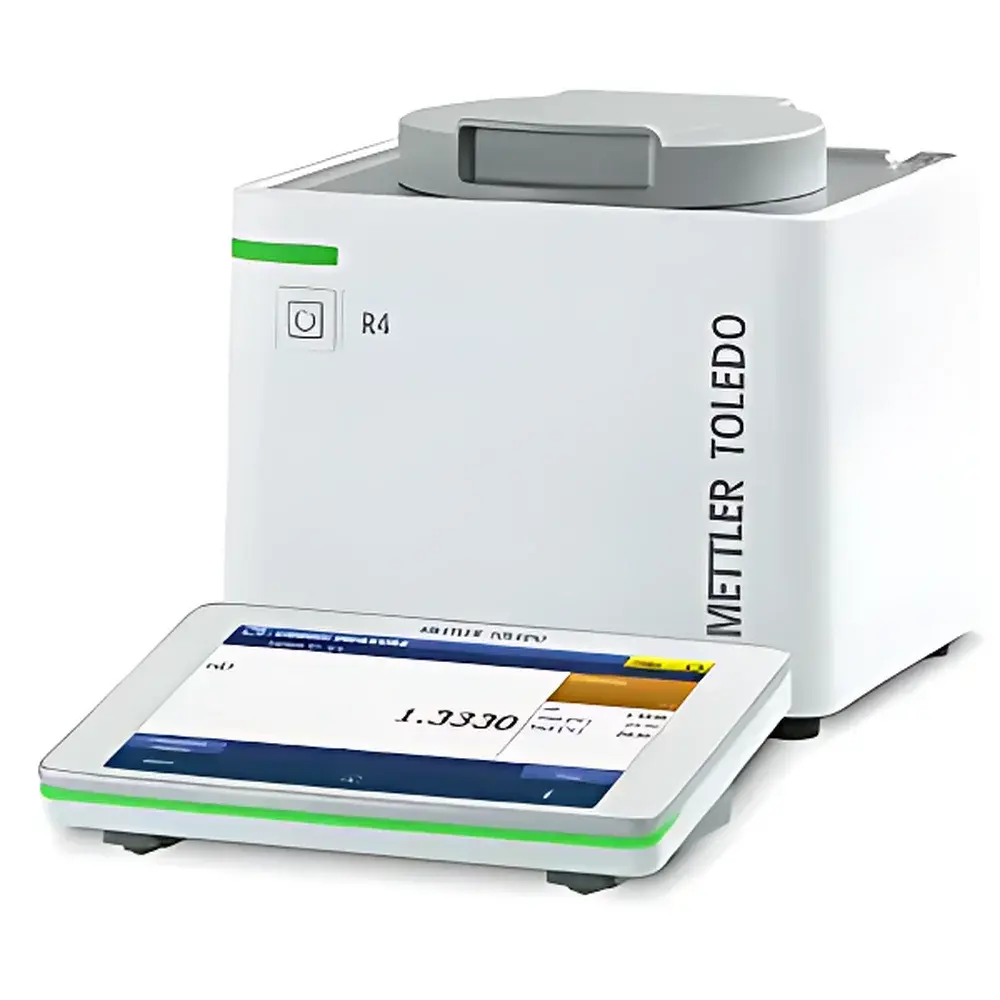
METTLER TOLEDO R4 Advanced Desktop Refractometer
| Brand | METTLER TOLEDO |
|---|---|
| Origin | Germany |
| Product Type | Benchtop Refractometer |
| Temperature Control | Yes |
| Digital Display | Yes |
| Refractive Index Range | 1.3200–1.7000 nD |
| Accuracy | ±0.0001 nD |
| Repeatability | ±5×10⁻⁵ nD |
| Brix Range | 0–100 % w/w |
| Brix Accuracy | ±0.05 % w/w |
| Temperature Control Range | 5–100 °C |
| Temp. Control Accuracy | ±0.1 °C |
| Minimum Sample Volume | 0.50 mL |
| Built-in Units | Refractive Index, Brix, pH, Chemical Concentration, Freezing Point, Salinity, and up to 30 user-defined concentration tables |
| Connectivity | USB Host (3 ports), RS232, Ethernet, HDMI, CAN, USB Device |
| Compliance | ASTM D1807, D1218, D1747, D2140, D3321, D4095, D4542, D5006, D524 |
Overview
The METTLER TOLEDO R4 Advanced Desktop Refractometer is an engineered optical measurement instrument designed for high-precision determination of refractive index (nD) and derived concentration parameters—including Brix, freezing point depression, salinity, acidity, and custom chemical concentrations—across pharmaceutical, food & beverage, chemical, and academic laboratories. Operating on the principle of total internal reflection at the prism-sample interface, the R4 employs a high-stability LED light source and precision-machined sapphire prism to deliver traceable, temperature-compensated measurements with metrological integrity. Its core architecture integrates Peltier-based active temperature control (5–100 °C), real-time thermal equilibration monitoring, and automatic refractive index correction per ISO 280 and OIML R 108 standards. Unlike legacy analog or semi-automated refractometers, the R4 implements a closed-loop optical path with zero-drift calibration referencing, ensuring long-term stability and inter-laboratory comparability under GLP/GMP-regulated environments.
Key Features
- 7-inch full-color capacitive touchscreen interface with intuitive One Click™ workflow navigation—enabling complete sample analysis (loading, measurement, rinse, dry, SOP execution) in a single tap
- Integrated Peltier temperature control system with ±0.1 °C accuracy and programmable ramp profiles, compliant with ASTM D1747 and AOAC 920.141 thermal conditioning requirements
- Color-coded pass/fail result display aligned with user-defined specification limits—supporting immediate visual QA/QC decision-making without interpretation delay
- Multi-level user management with role-based access control (RBAC), individualized home screens, language selection (14 languages), and password-protected configuration changes
- Modular connectivity suite: three USB host ports (for barcode scanners, printers, flash drives, HID peripherals), Ethernet (for LabX network deployment), RS232 (for automated liquid handlers), CAN (for level sensors), and HDMI (for external display mirroring)
- Comprehensive unit flexibility—supports direct output in refractive index (nD), Brix (% w/w), pH-equivalent values, molality, mass fraction, and up to 30 user-defined concentration tables (polynomial or tabular interpolation)
Sample Compatibility & Compliance
The R4 accommodates aqueous, organic, viscous, and mildly corrosive samples with minimum volume requirement of 0.50 mL—optimized for routine QC testing of syrups, juices, solvents, electrolytes, and API solutions. Its sapphire prism surface resists scratching and chemical etching, enabling reliable use with acids (e.g., HCl, HNO₃), bases (e.g., NaOH), and polar aprotic solvents (e.g., DMF, DMSO). The instrument meets critical regulatory benchmarks including USP , European Pharmacopoeia 2.2.6, AOAC Official Methods (e.g., 940.09 for honey, 970.15 for fruit juices), ASTM D1807 (petroleum products), and ICUMSA GS4/3–13 (sugar industry). Full compliance with 21 CFR Part 11 and EU Annex 11 is achieved when paired with LabX software—enabling electronic signatures, immutable audit trails, and ALCOA+ data integrity governance.
Software & Data Management
LabX Express (embedded) provides local method storage, report generation (PDF/CSV), and basic data export. For enterprise-scale deployment, LabX Server enables centralized instrument management, multi-user SOP enforcement, electronic batch records (EBR), and seamless LIMS integration via ASTM E1384 or HL7 protocols. All measurements include embedded metadata: timestamp, operator ID, temperature log, prism status, calibration history, and environmental conditions. Audit trail functionality—activated in LabX—is fully configurable to record every parameter change, user login/logout, and result modification with IP address and reason-for-change annotation—meeting FDA and EMA expectations for data provenance.
Applications
- Pharmaceutical: Excipient concentration verification (e.g., glycerol, propylene glycol), solvent purity screening (ethanol/water blends), and lyophilization cycle endpoint detection
- F&B Quality Control: Brix standardization in soft drinks and fruit concentrates; sugar inversion monitoring in confectionery; alcohol content estimation in wines (via density correlation)
- Chemical Manufacturing: HCl/H₂SO₄ titrant strength validation; ethylene glycol coolant concentration; lithium bromide absorption chiller fluid analysis
- Academic Research: Polymer solution refractivity studies; thermodynamic modeling of binary mixtures; teaching labs for optical property fundamentals
- Cosmetics & Personal Care: Surfactant concentration profiling in shampoos; glycerin content in lotions; preservative efficacy testing
FAQ
Does the R4 support GLP-compliant calibration documentation?
Yes—calibration events (including prism cleaning verification, standard reference material (SRM) checks using certified sucrose or water standards), are automatically logged with operator ID, date/time, and deviation values when LabX is enabled.
Can I import my own concentration conversion formulas?
Yes—the R4 allows entry of polynomial equations (up to 5th order) or discrete lookup tables for custom analytes, with validation against NIST-traceable reference materials.
Is external temperature probe integration possible?
No—the R4 relies exclusively on its internal platinum resistance thermometer (Pt100) embedded in the prism block; external probes are not supported to maintain thermal boundary consistency.
What is the recommended recalibration frequency?
Per ISO/IEC 17025 guidance, recalibration is advised every 6 months or after 500 measurements—whichever occurs first—using certified nD standards (e.g., ATAGO SRM-1, NIST SRM 1700 series).
How does the R4 handle particulate-containing samples?
Samples must be particle-free and homogeneous; suspended solids will scatter incident light and invalidate the critical angle measurement—centrifugation or filtration (0.45 µm) is required prior to analysis.



