
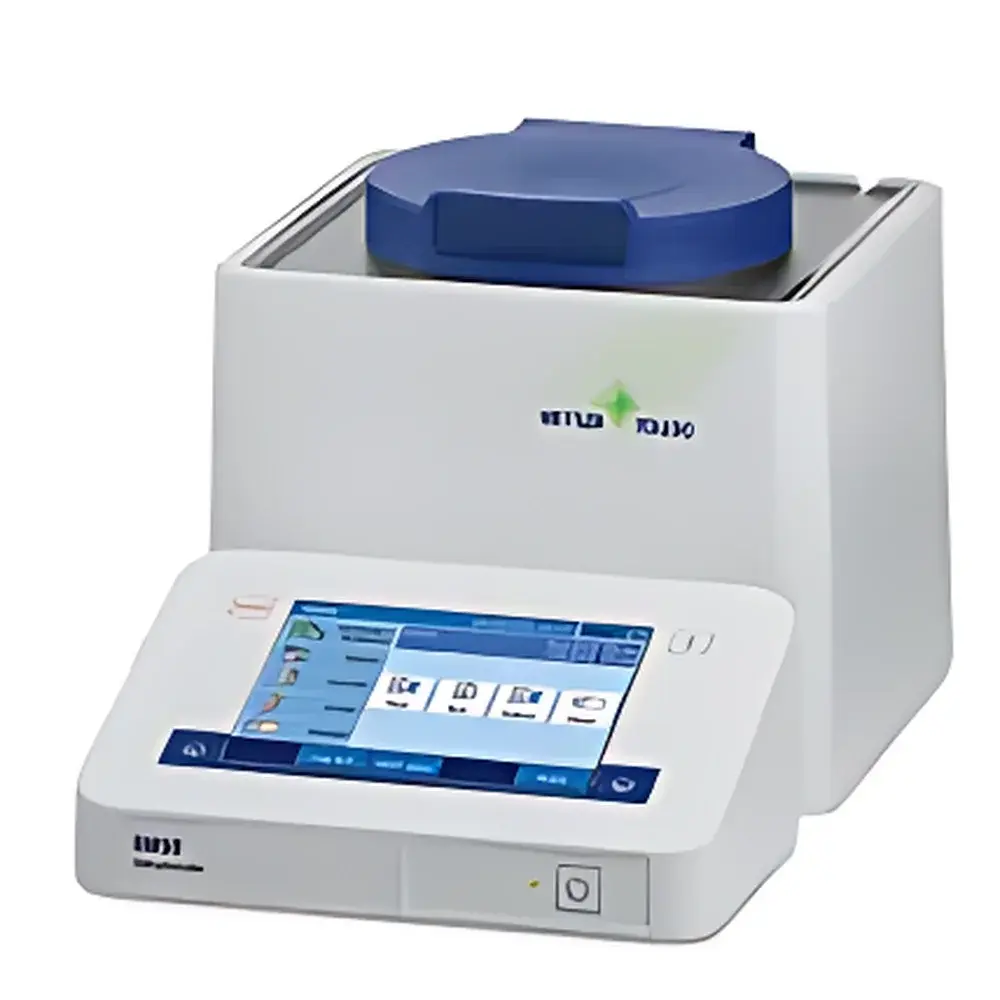
METTLER TOLEDO RM40 Desktop Refractometer
| Brand | METTLER TOLEDO |
|---|---|
| Origin | Switzerland |
| Product Type | Benchtop Refractometer |
| Temperature Control | Yes |
| Digital Display | Yes |
| Refractive Index Range | 1.3200–1.7000 |
| Brix Range | 0.0–100.0 % w/w |
| Refractive Index Accuracy | ±0.0001 |
| Refractive Index Repeatability (nD, n=10) | ±0.00005 |
| Temperature Range | 5–100 °C |
| Temperature Accuracy | ±0.1 °C |
| Compliance | FDA 21 CFR Part 11, ISO/IEC 17025, ASTM D1218, USP <831> |
Overview
The METTLER TOLEDO RM40 Desktop Refractometer is a high-precision, temperature-controlled optical instrument engineered for accurate and traceable refractive index (nD) and Brix measurements across demanding laboratory and quality control environments. Based on the principle of total internal reflection at the prism-sample interface, the RM40 employs a high-stability LED light source and a precision sapphire measuring prism to deliver consistent angular detection of the critical angle—converted in real time to refractive index values with digital resolution down to 0.00001. Its integrated Peltier temperature control system maintains sample temperature within ±0.1 °C across a broad operational range (5–100 °C), eliminating thermal drift and enabling standardized measurements per ASTM D1218 (hydrocarbon liquids), USP (pharmaceutical solutions), and ISO 21745 (food and beverage applications). Designed as part of the LiquiPhysics™ Beyond Series, the RM40 supports modular expansion—allowing co-integration with density, pH, conductivity, and colorimetry modules—without compromising measurement integrity or footprint.
Key Features
- Precision sapphire prism with chemical resistance and long-term optical stability
- Active Peltier-based temperature control (5–100 °C) with real-time monitoring and automatic stabilization
- OneClick™ method-driven operation: pre-configured, product-specific measurement workflows with built-in error detection and auto-validation
- SmartCodes™ barcode integration: direct method recall via ScanStraight™—no manual parameter entry required
- ErgoSens™ acoustic start: initiates measurement without physical contact, reducing cross-contamination risk and operator fatigue
- LevelSens™ overflow protection: automatically halts dispensing when waste reservoir reaches capacity
- Modular architecture supporting future upgrades to combined density/refractometry (e.g., RM40 + DM40), pH, conductivity, and color modules
- Compliant hardware interfaces for automated liquid handling—including peristaltic pumps and high-viscosity autosamplers
Sample Compatibility & Compliance
The RM40 accommodates a wide spectrum of liquid and semi-liquid samples, including aqueous solutions, organic solvents, syrups, essential oils, bituminous materials (up to 100 °C), pharmaceutical formulations, and food-grade concentrates. Its sealed optical path and corrosion-resistant fluidic components meet stringent hygiene requirements for GMP and GLP laboratories. All measurement data—including timestamps, operator ID, method version, environmental conditions, and raw sensor outputs—are logged with full audit trail capability in accordance with FDA 21 CFR Part 11. System validation documentation, IQ/OQ protocols, and calibration certificates (traceable to NIST and PTB standards) are provided. The instrument complies with ISO/IEC 17025 for testing laboratories, ASTM D1218 for hydrocarbons, USP for refractometric assays, and EU Pharmacopoeia 2.2.6.
Software & Data Management
The RM40 operates natively with METTLER TOLEDO LabX™ laboratory software—a centralized, server-based platform that enables secure user management, electronic signatures, role-based access control, and full 21 CFR Part 11 compliance. LabX supports automated data capture, customizable report generation (PDF, Excel, CSV), and seamless integration with LIMS, SAP, and MES systems via standard ODBC, OPC UA, or RESTful API protocols. Measurement methods—including temperature ramp profiles, multi-point Brix calibration curves, and pass/fail limits—are centrally stored, version-controlled, and distributed across instruments. Audit trails record every action—from parameter modification to result approval—with immutable timestamps and user attribution. Optional LabX Remote Access allows off-site instrument monitoring and troubleshooting without compromising network security.
Applications
- Pharmaceutical QC: verification of excipient concentration, solvent purity, and syrup formulation per USP monographs
- F&B production: inline Brix control for juice, honey, dairy, and confectionery manufacturing
- Petrochemical analysis: refractive index profiling of lubricants, fuels, and asphalt binders at elevated temperatures
- Cosmetic R&D: active ingredient quantification in emulsions and hydrosols
- Academic research: thermooptical characterization of polymer solutions and colloidal dispersions
- Contract testing labs: accredited refractometry services compliant with ISO/IEC 17025 scope requirements
FAQ
What is the refractive index measurement principle used in the RM40?
The RM40 utilizes the critical angle method based on total internal reflection at the sapphire prism–sample interface, with angular detection performed by a high-resolution photodiode array.
Can the RM40 measure highly viscous or particulate-containing samples?
Yes—when paired with the optional high-viscosity autosampler or flow cell kit, the RM40 handles samples up to 10,000 mPa·s; filtration is recommended for suspended solids >5 µm.
Is temperature calibration traceable to national standards?
Yes—integrated Pt100 sensor calibration is certified against PTB (Physikalisch-Technische Bundesanstalt) reference standards, with certificate included.
Does the RM40 support multi-parameter analysis in a single run?
Not natively—but as part of the LiquiPhysics™ Beyond platform, it can be physically and software-integrated with DM40 density meters and other modules for synchronized nD/ρ/pH/conductivity acquisition.
How is data integrity ensured during electronic signature workflows?
LabX enforces dual authentication (username + token/password), mandatory reason-for-change fields, and cryptographic hash logging—fully satisfying 21 CFR Part 11 §11.10 and §11.200 requirements.





