
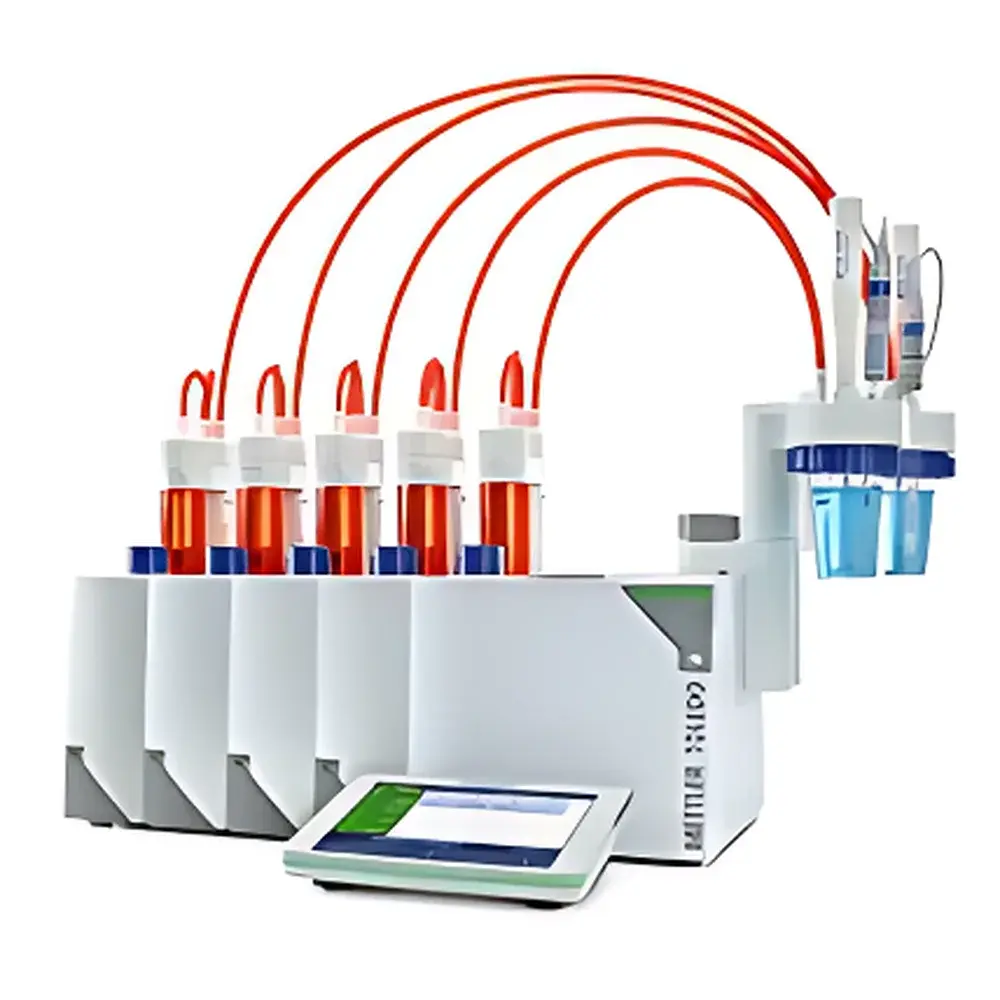
METTLER TOLEDO T9 Excellence Series Automatic Potentiometric Titrator
| Brand | METTLER TOLEDO |
|---|---|
| Origin | Switzerland |
| Model | T9 |
| Measurement Range | −2000 to +2000 mV |
| Meter Accuracy | ±0.2 mV |
| Meter Resolution | 0.01 mV |
| Titration Precision | ±0.3 µL |
| Titrant Drive Units | 1 internal + 7 external |
| Parallel Titration Capacity | up to 30 tasks, 8 concurrent |
| IF-THEN Logic Support | Yes |
| GLP Compliance | Yes |
| Language Support | English, German, French, Spanish, Italian, Russian, Polish, Korean, Portuguese, Chinese |
| Interface | USB (printer, barcode reader), RS-232 |
| SmartSample Integration | Yes |
| Auto Electrode & Burette Recognition | Yes |
| InMotion™ Auto-sampler Compatible | Yes |
Overview
The METTLER TOLEDO T9 Excellence Series Automatic Potentiometric Titrator is an advanced, modular electrochemical platform engineered for high-reproducibility potentiometric titrations in regulated and research-intensive laboratory environments. Based on the proven coulometric and volumetric potentiometric measurement principle—where endpoint detection relies on real-time monitoring of potential change (ΔE/ΔV) across a reference–indicator electrode pair—the T9 delivers traceable, auditable, and method-robust quantification of acid-base, redox, complexometric, precipitation, non-aqueous, conductometric, and Karl Fischer moisture determinations. Designed and manufactured in Switzerland, the system complies with core analytical instrumentation requirements for ISO/IEC 17025-compliant testing laboratories and supports full alignment with GLP, GMP, and FDA 21 CFR Part 11 data integrity expectations through built-in audit trails, electronic signatures, and secure user permission hierarchies.
Key Features
- Parallel Titration Architecture: Simultaneously executes up to eight independent titration tasks across two physically separated analysis zones—enabling true method co-processing (e.g., volumetric Karl Fischer on one station and redox titration on another) without cross-contamination or scheduling conflict.
- IF-THEN Method Logic Engine: Enables conditional decision-making within methods—such as pH pre-measurement followed by branching into acid or base titration—reducing manual intervention and increasing method adaptability for heterogeneous sample matrices.
- SmartSample Workflow Integration: Automatically coordinates sample identification (via integrated USB barcode reader), vial positioning, reagent priming, electrode conditioning, and post-titration rinsing—minimizing operator dependency and inter-run variability.
- Hot-Swappable Sensor & Burette Recognition: Plug-and-play detection of electrodes (pH, redox, ion-selective, photometric) and burettes via embedded RFID tags ensures automatic parameter loading, calibration history recall, and usage tracking per consumable.
- StatusLight™ Visual Status System: A three-color LED indicator provides at-a-glance operational status—green (ready), yellow (in progress or warning), red (error or maintenance required)—enhancing lab-wide instrument awareness and reducing downtime.
- Modular Expansion Capability: Supports up to seven external titrant drive units and three sensor interface boards, allowing seamless integration of conductometric, photometric, or thermometric detection modules alongside standard potentiometric workflows.
Sample Compatibility & Compliance
The T9 accommodates a broad range of sample types—including viscous oils, suspensions, solid powders (with dissolution protocols), organic solvents, and aqueous matrices—without requiring hardware modification. Its sealed titration vessel design and programmable purge gas control minimize atmospheric interference during non-aqueous or low-dielectric titrations. All system-generated reports include full metadata: timestamped raw potential curves, derivative plots, equivalence point calculations, intermediate results, reagent lot numbers, electrode IDs, environmental conditions (optional), and user authentication logs. The platform is validated for compliance with ASTM E203 (Karl Fischer), ISO 8587 (sensory analysis—applicable to titration-based sensory threshold determination), USP (titrimetry), and EP 2.2.20 (potentiometric titration). Full GLP report generation includes instrument qualification status, calibration certificates, and method version control.
Software & Data Management
Powered by METTLER TOLEDO’s tiamo™ software (v3.5+), the T9 supports centralized method library management, role-based access control (RBAC), and encrypted database storage compliant with 21 CFR Part 11 Annex 11 requirements. Audit trails record every user action—including method edits, result overrides, calibration events, and report exports—with immutable timestamps and digital signatures. Data export formats include PDF/A-2 (archival), CSV (for LIMS integration), and XML (for ELN synchronization). The “Task Queue” function allows heterogeneous sample series—spanning multiple methods, users, and priority levels—to be batched, scheduled, and executed sequentially or in parallel, optimizing instrument utilization across shifts. Backup and restore routines are fully scriptable and support network-attached storage (NAS) deployment.
Applications
The T9 serves as a primary quantitative tool in pharmaceutical QC labs (assay of active ingredients, residual solvent analysis, excipient purity), chemical manufacturing (acid number, saponification value, peroxide value), food & beverage (titratable acidity, salt content, SO₂ determination), petrochemicals (TAN/TBN, chloride content), and academic research (electrode kinetics, ligand binding stoichiometry, protonation equilibria). Its dual-capability Karl Fischer module—supporting both coulometric (ppm-level water) and volumetric (0.01–100% water) modes—eliminates the need for separate instruments while maintaining traceability to NIST-traceable water standards. Photometric and thermometric add-ons further extend applicability to turbidimetric endpoints or enthalpy-driven reactions.
FAQ
Does the T9 support 21 CFR Part 11-compliant electronic records and signatures?
Yes—the system implements role-based user authentication, audit trail logging, electronic signature capture, and data encryption in accordance with FDA 21 CFR Part 11 and EU Annex 11 requirements.
Can I run volumetric and coulometric Karl Fischer titrations simultaneously?
Yes—parallel titration architecture enables concurrent operation of both Karl Fischer modes on separate analysis stations, each with dedicated reagent handling and endpoint detection.
Is method development possible without programming expertise?
Yes—tiamo™ software provides drag-and-drop logic building blocks, including IF-THEN-ELSE constructs, variable assignment, and conditional branching, all configured via graphical interface without scripting.
What auto-samplers are compatible with the T9?
The system natively integrates InMotion™ series auto-samplers (including InMotion Rondolino and Stromboli), supporting up to 30-position racks with customizable wash cycles and temperature-controlled sample trays.
How is calibration and maintenance tracked?
All electrode calibrations, burette verifications, and preventive maintenance events are logged automatically with user ID, timestamp, and result values—accessible via the tiamo™ maintenance dashboard and exportable for QA review.




