
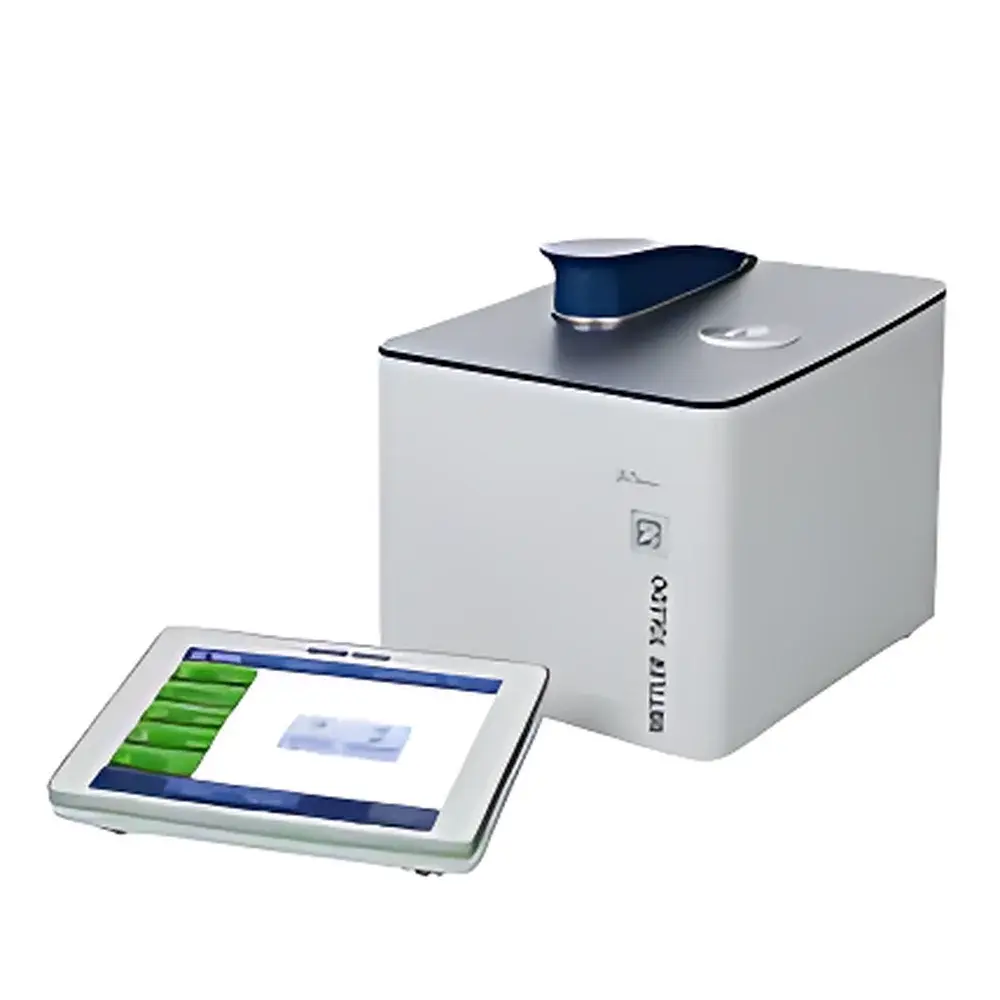
METTLER TOLEDO UV5Nano Ultra-micro UV-Vis Spectrophotometer
| Brand | METTLER TOLEDO |
|---|---|
| Origin | Switzerland |
| Manufacturer Type | Authorized Distributor |
| Origin Category | Imported |
| Model | UV5Nano |
| Instrument Architecture | Dual-wavelength |
| Detector Type | Photodiode Array (PDA) |
| Wavelength Range | 190 nm – 1,100 nm |
| Wavelength Accuracy | ±1.0 nm |
| Photometric Accuracy (K₂Cr₂O₇) | ±0.01 A |
| Path Length Options | 0.1 mm and 1.0 mm |
| Cuvette Holder | Yes |
| Automation Level | Automatic Wavelength Selection |
| Sample Volume Requirement | As low as 0.3 µL |
Overview
The METTLER TOLEDO UV5Nano Ultra-micro UV-Vis Spectrophotometer is an engineered solution for rapid, accurate, and reproducible quantification and purity assessment of nucleic acids and proteins in life science laboratories. Based on dual-beam optical architecture with a high-stability xenon flash lamp and photodiode array detection, the UV5Nano delivers full-spectrum acquisition (190–1,100 nm) in under one second. Its core innovation—LockPath™ technology—enables dynamic, software-controlled path length adjustment between 0.1 mm and 1.0 mm without mechanical recalibration or manual intervention. This eliminates dilution bias and ensures linear absorbance response across an exceptionally broad concentration range: from 6 ng/µL to 15,000 ng/µL for double-stranded DNA. The instrument operates on the Beer–Lambert principle, with real-time correction for baseline drift and stray light, ensuring traceable photometric accuracy per ISO 8579 and ASTM E275 standards.
Key Features
- LockPath™ technology for automatic, user-selectable path lengths (0.1 mm and 1.0 mm), enabling direct measurement of undiluted samples across six orders of magnitude in concentration
- Open-access sample stage with ergonomic left/right-handed pipetting design and removable stainless-steel top cover for rapid decontamination
- Integrated 7-inch capacitive touchscreen terminal with customizable One Click™ application shortcuts—no PC required for routine operation
- Dual-mode operation: ultra-micro volume measurement (0.3–2 µL) via integrated pedestal, and conventional cuvette-based analysis (10 mm path length compatible)
- Xenon flash lamp with >10⁹ shot lifetime, eliminating warm-up delays and spectral drift associated with deuterium/tungsten sources
- Photometric accuracy validated using potassium dichromate (K₂Cr₂O₇) reference standard per ISO 6060, yielding ±0.01 A at 257 nm
Sample Compatibility & Compliance
The UV5Nano supports native biological samples—including dsDNA, ssDNA, RNA, oligonucleotides, and proteins—without requirement for buffer exchange or dilution. Its optical path geometry minimizes evaporation during measurement, preserving sample integrity and improving inter-run reproducibility (CV < 0.5% for repeated dsDNA measurements). The system complies with GLP/GMP-aligned workflows: all measurements include embedded timestamping, operator ID, method version, and instrument calibration status. When connected to LabX UV/VIS software, full audit trails—including parameter changes, result edits, and user logins—are maintained in accordance with FDA 21 CFR Part 11 and EU Annex 11 requirements. Cuvette compatibility includes standard 10 mm square quartz and plastic cells, as well as specialized low-volume cuvettes down to 50 µL fill volume.
Software & Data Management
LabX UV/VIS software extends the UV5Nano’s functionality through advanced spectral evaluation tools, including derivative spectroscopy, peak integration, multi-component quantitation, and custom equation builder. The software supports automated report generation in PDF, CSV, and XML formats, with configurable templates for lab-specific SOPs. All raw spectra and metadata are stored in a centralized, password-protected SQL database with role-based access control. Method validation records—including linearity, LOD/LOQ, and precision studies—can be archived alongside analytical runs. Integration with enterprise LIMS systems is supported via ODBC and RESTful API protocols. Offline mode allows full method development and data review on standalone workstations, with seamless synchronization upon network reconnection.
Applications
The UV5Nano serves critical roles in molecular biology, biopharmaceutical QC, and academic research labs. Typical applications include: nucleic acid quantification and A260/A280 or A260/A230 ratio analysis for purity assessment; protein concentration determination via direct 280 nm absorbance or colorimetric assays (Bradford, BCA, Lowry, Biuret); kinetic monitoring of enzyme-coupled reactions; verification of oligonucleotide synthesis yield; and quality control of purified monoclonal antibodies. Its dual-path capability also enables comparative analysis—e.g., measuring the same sample in both ultra-micro and cuvette modes to cross-validate extinction coefficients or assess aggregation-induced scattering effects.
FAQ
Does the UV5Nano require external calibration standards for routine use?
No—factory-calibrated wavelength and photometric accuracy are maintained via internal reference filters and lamp spectral signatures. Annual performance verification using NIST-traceable K₂Cr₂O₇ solution is recommended per ISO/IEC 17025 guidelines.
Can the UV5Nano measure turbid or particulate-containing samples?
Yes, when used in cuvette mode with appropriate blank subtraction and optional scatter correction algorithms available in LabX software.
Is method transfer between instruments supported?
Yes—One Click™ methods and custom protocols are exportable as encrypted .mth files and can be deployed across any UV5Nano unit within the same LabX domain.
What is the minimum detectable absorbance for low-concentration samples?
At 260 nm, the instrument achieves a noise-limited detection threshold of 0.002 AU (RMS), corresponding to ~0.3 ng/µL dsDNA using the 0.1 mm path length.
How is data integrity ensured during network outages?
All measurements are locally cached on the instrument’s internal SSD with write-once-read-many (WORM) protection. Sync to LabX occurs automatically upon network recovery, with conflict resolution logs generated for audit purposes.




