
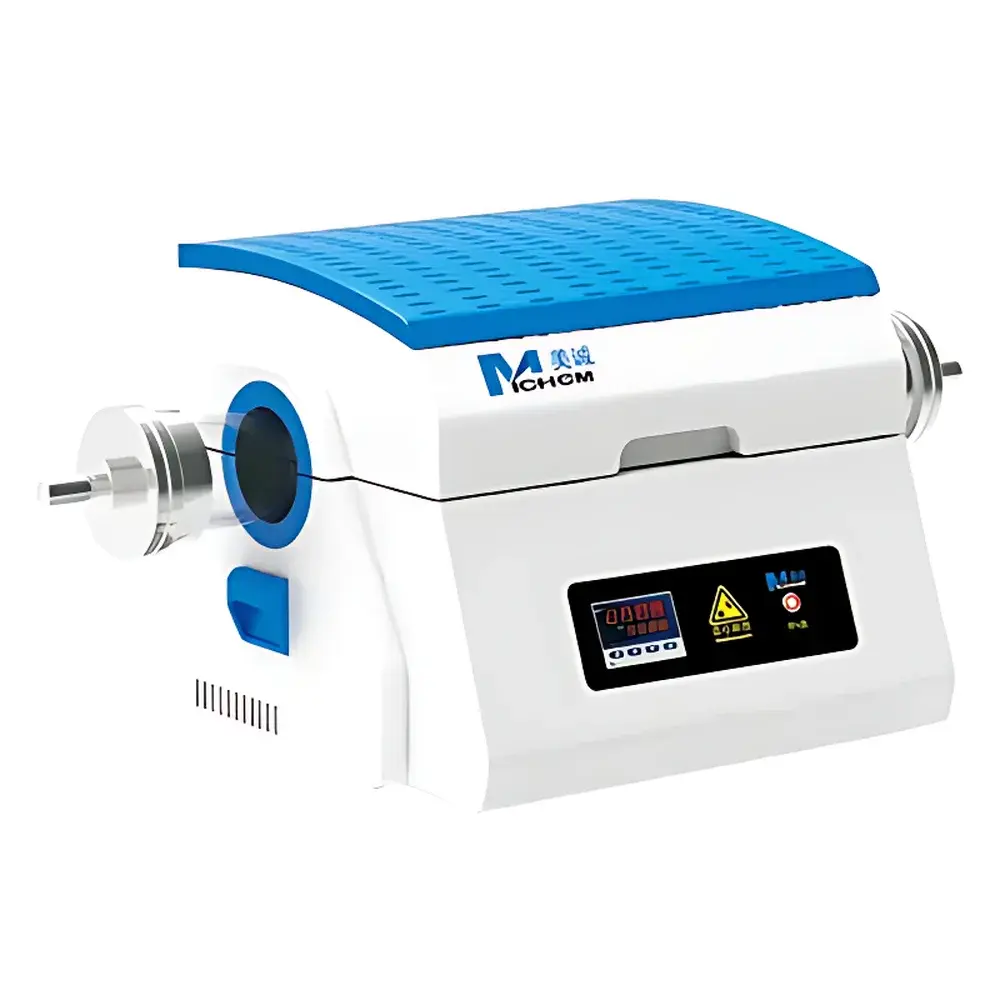
MICHEM TF12 Series Vacuum & Atmosphere Tube Furnace
| Brand | MICHEM |
|---|---|
| Origin | Beijing, China |
| Model | TF12 Series |
| Instrument Type | Horizontal Tube Furnace |
| Max Temperature | 1200 °C |
| Temperature Control Accuracy | ±1 °C |
| Max Power | 2500 W |
| Heating Time to Max Temp | ≤50 min |
| Heating Element | HRE High-Temperature Alloy |
| Internal Dimensions | Ø60×54×1000 mm / Ø80×74×1000 mm / Ø100×94×1000 mm |
Overview
The MICHEM TF12 Series Vacuum & Atmosphere Tube Furnace is a precision-engineered horizontal high-temperature thermal processing system designed for controlled-atmosphere and vacuum-based heat treatment, sintering, annealing, calcination, and material synthesis in research laboratories and quality control environments. Unlike conventional muffle furnaces, the TF12 employs a sealed quartz or high-purity alumina tube configuration, enabling operation under inert (N₂, Ar), reducing (H₂/N₂), oxidizing (O₂), or vacuum conditions (down to 10⁻³ mbar with optional pump integration). Its core thermal architecture utilizes HRE (High Resistance Electrothermal) alloy heating elements wound in optimized helical zones, delivering uniform axial temperature profiles across the hot zone with minimal thermal gradient (<±3 °C over 200 mm at 1200 °C). The furnace chamber is insulated with multi-layer ceramic fiber modules rated for continuous service at 1200 °C, ensuring low external surface temperature (<65 °C after 1 h at max temp) and high thermal efficiency—critical for energy-conscious labs operating under ISO 50001-aligned protocols.
Key Features
- Precision Temperature Control: Equipped with a 30-segment programmable PID controller (PP3 series) offering ±1 °C setpoint accuracy and 0.2% full-scale stability; supports ramp-hold-soak profiles with user-defined heating/cooling rates (0.1–20 °C/min).
- Vacuum & Gas Compatibility: Standard flanged quartz tube (OD 60/80/100 mm) with stainless-steel end caps, VCR or KF fittings, and integrated gas inlet/outlet ports; compatible with mechanical vacuum pumps and mass flow controllers (MFCs) for precise atmosphere regulation.
- Robust Thermal Architecture: Dual-zone heating design ensures axial uniformity; HRE alloy elements provide extended service life (>3000 h at 1200 °C) and resistance to thermal cycling fatigue.
- Safety-Certified Operation: Integrated safety interlocks include over-temperature cutoff (independent thermocouple), door-open power disconnect, and real-time element resistance monitoring to prevent dry-run failure.
- Energy-Efficient Design: Ceramic fiber insulation (≥140 mm thickness) reduces standby heat loss by >40% versus refractory brick alternatives; typical power consumption: 2.5 kW for Ø60 mm configuration, scalable to 6 kW for Ø100 mm units.
- Modular Physical Configuration: Three standard internal dimensions support flexible sample loading: Ø60×54×1000 mm (6 L effective volume), Ø80×74×1000 mm (9 L), and Ø100×94×1000 mm (12 L); all models feature adjustable tube support rails and centering fixtures.
Sample Compatibility & Compliance
The TF12 Series accommodates crucibles, boats, and substrates made from alumina, quartz, silicon carbide, and molybdenum—compatible with powders, thin films, fibers, and bulk metallic/ceramic specimens up to 100 g per run. It meets essential laboratory safety and performance benchmarks including IEC 61000-6-3 (EMC emission limits), UL 61010-1 (electrical safety), and conforms to ASTM E1142 (standard terminology for thermal analysis) and ISO/IEC 17025:2017 clause 6.4.7 regarding equipment suitability for intended use. When operated with validated temperature mapping and calibrated Type S thermocouples traceable to NIST standards, the system supports GLP/GMP-compliant thermal validation protocols—including IQ/OQ documentation packages for regulated QC labs.
Software & Data Management
Optional RS485/Modbus RTU or USB-C interface enables integration with LabVIEW™, MATLAB®, or custom SCADA systems for remote parameter setting, real-time temperature logging (1 Hz resolution), and alarm-triggered data export. The PP3 controller stores up to 30 independent programs with timestamped execution logs, supporting audit-ready record retention per FDA 21 CFR Part 11 requirements when paired with electronic signature-capable host software. All thermal profiles are exportable as CSV files for post-processing in Excel® or statistical process control (SPC) platforms.
Applications
- Controlled-atmosphere sintering of Li-ion battery cathode precursors (e.g., NMC, LFP) under Ar/H₂ mixtures
- Vacuum annealing of semiconductor wafers and MEMS devices to eliminate interstitial oxygen
- Thermal gravimetric analysis (TGA) coupling via integrated balance feedthrough ports
- Graphitization of carbon nanomaterials at 1100–1200 °C under inert purge
- Pre-oxidation of zirconia-toughened alumina (ZTA) composites for microstructural stabilization
- Calibration source verification for high-temperature pyrometers (validatable to ITS-90 reference points)
FAQ
What vacuum level can the TF12 achieve without auxiliary pumping?
The base configuration maintains static vacuum integrity (~10⁻¹ mbar) via O-ring sealed flanges; for active vacuum operation down to 10⁻³ mbar, a two-stage rotary vane pump (e.g., Edwards RV8) is recommended and easily integrated via KF25 port.
Is the furnace suitable for hydrogen atmosphere processing?
Yes—when equipped with H₂-rated seals, leak-tested tubing, and optional flame arrestors; maximum safe H₂ concentration is 10% in N₂ per NFPA 55 guidelines.
Can I upgrade the controller to support Ethernet communication?
The PP3 controller supports optional Ethernet-to-Modbus gateway modules (e.g., Moxa EDS-205A) for TCP/IP integration into facility-wide lab networks.
What is the expected service life of the HRE heating elements at 1200 °C?
Under continuous operation with proper thermal cycling (≤3 cycles/day), HRE elements maintain nominal resistance and uniformity for ≥3000 hours; annual calibration drift remains <±0.5 °C when using dual-sensor redundancy.
Does MICHEM provide IQ/OQ documentation templates?
Yes—validated protocol templates aligned with ISO/IEC 17025 and ASTM E2877 are supplied with each unit, including temperature mapping grid definitions, sensor calibration certificates, and preventive maintenance checklists.



