
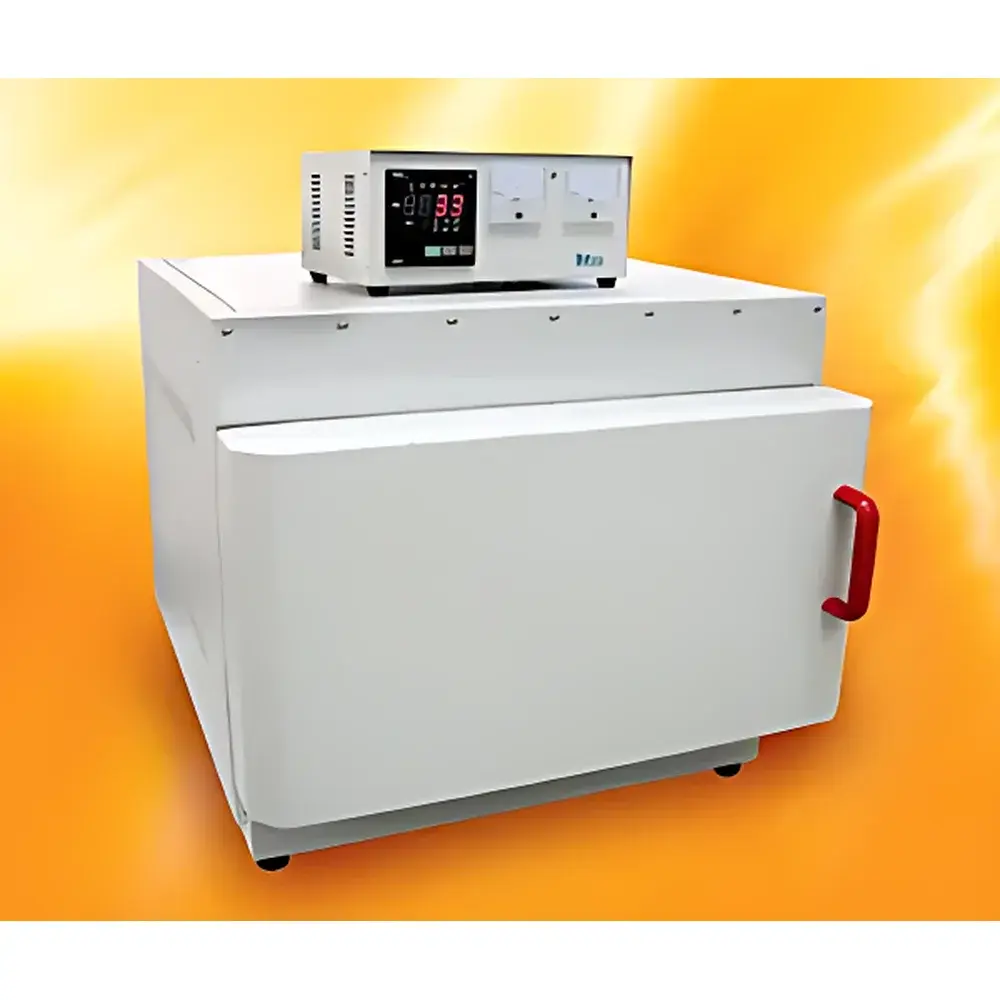
MICHEM TM1700 Series Ceramic Fiber Muffle Furnace
| Brand | MICHEM |
|---|---|
| Origin | Beijing, China |
| Model | TM1700 Series |
| Furnace Type | Box-Type Muffle Furnace |
| Max Operating Temperature | 1700 °C |
| Temperature Uniformity | ±1 °C (at 1700 °C, steady state) |
| Heating Element | Silicon-Molybdenum (MoSi₂) Rods |
| Internal Chamber Volume | 4 L (160×170×150 mm), 6 L (160×250×150 mm), or 9 L (200×300×150 mm) |
| Max Power Input | 7.5 kW |
| Ramp Time to 1700 °C | ≤90 min (from ambient) |
| Insulation Material | High-Purity Alumina-Silica Ceramic Fiber (density: ~128 kg/m³) |
| External Surface Temp (at 1000 °C hold) | ≤60 °C |
| Control System | 30-Step Programmable PID Controller (PP3 series) with ramp-soak profiling, 0.2% FS stability, 9999 min/step timer |
| Safety Features | Automatic power cutoff upon door opening, over-temperature cutout, grounded chassis |
| Compliance | Designed for GLP-compliant thermal processing |
Overview
The MICHEM TM1700 Series Ceramic Fiber Muffle Furnace is a high-temperature box-type furnace engineered for precision thermal processing in analytical, metallurgical, materials science, and quality control laboratories. It operates on the principle of resistive heating via silicon-molybdenum (MoSi₂) rods embedded in a low-thermal-conductivity, high-purity ceramic fiber insulation matrix. This architecture enables stable, repeatable operation at up to 1700 °C — among the highest continuous operating temperatures achievable in commercially available benchtop muffle furnaces. The furnace is not intended for direct flame contact or reducing atmospheres; it is optimized for air-atmosphere oxidizing or inert-gas purged applications including ashing, calcination, sintering, heat treatment (annealing, tempering), and high-temperature calibration source duties. Its lightweight construction (e.g., 94 kg for the 6 L model), rapid thermal response, and low external surface temperature reflect an integrated design focused on energy efficiency, operator safety, and long-term thermal stability (<±2 °C drift over 4-hour dwell at 1700 °C).
Key Features
- Ultra-high temperature capability: Certified continuous operation at 1700 °C with MoSi₂ heating elements rated for >2000 h service life under cyclic thermal stress.
- Ceramic fiber insulation: 140 mm thick alumina-silica fiber lining (≥95% Al₂O₃/SiO₂) provides thermal conductivity <0.12 W/m·K at 1000 °C, minimizing standby losses and enabling rapid cool-down rates (~15 °C/min from 1700 °C to 400 °C).
- Precision programmable control: PP3-series 30-segment PID controller supports ramp rates from 0.1 to 30 °C/min, soak times up to 9999 minutes per step, and real-time deviation logging with ±0.2% full-scale accuracy.
- Thermal uniformity engineering: Dual-zone heating configuration and symmetrical element placement ensure ±5 °C uniformity across the working zone (per ASTM E220 calibration methodology) at 1700 °C.
- Integrated safety architecture: Door-interlocked main contactor, redundant over-temperature protection (mechanical and digital), Class I grounding, and UL-listed terminal blocks compliant with IEC 61000-6-3 EMC requirements.
- Energy-optimized electrical design: 220 V/25 A (6 L) or 380 V/16 A (9 L) input configurations minimize line current draw; measured wall-to-chamber efficiency exceeds 42% at 1700 °C (vs. <28% for traditional brick-lined equivalents).
Sample Compatibility & Compliance
The TM1700 accommodates crucibles and sample holders made from high-purity alumina (Al₂O₃), silicon carbide (SiC), platinum, or molybdenum — all compatible with oxidizing atmospheres up to 1700 °C. It is unsuitable for use with carbon-containing materials in air above 500 °C due to MoSi₂ oxidation kinetics. For regulatory traceability, the furnace supports audit-ready operation: temperature profiles are timestamped and exportable via RS485/Modbus RTU interface; controller firmware includes configurable electronic signature fields for GLP/GMP workflows. While not FDA 21 CFR Part 11–certified out-of-the-box, its data logging architecture meets foundational requirements for validation (IQ/OQ/PQ), and it has been deployed in laboratories performing ASTM C114 (cement analysis), ISO 5660-1 (fire calorimetry), and ISO 11358 (polymer thermogravimetry) protocols.
Software & Data Management
The PP3 controller features a backlit LCD interface with intuitive menu navigation and real-time graphing of setpoint vs. actual temperature. Optional PC connectivity (via USB-to-RS485 adapter) enables integration with MICHEM’s free ThermLog Pro software — a Windows-based application supporting batch profile import/export, CSV-formatted session reports, trend analysis, and deviation alerts. All logged data include ISO 8601 timestamps, furnace ID, operator ID field, and checksum-verified integrity flags. Raw temperature readings are sampled at 1 Hz and stored in non-volatile memory with 10-year retention capability. Firmware updates are delivered via signed binary packages to prevent unauthorized modification.
Applications
- Quantitative ash content determination per AOAC 942.05 and EPA Method 1694 (pharmaceutical, environmental, food matrices).
- High-temperature sintering of advanced ceramics (ZrO₂, Si₃N₄, AlN) requiring precise dwell control and minimal thermal gradient.
- Calibration of secondary thermocouples (Type B, S, R) and infrared pyrometers using fixed-point references (e.g., Pd-C, Co-C, Re-C).
- Metallurgical flux fusion for XRF sample preparation (ASTM E1338, ISO 22037).
- Thermal aging studies of aerospace composites and refractory coatings under controlled oxidative conditions.
- Pre-treatment of catalyst supports prior to impregnation or activation steps in heterogeneous catalysis R&D.
FAQ
What atmosphere options are supported?
The TM1700 operates in ambient air by default. Optional quartz tube inserts with flanged gas inlet/outlet ports enable inert (N₂, Ar) or weakly reducing (5% H₂/N₂) atmospheres. Vacuum operation is not supported.
Is the furnace suitable for GMP-regulated production environments?
Yes — when paired with documented IQ/OQ protocols and configured with optional data-logging accessories, it meets baseline requirements for thermal process validation under EU Annex 15 and PIC/S PI 007-1.
How often does the MoSi₂ heating element require replacement?
Under typical laboratory cycling (≤3 cycles/day, 1700 °C × 2 h), mean time between failures exceeds 2000 hours. Visual inspection every 500 hours is recommended.
Can the internal chamber dimensions be customized?
Standard configurations are fixed per model (TM0417/TM0617/TM0917). Custom cavity geometries are available under OEM agreement with minimum order quantity.
Does the furnace include NIST-traceable temperature calibration documentation?
Each unit ships with a factory calibration certificate referencing ITS-90 standards, verified at three points (1000 °C, 1400 °C, 1700 °C) using dual-reference thermocouples calibrated to NIST SRM 1749.



