
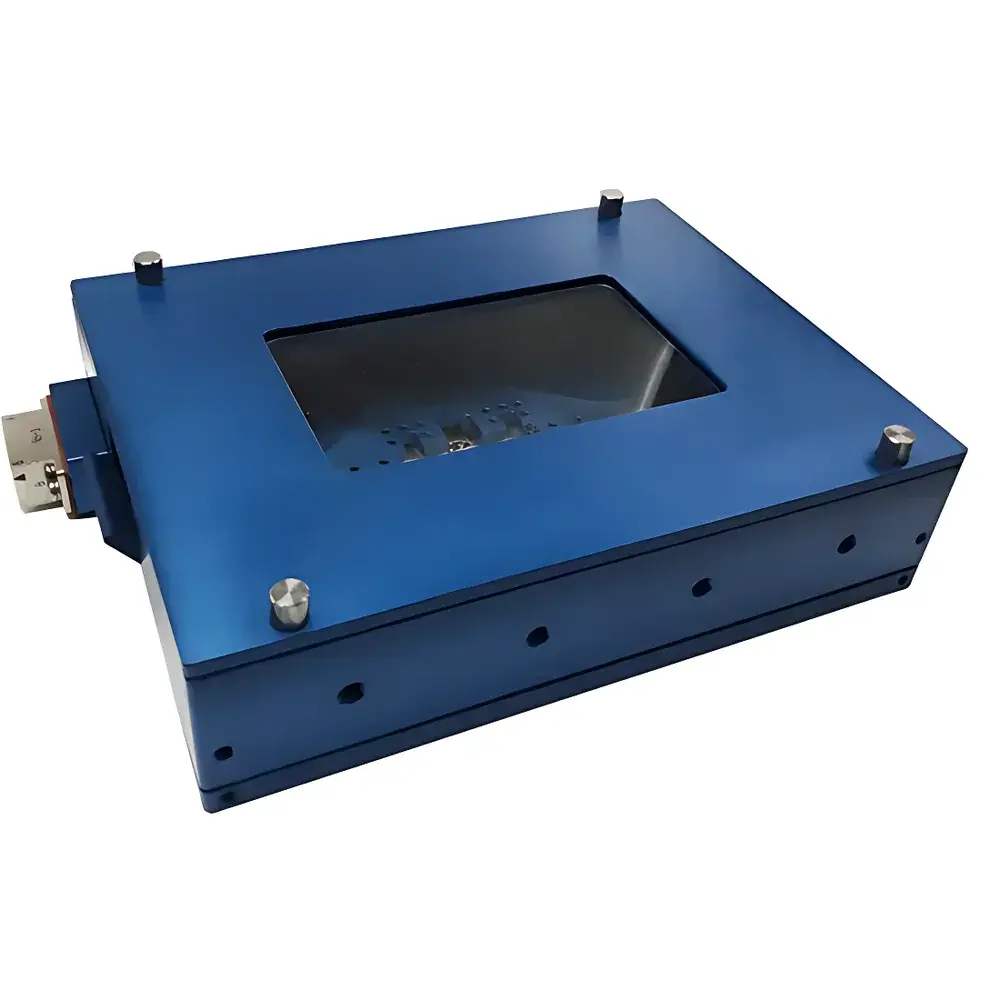
Microblox ECO-M Microfluidic Cell Culture Environmental Chamber
| Brand | Microblox |
|---|---|
| Model | ECO-M |
| Category | CO₂ Incubator for Microfluidic Platforms |
| Origin | Beijing, China |
| Temperature Range | Ambient to 50 °C (customizable up to 65 °C) |
| Humidity Range | 5–95% RH |
| Internal Dimensions | 152 × 110 × 32 mm (L × W × H) |
| Chip Compatibility | Standard microscope slides (75 × 25 × 2 mm), dual 45 × 15 × 2 mm formats, PDMS/glass/plastic chips |
| Heating Method | Transparent metal-oxide conductive glass (uniform thermal distribution) |
| Observation Windows | Bottom optical glass (0.7–1.0 mm thick, customizable), top quartz or heated glass |
| Fluidic Interface | 1/16″ stainless steel ferrule ports |
| Gas Interface | Push-to-connect fittings (CO₂/O₂/N₂ mixing capable) |
| Electrical Interface | Quick-lock IEC 60320 C14 input |
| Sensor Accuracy | ±0.1 °C (PT1000 RTD) |
| Optional CO₂ Control | 0–15% v/v, flow rate 0.6–1.0 L/min |
Overview
The Microblox ECO-M Microfluidic Cell Culture Environmental Chamber is an engineered platform designed to maintain precise, spatiotemporally resolved physiological conditions directly on the microscope stage during live-cell microfluidic experiments. Unlike conventional benchtop CO₂ incubators—whose large thermal mass and slow response times preclude real-time environmental modulation—the ECO-M integrates localized temperature regulation, dynamic humidity control, and optional gas-phase composition management within a compact, optically optimized enclosure. Its core operating principle relies on resistive heating via transparent indium tin oxide (ITO)-coated glass, enabling uniform thermal distribution (±0.3 °C typical spatial gradient across chamber floor) while preserving high light transmission (>88% at 400–1000 nm) for phase contrast, DIC, fluorescence, and transmitted-light imaging. The chamber operates as a closed-loop environmental module, interfacing seamlessly with external controllers for temperature (PID-regulated), humidity (capacitive sensor feedback), and gas blending (mass flow controllers). It conforms to ISO 13485 design principles for in vitro diagnostic support equipment and supports GLP-compliant experimental traceability when paired with compliant data logging systems.
Key Features
- Stage-integrated form factor: External dimensions of 180 × 138 × 42 mm enable direct placement on inverted microscope stages without obstructing objective clearance or Köhler illumination paths.
- Optimized optical access: Bottom observation window fabricated from precision-ground optical glass (standard 0.7 mm or 1.0 mm thickness; thinner options available upon request); top window configurable as fused quartz or heated ITO glass for top-illumination compatibility.
- Modular fluidic integration: Six standardized 1/16″ Swagelok-compatible ports support independent inlet/outlet routing for media perfusion, waste aspiration, and reagent injection—enabling multi-channel laminar flow control in organ-on-chip assays.
- Secure chip retention system: Interchangeable aluminum alloy clamping fixtures accommodate standard 75 × 25 × 2 mm glass slides or dual 45 × 15 × 2 mm microfluidic devices; clamps feature self-locking cam mechanisms for vibration-resistant fixation during long-term time-lapse acquisition.
- Corrosion-resistant architecture: Anodized 6061-T6 aluminum housing provides mechanical stability and chemical resistance against ethanol, isopropanol, and common cell culture disinfectants.
- Rapid interconnect ecosystem: Push-to-connect gas fittings (ISO 8573-1 Class 2 certified), quick-lock power interface (IEC 60320 C14), and keyed electrical connectors minimize setup time and reduce risk of misalignment or leakage.
Sample Compatibility & Compliance
The ECO-M chamber supports a broad range of microfabricated substrates including polydimethylsiloxane (PDMS), borosilicate glass, cyclic olefin copolymer (COC), and thermoplastic elastomer (TPE) chips. Its low-profile internal volume (53.5 mL) ensures rapid equilibration (<90 s for ±0.5 °C setpoint change) and minimal reagent consumption—critical for precious primary cell cultures and patient-derived organoid models. The system meets electromagnetic compatibility requirements per EN 61326-1:2013 and is CE-marked for laboratory use. While not classified as a medical device under EU MDR 2017/745, it is validated for use in ISO/IEC 17025-accredited laboratories performing cell-based assay development aligned with USP , ASTM F2971-22 (microphysiological systems), and OECD TG 497 (in vitro skin sensitization testing).
Software & Data Management
The ECO-M operates independently or synchronously with third-party control platforms via analog (0–10 V) and digital (RS-485 Modbus RTU) interfaces. When integrated with Microblox’s optional Environmental Control Hub (ECH-2), users gain access to timestamped, audit-trail-enabled logging of temperature, humidity, and CO₂ concentration at 1 Hz resolution—fully compliant with FDA 21 CFR Part 11 requirements for electronic records and signatures. All sensor data are stored in .csv and HDF5 formats, supporting post-hoc correlation with time-lapse image metadata (e.g., ImageJ ROI timestamps, NIS-Elements acquisition logs). No proprietary software installation is required for basic operation; configuration and monitoring are accessible through browser-based UI or LabVIEW/VB.NET SDKs.
Applications
- Real-time monitoring of endothelial barrier function under shear stress and inflammatory cytokine gradients.
- Long-duration (>72 h) neuronal axon guidance assays with on-chip gradient generation and simultaneous calcium imaging.
- High-content drug screening in tumor spheroid-on-chip models under controlled hypoxia (5% O₂) and hypercapnia (10% CO₂).
- Developmental biology studies tracking embryoid body differentiation under dynamically cycled temperature profiles (e.g., circadian-mimetic 37 °C ↔ 35.5 °C transitions).
- Immuno-oncology co-cultures evaluating T-cell infiltration kinetics across engineered stromal barriers under physiologically relevant humidity (60–70% RH) to prevent evaporation-induced osmotic shock.
FAQ
Can the ECO-M be used with upright microscopes?
Yes—when mounted on a custom dovetail adapter plate (optional accessory), the chamber maintains full optical path compatibility with water-immersion objectives and transmitted-light condensers.
Is CO₂ calibration traceable to NIST standards?
The optional integrated CO₂ sensor (Vaisala CARBOCAP® GMP252) includes factory calibration certificate with NIST-traceable uncertainty values (±0.15% absolute at 5% CO₂). Field recalibration is supported using certified gas standards.
What is the maximum recommended media flow rate through the chamber?
For stable thermal equilibrium and laminar flow integrity, we recommend ≤15 µL/min per inlet channel when using standard 100 µm-height microchannels; higher rates require active heat compensation via external Peltier modules.
Does the chamber support sterilization protocols?
The aluminum housing and glass windows tolerate 70% ethanol wipe-down and UV-C (254 nm, 30 mJ/cm²) exposure; PDMS chips must be sterilized separately via plasma treatment or autoclaving prior to loading.
How is temperature uniformity verified during validation?
Uniformity is assessed using a 9-point thermocouple grid (ASTM E2207-20 Annex A1 protocol) mapped across the chamber floor at steady-state; typical deviation is ≤±0.25 °C at 37 °C setpoint.




