
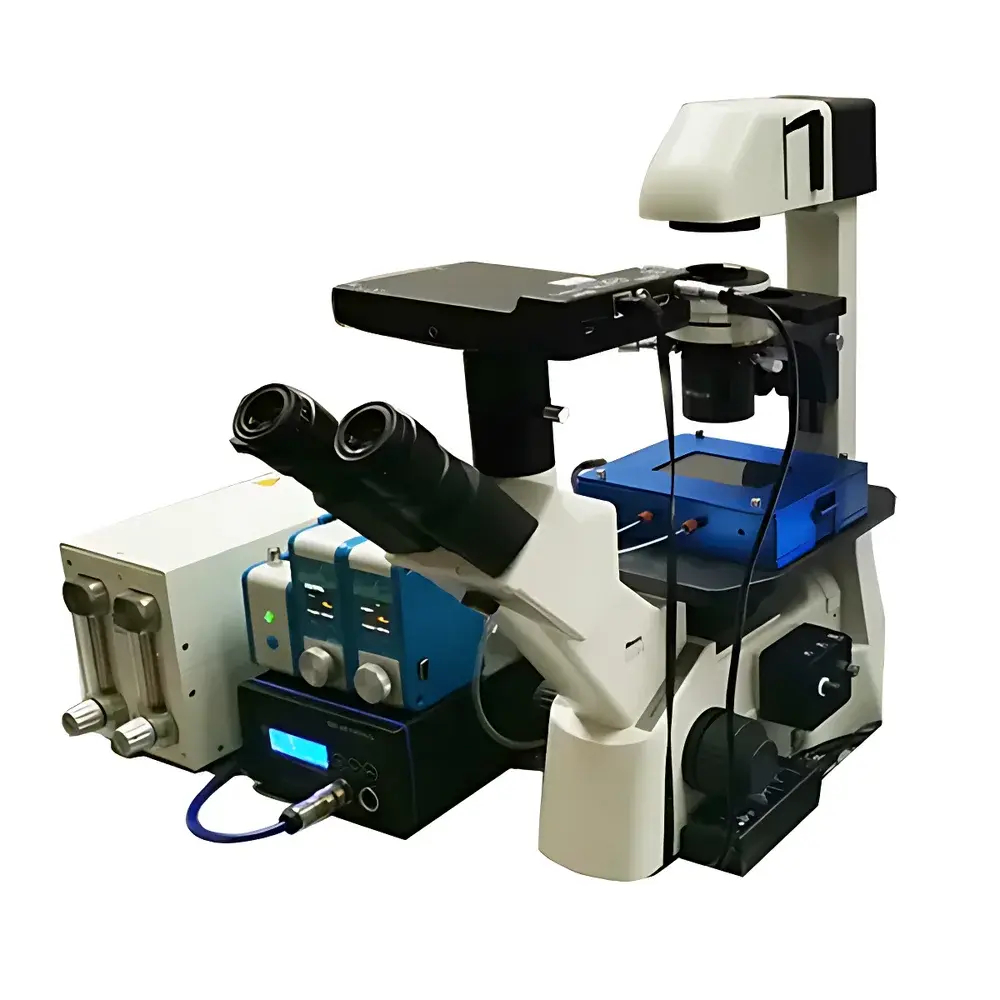
Microblox-OOC Organ-on-a-Chip (OOC) Microfluidic Cell Culture System
| Brand | Microblox |
|---|---|
| Origin | France |
| Model | Microblox-OOC |
| Instrument Type | Multifunctional Microfluidic Perfusion Platform |
| Sample Compatibility | Standard 1/16" tubing, microscope-compatible chamber formats |
| Temperature Control Range | Ambient to 45 °C (±0.2 °C stability) |
| Humidity Control | Optional integrated module (20–95% RH, ±3% accuracy) |
| Gas Control | Manual air/CO₂ mixing or optional precision gas mixer (N₂/O₂/CO₂/air, ±0.5% flow accuracy) |
| Flow Rate Range | 10 nL/min – 5 mL/min (with selectable pressure or syringe pump actuation) |
| Positioning Precision | N/A (modular, non-robotic fluidic routing) |
| Cleaning Protocol | Solvent-compatible needle flush with programmable dwell time |
| Regulatory Compliance | Designed for GLP-compliant workflows |
Overview
The Microblox-OOC Organ-on-a-Chip (OOC) Microfluidic Cell Culture System is an engineered platform for physiologically relevant in vitro modeling of human organ-level functions using microfluidic cell culture technology. It operates on the principle of controlled laminar perfusion through microstructured polymeric chips—enabling dynamic mechanical cues (e.g., cyclic strain, shear stress), spatiotemporal chemical gradients, and precise environmental regulation (temperature, humidity, gas composition) essential for long-term maintenance of polarized epithelial monolayers, 3D tissue constructs, and multicellular organotypic models. Unlike conventional static well-plate systems, the Microblox-OOC platform replicates interstitial flow, barrier integrity, and tissue-tissue crosstalk observed in vivo—making it suitable for translational applications including drug absorption screening, toxicity assessment, disease modeling, and mechanistic studies of barrier function.
Key Features
- Modular architecture with self-locking snap-fit connectors and push-to-connect fluidic interfaces—enabling rapid reconfiguration without tools or adhesives.
- Integrated Eco-M environmental control unit featuring a transparent, microscope-compatible incubation chamber with PID-controlled heating (±0.2 °C), optional humidity regulation (20–95% RH), and configurable gas inlet ports for manual or automated air/CO₂/N₂/O₂ blending.
- High-resolution microfluidic perfusion: compatible with both pressure-driven and syringe-pump-based actuation; supports real-time flow monitoring via calibrated thermal mass flow sensors (resolution down to 7.5 nL/min).
- Expandable fluid handling: multi-port solenoid valves (up to 10-way selection) enable automated sequential delivery, recirculation, and bolus injection of culture media, drugs, or cytokines—fully programmable via LabVIEW or Python API.
- Dual-mode operation: supports both open-chamber observation (for high-NA microscopy) and sealed perfusion (for extended time-lapse imaging under physiological conditions).
- Interchangeable chip interface: standardized footprint accommodates industry-leading OOC devices—including BE-Transflow (dual-chamber, porous membrane-based), BE-Gradient (electrochemical gradient-enabled 3D culture), and Micronit multilayer chips with replaceable membrane inserts.
Sample Compatibility & Compliance
The Microblox-OOC system is validated for use with primary human cells, iPSC-derived lineages (e.g., hepatocytes, cardiomyocytes, intestinal enteroids), and co-cultures across epithelial–endothelial, epithelial–stromal, and neurovascular configurations. Chip formats support 2D monolayer, air–liquid interface (ALI), and scaffold-free 3D organoid perfusion. All hardware components comply with IEC 61000-6-3 (EMC) and IEC 61010-1 (safety). The platform is designed to meet requirements for GLP-compliant study execution, including full traceability of environmental logs, flow profiles, and valve actuation sequences. When paired with the optional Aria Controller, the system supports 21 CFR Part 11–compliant electronic records—including user authentication, audit trail generation, and immutable data archiving.
Software & Data Management
System operation is managed through the Microblox Control Suite—a cross-platform application built on Qt and Python that provides intuitive graphical workflow configuration, real-time sensor visualization (temperature, pressure, flow), and event-triggered automation (e.g., “inject 100 nL upon detection of TEER drop >15%”). Raw sensor data are exported in HDF5 or CSV format with ISO 8601 timestamps and SI-unit metadata. Integration with third-party imaging platforms (e.g., Zeiss ZEN, Nikon NIS-Elements) is supported via TTL synchronization and TCP/IP command relay. For advanced users, a documented RESTful API and Python SDK allow custom pipeline development—including integration with ML-driven phenotypic analysis tools.
Applications
- Pharmacokinetic/pharmacodynamic (PK/PD) modeling: quantitative assessment of compound permeability across intestinal, blood–brain, or placental barriers.
- Toxicology screening: real-time monitoring of mitochondrial respiration, barrier integrity (TEER), and cytokine release under chronic exposure.
- Disease pathogenesis: modeling of inflammatory bowel disease (IBD), non-alcoholic steatohepatitis (NASH), or pulmonary fibrosis using patient-derived cells.
- Stem cell differentiation: spatially controlled morphogen delivery to guide iPSC patterning into region-specific organoids.
- Immunooncology: T-cell trafficking assays across tumor–endothelium interfaces under chemokine gradients.
- Regulatory science: generation of non-animal data packages aligned with OECD TG 497 (skin sensitization) and draft EMA guidelines on complex in vitro models.
FAQ
Is the Microblox-OOC system compatible with inverted and upright microscopes?
Yes—the Eco-M environmental chamber features optical-grade acrylic sidewalls and a removable top plate, enabling compatibility with standard 4× to 63× objectives on both inverted and upright platforms.
Can I integrate my existing microfluidic chips with this system?
Absolutely—chip mounting is standardized to ANSI/SLAS footprint specifications; custom adapter plates are available for non-standard formats.
Does the system support long-term culture (>7 days)?
Yes—validated for uninterrupted perfusion over 21 days using sterile-filtered media reservoirs and gas-permeable tubing; evaporation loss is minimized via humidity control and sealed reservoir caps.
What level of technical support is provided for method development?
Microblox offers application engineering support—including protocol optimization, chip selection guidance, and data interpretation workshops—as part of enterprise licensing agreements.
Are validation documents (IQ/OQ/PQ) available?
Yes—comprehensive qualification packages—including installation, operational, and performance qualification protocols—are supplied upon request and align with ISO/IEC 17025 and ASTM E3075 standards.
Related Products




