
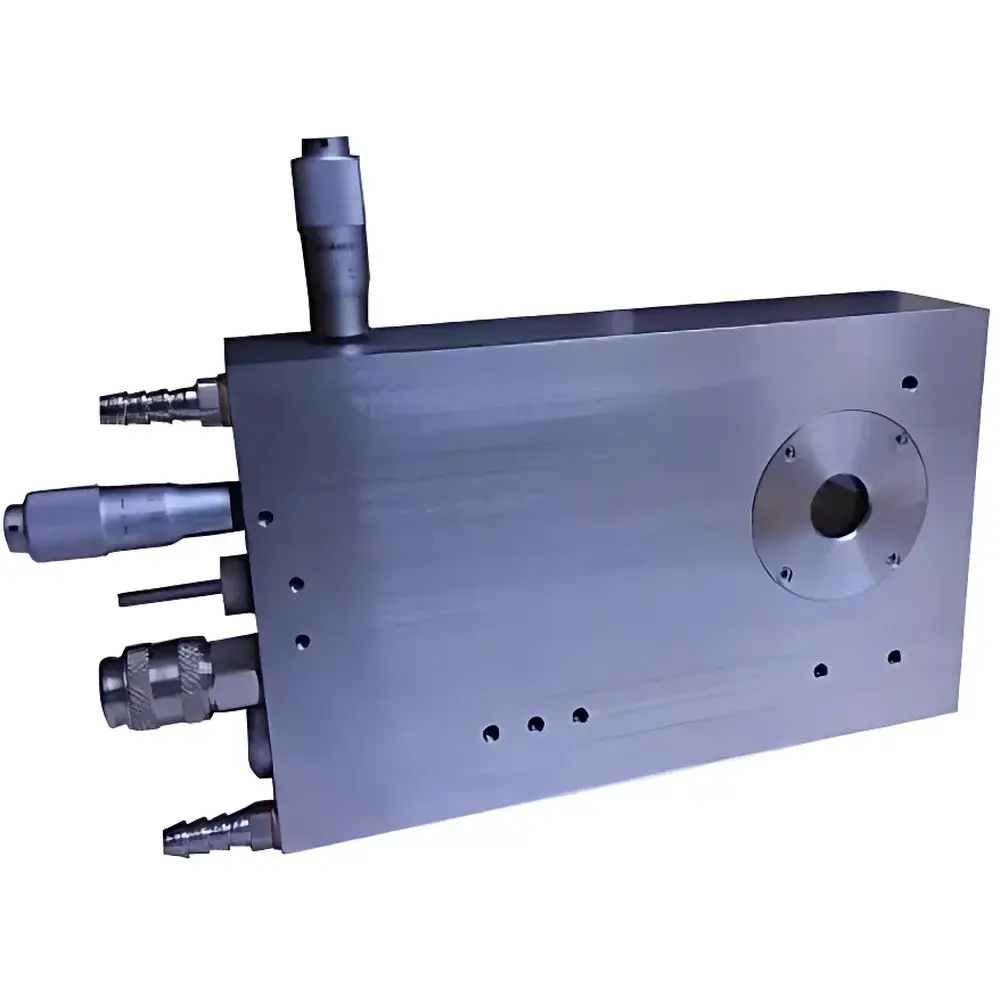
MicrOptik MHCS400-VS High-Performance Heated and Cooled Stage for Metallurgical Microscopy
| Brand | MicrOptik |
|---|---|
| Origin | Netherlands |
| Model | MHCS400-VS |
| Temperature Range | −190 °C to 400 °C |
| Temperature Resolution | 0.1 °C |
| Temperature Stability at 100 °C | ±0.1 °C |
| Max Heating Rate | 100 °C/min |
| Max Cooling Rate | 60 °C/min |
| Minimum Heating Rate | 0.1 °C/min |
| Control Method | PID/PID-Switching |
| Sensor Type | RTD (Pt100) |
| Aperture | 5 mm (transmission), 30 mm (reflection) |
| Sample Area | 40 mm × 40 mm |
| Chamber Height | 8.5 mm |
| Vacuum/Gas Port Options | KF10, KF16, or 1/8″ Swagelok (customizable) |
| Overall Dimensions | 185 mm × 102 mm × 37 mm |
| Integrated XY Precision Stage | Protable, coaxial micrometer-driven |
| Controller | MTDC600 Programmable Temperature Controller (software- and manual-operable) |
| Optional Cryogenic Support | LN2-SYS Liquid Nitrogen Cooling System |
Overview
The MicrOptik MHCS400-VS is a high-precision, dual-mode thermal stage engineered specifically for integration with metallurgical microscopes and advanced optical characterization systems. Designed to enable in situ microstructural analysis under precisely controlled thermal conditions, it operates across an exceptionally broad temperature range—from cryogenic −190 °C to elevated 400 °C—while maintaining sub-degree thermal stability and repeatability. Its core architecture incorporates a thermally isolated chamber with integrated resistive heating elements and optional liquid nitrogen cooling pathways, enabling both rapid thermal ramping and ultra-stable isothermal holds. The stage utilizes a hermetically sealed vacuum/gas-compatible enclosure, supporting experiments under inert atmospheres (e.g., N₂, Ar), reducing oxidation during high-temperature metallographic observation, or maintaining sterility for hybrid materials studies. Its mechanical design features a rigid aluminum alloy chassis with internal thermal shielding (“thermal shell”) to minimize thermal crosstalk and ensure spatial uniformity across the 40 mm × 40 mm sample zone—critical for quantitative grain growth, phase transformation, or interfacial reaction studies.
Key Features
- Ultra-wide operational range: −190 °C to +400 °C, validated for continuous use in ambient air, inert gas, or high-vacuum environments (down to 10⁻⁶ mbar with compatible pumping)
- MTDC600 programmable temperature controller with dual-mode PID/PID-switching algorithm, delivering ±0.1 °C stability at 100 °C and 0.1 °C resolution over full scale
- Integrated coaxial XY micro-positioning stage with 10 µm repeatability and vernier-scale readouts, enabling precise navigation of regions of interest without stage re-alignment
- Modular optical access: 5 mm central aperture for transmission-mode illumination (e.g., polarized light, DIC), plus 30 mm peripheral opening optimized for reflected-light metallurgical imaging
- Quick-release vacuum/gas interface using Camozzi-style fast couplers; standard port configurations include KF10, KF16, and 1/8″ Swagelok, with custom flange options available upon request
- Thermally decoupled mounting architecture supporting horizontal, vertical, or inverted installation on upright or inverted metallurgical microscopes, spectroscopic platforms, or custom optical benches
- Optional accessories: LN2-SYS cryogenic delivery module, water-cooled base plate for extended high-temperature operation, purge gas manifold with mass flow control, and removable top cover for rapid sample exchange
Sample Compatibility & Compliance
The MHCS400-VS accommodates standard metallurgical specimens—including polished metallographic mounts (up to 40 mm square), thin-film substrates, sintered ceramics, and encapsulated biological-inorganic composites—without requiring specialized holders. Its open-top design and removable cover allow direct placement of samples mounted on standard microscope slides or stubs. For regulated environments, the system supports GLP-compliant workflows: the MTDC600 controller logs timestamped temperature profiles with audit-trail capability (via optional USB/RS-485 interface), and firmware complies with IEC 61000-6-2/6-4 for electromagnetic compatibility. While not certified as medical device hardware, its construction meets ISO 14644-1 Class 5 cleanroom compatibility when used with filtered purge gas. No hazardous substances are employed per RoHS Directive 2011/65/EU.
Software & Data Management
The MTDC600 controller provides native support for LabVIEW™, Python (PyVISA), and MATLAB® via SCPI command set over USB or RS-485. A Windows-based configuration utility enables multi-segment ramp/soak programming, real-time graphing of sensor feedback, and export of CSV-formatted thermal logs with millisecond time stamps. All temperature setpoints, actual readings, and error flags are accessible through ASCII protocol for integration into LIMS or MES platforms. Firmware supports configurable alarm thresholds, automatic shutdown on sensor fault, and non-volatile memory retention of last-used parameters after power cycle. Data integrity is preserved through CRC-16 checksum validation on all serial communications.
Applications
- In situ observation of solid-state phase transformations (e.g., austenite → martensite, α ↔ β Ti alloys) during controlled heating/cooling cycles
- Real-time assessment of thermal expansion mismatch and interfacial delamination in coated systems (e.g., thermal barrier coatings on Ni-superalloys)
- High-resolution monitoring of recrystallization kinetics and grain boundary migration in cold-rolled or additively manufactured metals
- Correlative microscopy combining optical contrast (brightfield/darkfield/polarized) with simultaneous thermal profiling for failure analysis
- Material screening under simulated service conditions—e.g., solder joint reliability testing, brazing process optimization, or refractory ceramic sintering behavior
- Hybrid studies coupling thermal stimuli with Raman, FTIR, or photoluminescence spectroscopy via side-access optical ports
FAQ
Can the MHCS400-VS be used under high vacuum?
Yes—the stage is rated for operation down to 10⁻⁶ mbar when paired with appropriate vacuum feedthroughs and sealing gaskets; KF16 and CF flange variants are available for UHV applications.
Is the XY positioning stage motorized?
No—the included coaxial micrometer-driven stage is manually operated for maximum mechanical stability and zero electromagnetic interference; motorized versions (e.g., with stepper-driven Z-axis) are available as custom configurations.
What is the thermal uniformity across the 40 mm × 40 mm sample area at 300 °C?
Measured uniformity is ≤ ±0.8 °C over the central 25 mm × 25 mm region under steady-state conditions, verified by calibrated micro-thermocouple mapping.
Does the system support ASTM E112 or ISO 643 grain size analysis protocols?
Yes—its stable thermal platform, large field-of-view apertures, and compatibility with automated stage interfaces enable full compliance with standardized metallographic measurement procedures when integrated with certified image analysis software.
Can the MTDC600 controller be integrated into a PLC-based industrial furnace control network?
Yes—via Modbus RTU over RS-485, the controller supports read/write access to setpoint, PV, status bits, and alarm states, enabling synchronized operation within factory automation architectures.



