
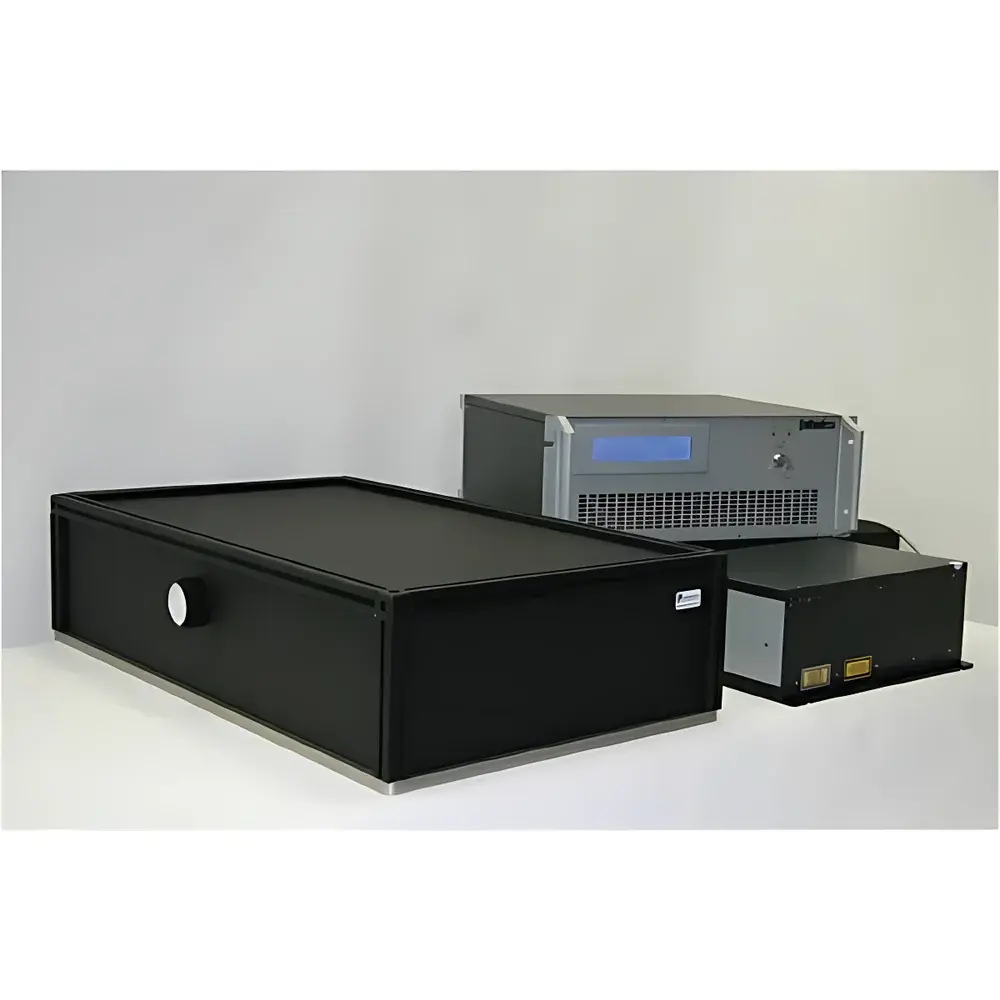
Microtech TPO Terahertz Parametric Oscillator
| Brand | Microtech |
|---|---|
| Origin | USA |
| Manufacturer Type | Authorized Distributor |
| Product Category | Imported |
| Model | TPO |
| Core Component | Femtosecond-Pumped Optical Parametric Oscillator (OPO) with Quasi-Phase-Matched GaAs Crystal |
| THz Pulse Duration | 6–10 ps |
| Repetition Rate | 110 MHz |
| Average Power | >0.3 mW |
| Peak Power | >400 mW |
| Central Frequencies | 0.85 THz or 1.5 THz |
| Spectral Bandwidth | ≥100 GHz |
| Output Configuration | Collimated, Polarized, Free-Space THz Beam |
Overview
The Microtech TPO Terahertz Parametric Oscillator is a compact, turnkey source engineered for high-repetition-rate, broadband terahertz (THz) generation via difference-frequency mixing in a quasi-phase-matched gallium arsenide (GaAs) crystal. It operates as a synchronously pumped optical parametric oscillator (OPO), driven by a mode-locked femtosecond laser operating in the near-infrared (typically ~800 nm or ~1040 nm, depending on system configuration). Unlike photoconductive antenna- or electro-optic-crystal-based THz emitters, the TPO leverages intracavity nonlinear frequency conversion to produce intense, phase-stable THz pulses with inherent timing synchronization to the optical pump—critical for time-domain spectroscopy and pump-probe applications.
Its output spans two selectable central frequencies—0.85 THz and 1.5 THz—with a spectral bandwidth exceeding 100 GHz. This bandwidth falls within key atmospheric transmission windows, enabling robust free-space propagation over meter-scale distances without significant absorption by water vapor. The device delivers transform-limited pulses of 6–10 ps duration at a stable 110 MHz repetition rate, supporting both time-resolved detection schemes and high-duty-cycle averaging for improved signal-to-noise ratio in imaging and spectroscopic measurements.
Key Features
- Quasi-phase-matched GaAs crystal optimized for efficient difference-frequency generation under femtosecond pumping
- Dual-center-frequency operation (0.85 THz / 1.5 THz) with user-selectable tuning via crystal angle or temperature control
- High peak power (>400 mW) enables nonlinear THz detection and coherent control experiments
- Sufficient average power (>0.3 mW) for compatibility with uncooled microbolometer arrays and pyroelectric detectors
- Full temporal synchronization between THz pulses and optical pump—no external delay-stage calibration required
- Integrated beam collimation and polarization control; output compatible with standard THz optics (TPX lenses, silicon hyperhemispheres, wire-grid polarizers)
- Rugged optomechanical housing with kinematic mounts and thermal stabilization for long-term operational stability
Sample Compatibility & Compliance
The TPO is designed for integration into laboratory-scale THz time-domain spectroscopy (THz-TDS) platforms, scanning THz imaging systems, and ultrafast pump-probe setups. Its free-space output interface supports direct coupling to reflection-mode or transmission-mode sample chambers—including cryostats, vacuum cells, and environmental enclosures. The device complies with IEC 61000-6-3 (EMC emission standards) and IEC 60825-1 (laser safety Class 1 when fully enclosed). While the THz output itself is non-ionizing and inherently safe at these power levels, full system integration must adhere to institutional laser safety protocols (ANSI Z136.1) due to the co-propagating near-IR pump beam. No regulatory certification (e.g., FDA, CE marking for medical use) applies, as the TPO is intended strictly for research-grade instrumentation—not clinical or industrial process control applications.
Software & Data Management
The TPO operates as a hardware-synchronized component within third-party data acquisition environments (e.g., LabVIEW, MATLAB, Python-based DAQ frameworks). It requires no proprietary software stack but interfaces seamlessly with common THz-TDS lock-in amplifiers, digitizers (e.g., Keysight U5303A), and motion controllers. All operational parameters—including crystal alignment status, temperature setpoint, and pump power monitoring—are accessible via RS-232 or USB-C TTL serial commands, enabling script-driven calibration routines and automated parameter sweeps. Audit trails for system configuration changes are maintained externally by host acquisition software; the TPO itself does not implement FDA 21 CFR Part 11-compliant electronic signatures or audit logging, consistent with its classification as a research instrument under GLP/GMP-exempt usage conditions.
Applications
- Terahertz Time-Domain Spectroscopy (THz-TDS): High signal-to-noise spectral acquisition across 0.1–3 THz range using coherent detection; ideal for characterizing phonon resonances, carrier dynamics, and intermolecular vibrations in pharmaceuticals, polymers, and 2D materials.
- THz Imaging: Transmission and reflection-mode raster scanning with sub-mm spatial resolution; validated for non-destructive testing of composite laminates, tablet coating uniformity, and art conservation analysis.
- Nonlinear THz Optics: High-field excitation for THz-induced second-harmonic generation (SHG), sum-frequency generation (SFG), and field-driven insulator-to-metal transitions in correlated oxides.
- Pump-Probe Dynamics: Sub-picosecond temporal resolution for tracking ultrafast carrier relaxation, spin precession, and coherent lattice oscillations in quantum materials.
- Atmospheric Science Prototyping: Source characterization within 0.8–1.6 THz atmospheric windows for developing remote sensing concepts and calibration standards.
FAQ
Is the TPO compatible with my existing femtosecond laser system?
Yes—provided your laser delivers ≥1 W average power at 780–820 nm or 1030–1064 nm with <100 fs pulse width and 100–120 MHz repetition rate. Custom OPO cavity alignment services are available upon request.
Can I tune the center frequency continuously across the THz band?
No—the TPO offers discrete selection between 0.85 THz and 1.5 THz via crystal orientation. Fine-tuning (<±10 GHz) is achievable through temperature modulation of the GaAs crystal, but broad spectral scanning requires alternative sources such as backward-wave oscillators or photomixers.
Does the system include THz detection hardware?
No—the TPO is an emitter-only platform. Recommended detection solutions include electro-optic sampling (EOS) with ZnTe or GaP crystals, or bolometric arrays calibrated for 0.1–3 THz response.
What maintenance is required during routine operation?
None beyond periodic verification of pump beam alignment and crystal temperature stability. The GaAs crystal is sealed in a dry-nitrogen-purged compartment; no consumables or recalibration intervals are specified.
Is technical support available for experimental integration?
Yes—Microtech provides application engineering support for optical layout design, synchronization electronics, and THz beam profiling, including remote collaboration via shared virtual lab sessions.





