
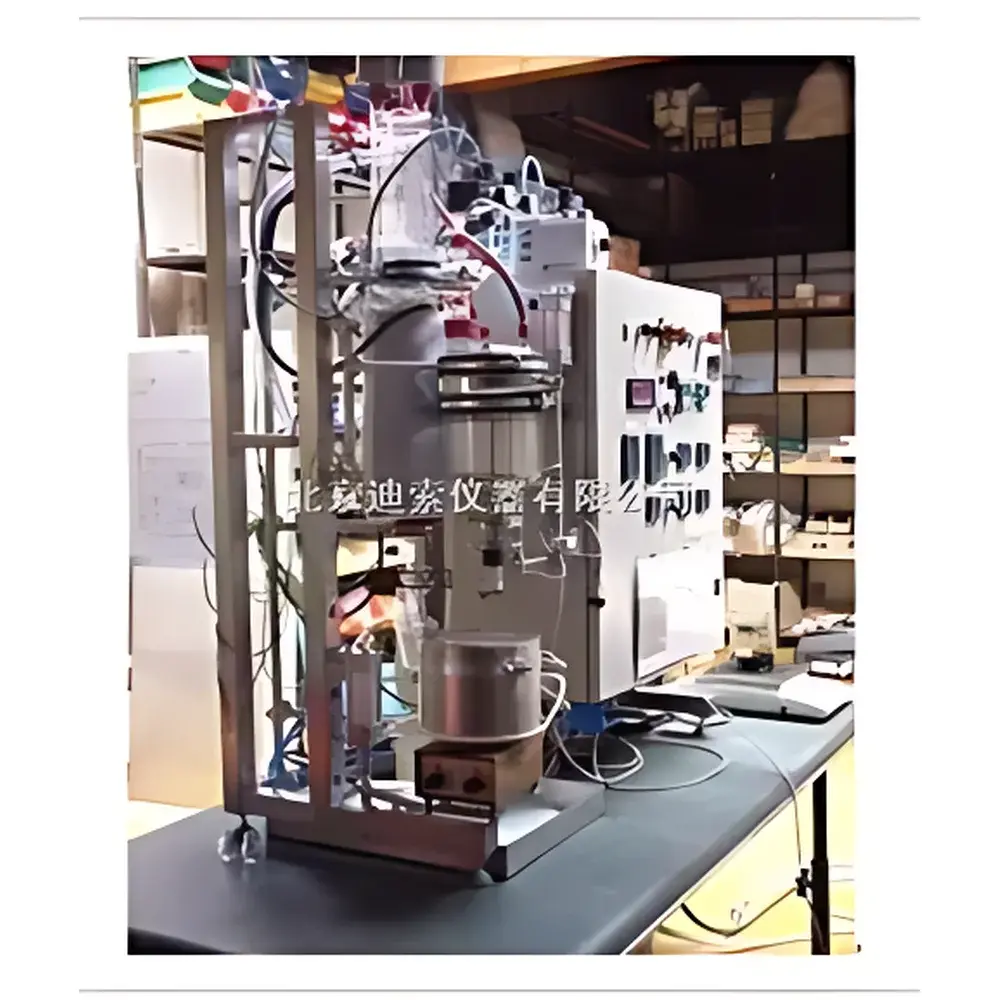
MICROTOP T Model Micro-scale True Boiling Point (TBP) Distillation Apparatus
| Origin | Germany |
|---|---|
| Manufacturer Type | Authorized Distributor |
| Origin Category | Imported |
| Model | MICROTOP T |
| Pricing | Available Upon Request |
| Compliance | ASTM D2892 (Standard), Optional ASTM D1160 & D5236 |
| Operating Pressure Range | 10–1000 Torr |
| Distillation Flask Volumes | 100 / 200 / 500 / 1000 mL |
| Column Type | Wiped-film Distillation Column |
| Column Internal Diameters | 18 mm / 25 mm |
| Fraction Collection | 10 Positions (10 mL or 25 mL Vials) |
| Temperature Reporting | True Boiling Point (°C) |
| Output Units | Absolute Volume (mL), % Volume (%V) |
| Maximum Final Boiling Point | Up to 400 °C AET (Atmospheric Equivalent Temperature) |
Overview
The MICROTOP T Model Micro-scale True Boiling Point (TBP) Distillation Apparatus is an engineered solution for high-fidelity compositional characterization of complex petroleum feedstocks, including crude oils, atmospheric and vacuum residues, and heavy fractions. It implements a standardized vacuum distillation methodology grounded in the principles of equilibrium flash vaporization and progressive fractional condensation under controlled pressure–temperature gradients. Unlike empirical distillation methods such as ASTM D86 or D1298, the MICROTOP T delivers true boiling point data—i.e., temperature–composition relationships derived from thermodynamic equilibrium between liquid and vapor phases at defined system pressures. This enables accurate reconstruction of hydrocarbon carbon number distribution, simulation input for process modeling (e.g., ASPEN HYSYS), and rigorous evaluation of distillation cut points in refinery design and optimization.
Key Features
- Full compliance with ASTM D2892 for standard TBP analysis of crude oil; optional configuration support for ASTM D1160 (high-boiling materials) and ASTM D5236 (detailed hydrocarbon analysis of heavy distillates)
- Automated, programmable distillation sequence with real-time pressure and temperature control across the entire operating range (10–1000 Torr)
- Modular wiped-film distillation column architecture—available in 18 mm and 25 mm internal diameters—to ensure consistent film formation, minimal hold-up volume, and reduced thermal degradation during high-temperature separation
- Integrated fraction collector with 10 independently addressable positions; vial options include 10 mL and 25 mL calibrated glass receivers for precise volumetric recovery
- Configurable distillation flask volumes (100 mL, 200 mL, 500 mL, and 1000 mL) to accommodate varying sample mass requirements while maintaining optimal surface-to-volume ratio for reproducible heating profiles
- Temperature reporting referenced to atmospheric equivalent temperature (AET), enabling direct correlation with atmospheric distillation units and refinery process simulators
Sample Compatibility & Compliance
The MICROTOP T is validated for use with non-volatile, thermally sensitive, and high-molecular-weight petroleum matrices—including whole crudes, deasphalted oils, vacuum bottoms, and bitumen-derived fractions. Its low thermal mass design and precise vacuum regulation minimize cracking and secondary reactions during distillation. All operational parameters—including ramp rates, hold times, pressure setpoints, and fraction cut logic—are fully traceable and configurable to meet GLP (Good Laboratory Practice) documentation requirements. The system supports audit-ready data export conforming to 21 CFR Part 11 guidelines when paired with compliant laboratory information management systems (LIMS). Instrument qualification documentation—including IQ/OQ protocols aligned with ISO/IEC 17025—can be supplied upon request.
Software & Data Management
The MICROTOP T operates via dedicated Windows-based control software that provides synchronized acquisition of pressure, column temperature profile, boiler temperature, and fraction collection timing. Raw output includes tabulated TBP curves (°C vs. %V), absolute volume per cut, and cumulative recovered volume. Export formats include CSV, Excel (.xlsx), and XML for seamless integration into refinery planning tools (e.g., Petro-SIM, PRO/II) and statistical analysis platforms (e.g., JMP, MATLAB). Software logs include full metadata: operator ID, method name, calibration timestamps, environmental conditions, and deviation flags—ensuring full chain-of-custody for regulatory submissions and internal QA/QC review.
Applications
- Determination of true boiling point distributions for crude assay and feedstock evaluation
- Characterization of vacuum residue composition prior to coking, hydrocracking, or solvent deasphalting
- Validation of simulated distillation (SimDis) GC methods against reference TBP data
- Supporting API gravity and sulfur distribution modeling across distillation cuts
- Refinery process unit modeling, especially atmospheric/vacuum distillation column simulation and energy balance calculations
- Research on thermal stability and decomposition onset temperatures of heavy ends
FAQ
What standards does the MICROTOP T comply with?
ASTM D2892 is the primary standard supported; optional firmware and method templates are available for ASTM D1160 and ASTM D5236.
Can the system operate at sub-atmospheric pressures below 10 Torr?
No—the minimum operational pressure is 10 Torr, optimized to maintain stable film dynamics and avoid excessive vapor-phase residence time.
Is calibration traceable to national standards?
Yes—temperature sensors are NIST-traceable; pressure transducers are certified to ISO 9001-accredited calibration laboratories.
How is fraction cut timing determined?
Cut points are programmable by either temperature increment (e.g., every 5 °C), volume threshold (e.g., every 2 mL), or %V interval (e.g., every 2% recovered volume), with overlapping logic support.
Does the system support automated cleaning cycles?
No—manual cleaning of the distillation column and boiler is required between runs using approved solvents (e.g., xylene, toluene); residue buildup must be monitored per maintenance schedule.



