
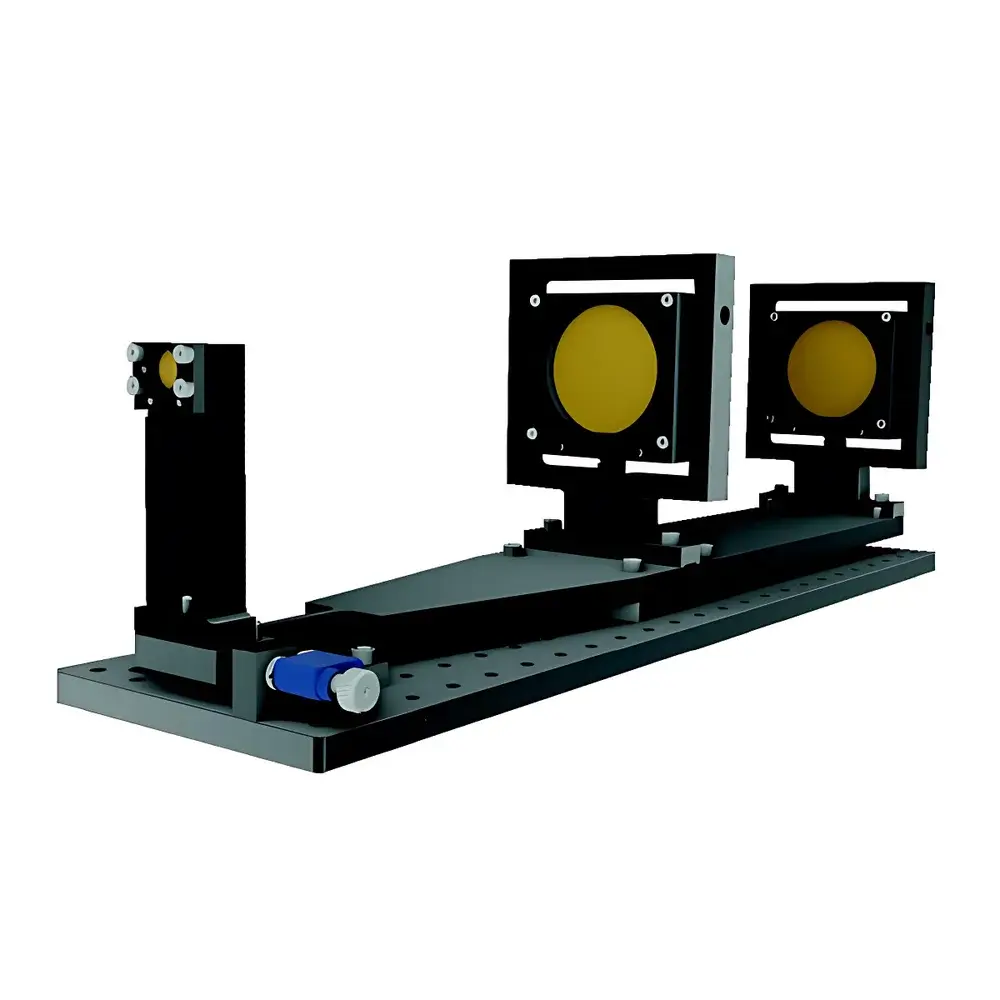
Microworks TALINT EDU X-ray Talbot-Lau Interferometry Kit for Phase-Contrast and Dark-Field Imaging
| Brand | Microworks |
|---|---|
| Origin | Germany |
| Model | TALINT EDU |
| Component Category | Optical & X-ray Interferometric Components |
| Dimensions | 60 cm × 15 cm × 20 cm |
| Grating Substrate | Graphite (G0/G2, 400 µm) / Silicon (G1, 200 µm) |
| G0/G2 Absorber | Au (>150 µm / >50 µm) |
| G1 Phase Shifter | Au (7.7 µm @ 40 keV) or Ni (7.4 µm @ 21 keV) |
| Grating Periods | 6.00 µm (40 keV design) or 4.80 µm (21 keV design) |
| G0/G2 Duty Cycle | 0.55 ± 0.05 |
| G1 Duty Cycle | 0.50 ± 0.05 |
| G0/G2 Effective Area | 15 mm × ? / 70 mm × ? |
| G1 Effective Area | 70 mm × ? |
| G0–G1 & G1–G2 Separation | 29 cm (precision dowel-mounted) |
| Field of View (sample) | 35 mm |
| Phase-Stepping Actuation | Closed-loop piezoelectric translation stage, 30 nm resolution (includes controller) |
| Fringe Visibility | >15% typical |
| Mounting Base | M6 threaded holes on 25 mm grid spacing |
Overview
The Microworks TALINT EDU is a compact, education- and research-optimized X-ray Talbot-Lau interferometry kit engineered for hands-on implementation of quantitative multi-contrast X-ray imaging. Unlike conventional absorption radiography, this system leverages the wave nature of X-rays to extract complementary information—absorption, differential phase shift, and ultra-small-angle scattering—within a single experimental setup. Based on the Talbot self-imaging effect and Lau’s extension for incoherent sources, the TALINT EDU implements a three-grating (G0–G1–G2) symmetric architecture optimized for laboratory-scale X-ray tubes (e.g., microfocus or rotating anode sources). Its modular, pre-aligned mechanical design enables full interferometer assembly in under 30 minutes on standard optical breadboards with 25 mm pitch. The system operates at two primary design energies—21 keV and 40 keV—each with rigorously matched grating periods (4.80 µm and 6.00 µm), duty cycles, and absorber/phase-shifter geometries to ensure high fringe visibility (>15%) and robust phase-stepping performance.
Key Features
- Three-grating Talbot-Lau interferometer architecture with precision dowel-mounted G0–G1 and G1–G2 separations (29 cm each)
- Dual-energy configurable grating sets: 4.80 µm period (21 keV design) and 6.00 µm period (40 keV design), both with validated duty cycle tolerances (G0/G2: 0.55 ± 0.05; G1: 0.50 ± 0.05)
- G0 and G2 fabricated on 400 µm graphite substrates with electroplated gold absorbers (>150 µm for G0, >50 µm for G2); G1 on 200 µm silicon with gold (7.7 µm) or nickel (7.4 µm) phase-shift structures
- Closed-loop piezoelectric phase-stepping stage with 30 nm resolution and integrated controller for precise, repeatable lateral displacement of G1
- Adjustable rotational alignment of G1 and G2 about the optical axis using micrometer-driven mounts for fine-tuning interference contrast
- Sample placement flexibility: accommodates specimens up to 35 mm field of view on either side of G1, enabling comparative studies of transmission geometry effects
- Standardized M6 mounting grid (25 mm pitch) ensures compatibility with commercial optical tables, kinematic mounts, and custom staging solutions
Sample Compatibility & Compliance
The TALINT EDU supports non-destructive, dose-efficient imaging of low-Z and composite materials where conventional absorption contrast is weak. It has been successfully applied to carbon-fiber-reinforced polymer (CFRP) tensile specimens, additively manufactured titanium lattice structures, and ceramic-matrix composites—revealing internal voids, fiber misalignment, microcracks, and residual powder via dark-field signal enhancement. While not a certified medical or industrial inspection device, its mechanical and optical specifications align with foundational requirements for ISO/IEC 17025-compliant metrology laboratories performing method development in X-ray phase imaging. All grating fabrication processes adhere to semiconductor-grade lithographic and electroforming protocols, ensuring dimensional stability and long-term repeatability. The system is compatible with standard X-ray safety enclosures and integrates with common detector interfaces (e.g., USB 3.0 or Camera Link) for seamless data acquisition.
Software & Data Management
The TALINT EDU operates in manual acquisition mode, delivering raw image stacks suitable for open-source or in-house phase-retrieval pipelines. Each phase step yields a series of projection images that serve as input for Fourier-based or iterative algorithms to reconstruct absorption (µ), differential phase (∂φ/∂x), and dark-field (σ) maps. Users may employ widely adopted frameworks such as PyTorch-based neural phase retrieval, MATLAB-based FFT processing, or C++ implementations compliant with NIST-developed reference standards for grating interferometry. While no proprietary software is bundled, the kit includes detailed calibration protocols—including fringe period measurement, visibility optimization, and G1 rotation sensitivity mapping—to support GLP-aligned documentation. Metadata (grating IDs, energy settings, step count, pixel size) is maintained externally in standardized HDF5 or TIFF+XML formats to ensure auditability and interoperability with laboratory information management systems (LIMS).
Applications
- Materials science: Quantitative mapping of microstructural heterogeneity in CFRP, metal foams, and biomaterial scaffolds via combined absorption–phase–dark-field analysis
- Mechanical testing: Real-time monitoring of crack initiation and propagation during in situ tensile/compression experiments, where dark-field contrast highlights sub-pixel scattering from dislocation networks or interfacial decohesion
- Additive manufacturing QA: Detection of unmelted powder particles, lack-of-fusion defects, and grain boundary scattering in Ti-6Al-4V and Inconel 718 parts without destructive sectioning
- Education and training: Pedagogical platform for teaching wave optics, coherence theory, X-ray interactions with matter, and inverse problem formulation in imaging physics
- Method validation: Benchmarking ground-truth performance of novel grating designs, detector response models, or reconstruction algorithms prior to synchrotron deployment
FAQ
Is the TALINT EDU compatible with standard laboratory X-ray sources?
Yes—it is designed for use with commercially available microfocus or rotating anode X-ray tubes operating in the 20–50 keV range, provided sufficient spatial coherence is achieved via source-size collimation or G0 pre-filtering.
Can the system be upgraded to automated acquisition?
Absolutely—the mechanical interface and piezo controller are fully compatible with third-party motion control APIs (e.g., Thorlabs Kinesis, PI GCS), enabling integration into automated scan routines and synchronized detector triggering.
What level of technical support is provided for phase-retrieval algorithm development?
Microworks supplies comprehensive calibration datasets, geometric parameter files (grating periods, alignments, distances), and reference Python scripts for FFT-based phase stepping analysis—intended to accelerate user-defined algorithm prototyping.
Are custom grating configurations available beyond the standard 21 keV and 40 keV sets?
Yes—custom grating periods, substrate thicknesses, absorber heights, and FOV-optimized layouts can be commissioned directly through Microworks’ engineering team, subject to minimum order quantities and lead time confirmation.
Does the kit include radiation shielding or safety interlocks?
No—radiation safety components must be sourced separately and installed in accordance with local regulatory requirements (e.g., IEC 61331-1, national radiation protection ordinances); the TALINT EDU is supplied as an open-beam optical component set only.



