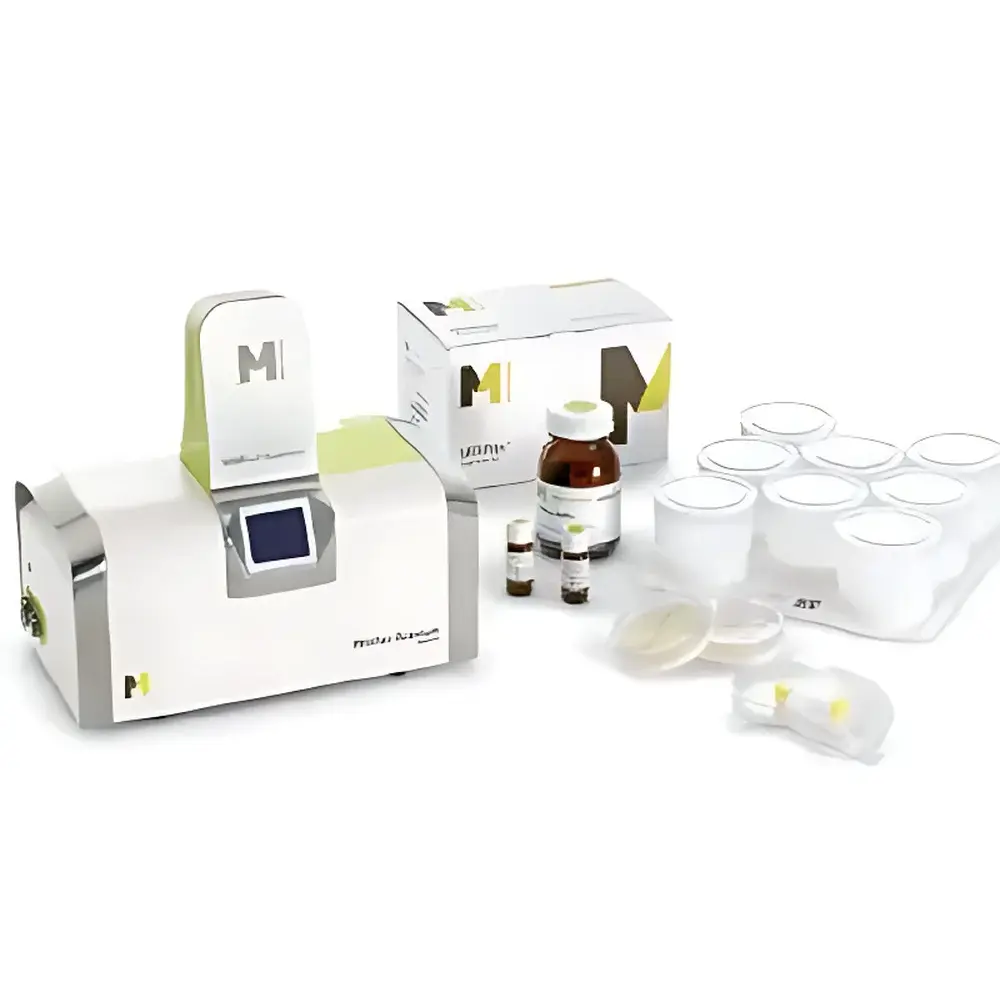
Millipore Milliflex® Quantum Rapid Microbial Detection System
| Brand | Millipore |
|---|---|
| Origin | USA |
| Model | Milliflex® Quantum |
| Instrument Type | Automated Microbial Enumeration System |
| Detection Throughput | 1 sample per run |
| Detection Limit | 1 CFU/sample |
| Filter Area | 55 mm diameter Milliflex membrane |
| Dimensions (Reader) | 14.2 × 24.9 × 12.5 cm |
| Weight | 4.4 kg |
| Power Input | 100–220 VAC, 50–60 Hz |
| Operating Temperature | 15–40 °C |
| Relative Humidity | < 90% |
| Altitude Limit | < 3000 m |
| Compliance | CE-marked, EMC Directive 89/336/EEC |
Overview
The Millipore Milliflex® Quantum Rapid Microbial Detection System is an automated, non-destructive enumeration platform engineered for pharmaceutical, biotechnology, and medical device manufacturers requiring rapid, reliable, and regulatory-compliant microbial monitoring of filterable products. It operates on the principle of metabolic enzymatic activation of a fluorogenic substrate—specifically, a non-fluorescent compound cleaved by intracellular esterases in viable, culturable microorganisms. Upon hydrolysis, the liberated fluorophore accumulates within the cytoplasm, generating amplified fluorescence signal detectable under excitation at a defined wavelength. Unlike ATP-bioluminescence or PCR-based methods, Milliflex® Quantum preserves cellular integrity post-staining, enabling downstream isolation and identification without compromising viability. The system integrates seamlessly with established industrial membrane filtration workflows—leveraging the same Milliflex® Plus vacuum pump and sterile filtration hardware used in conventional compendial methods (e.g., USP <61>, Ph. Eur. 2.6.12, ISO 8573-7)—thereby minimizing method validation burden while accelerating time-to-result from days to ≤48 hours for most samples.
Key Features
- Non-destructive enumeration: Fluorescent staining occurs without cell lysis or nucleic acid degradation, permitting subsequent sub-culturing and strain-level identification using standard biochemical, MALDI-TOF MS, or 16S rRNA sequencing protocols.
- Compendial alignment: Built upon validated Milliflex® membrane filtration architecture—compatible with pre-sterilized, gamma-irradiated culture media plates and standard 47-mm or 55-mm filters—ensuring straightforward equivalence studies against USP, EP, and JP microbiological limits tests.
- Compact, benchtop design: Aluminum and 304L stainless steel construction ensures durability and cleanroom compatibility; footprint (14.2 × 24.9 cm) allows operation inside laminar flow hoods or Grade C/D environments.
- Two assay formats: Universal Milliflex® Quantum Reagent Kit for broad-spectrum detection across raw materials, intermediates, final products, and environmental swabs; Water Control Kit optimized for low-biomass aqueous systems (e.g., purified water, WFI, clean steam condensate).
- Robust optical architecture: Integrated LED excitation source with OG550 long-pass filter and high-sensitivity monochrome camera ensure consistent signal capture across diverse colony morphologies—even under variable ambient lighting conditions.
- Minimal operator dependency: Standardized three-step workflow (filtration → incubation → staining/reading) requires no specialized microbiology training beyond routine membrane filtration practice.
Sample Compatibility & Compliance
The Milliflex® Quantum system supports a wide range of filterable matrices critical to GMP manufacturing: bulk drug substances, formulated APIs, excipients, process buffers, cell culture harvests, fermentation broths, sterilizing-grade filtered intermediates, and purified water systems. Its detection limit of 1 CFU per 55-mm membrane enables sensitive monitoring of low-bioburden processes where early contamination signals are essential for root cause analysis. Regulatory alignment includes full traceability for audit readiness: all image acquisitions, threshold settings, and enumeration logs are timestamped and user-attributed. While the instrument itself is CE-marked per EMC Directive 89/336/EEC, its application in regulated environments aligns with FDA guidance on rapid microbiological methods (RMMs), ICH Q5C, and Annex 1 (2022) requirements for environmental monitoring and sterility assurance. Data integrity conforms to ALCOA+ principles; when paired with compliant LIMS or electronic lab notebook (ELN) integration, it supports 21 CFR Part 11-compliant electronic records and signatures.
Software & Data Management
The Milliflex® Quantum software provides intuitive image acquisition, automated colony recognition, and configurable counting parameters—including size, intensity, and morphology filters—to minimize false positives from debris or background fluorescence. All raw images, processed counts, and metadata (operator ID, date/time, filter lot, reagent batch) are stored in a secure local database with export capability to CSV or PDF. Audit trail functionality records every user action—including parameter changes, result edits, and report generation—with immutable timestamps. For enterprise deployment, the system supports DICOM-compatible image export and RESTful API integration with major LIMS platforms (e.g., LabVantage, STARLIMS, Thermo Fisher SampleManager), facilitating automated data ingestion into quality event management systems and CAPA workflows.
Applications
- Routine microbial enumeration of purified water and water-for-injection (WFI) systems per USP <1231> and EU GMP Annex 1
- Environmental monitoring of Grade A/B cleanrooms and isolators using membrane-filtered settle plates or contact plates
- Bioburden testing of raw materials and excipients prior to sterilization or formulation
- In-process control of fermentation and cell culture bioreactors via periodic sampling and filtration
- Final product release testing for non-sterile pharmaceuticals, topicals, and ophthalmics per USP <61>
- Investigation of out-of-specification (OOS) results through parallel enumeration and isolate recovery for identification and phylogenetic analysis
FAQ
Is Milliflex® Quantum validated for use in GMP environments?
Yes—its foundation in compendial membrane filtration and non-destructive detection enables straightforward validation per ICH Q2(R2) and USP <1223>. Most users complete equivalence studies in ≤4 weeks using historical data and spiked recovery experiments.
Can the system differentiate between bacteria and yeasts/molds?
No—fluorescent signal reflects metabolic activity across all viable, culturable microorganisms. Morphological distinction requires post-isolation identification using orthogonal methods (e.g., Gram stain, MALDI-TOF, or sequencing).
What is the maximum sample volume that can be processed?
Using the Milliflex® funnel adapter, up to 1 L of low-turbidity aqueous samples (e.g., WFI) can be filtered; viscous or particulate-laden samples require dilution or centrifugation prior to filtration.
Does the system require calibration or routine maintenance?
No scheduled calibration is required; however, daily verification using a certified fluorescent reference slide (included) confirms optical performance. Annual preventive maintenance by authorized service engineers is recommended for long-term reliability.
How does Milliflex® Quantum compare to ATP bioluminescence or qPCR-based RMMs?
Unlike ATP assays—which detect total viable biomass but cannot distinguish cultivable vs. VBNC states—or qPCR—which detects DNA regardless of viability—Milliflex® Quantum enumerates only metabolically active, culturable cells, directly correlating with traditional plate counts while preserving isolates for investigation.