
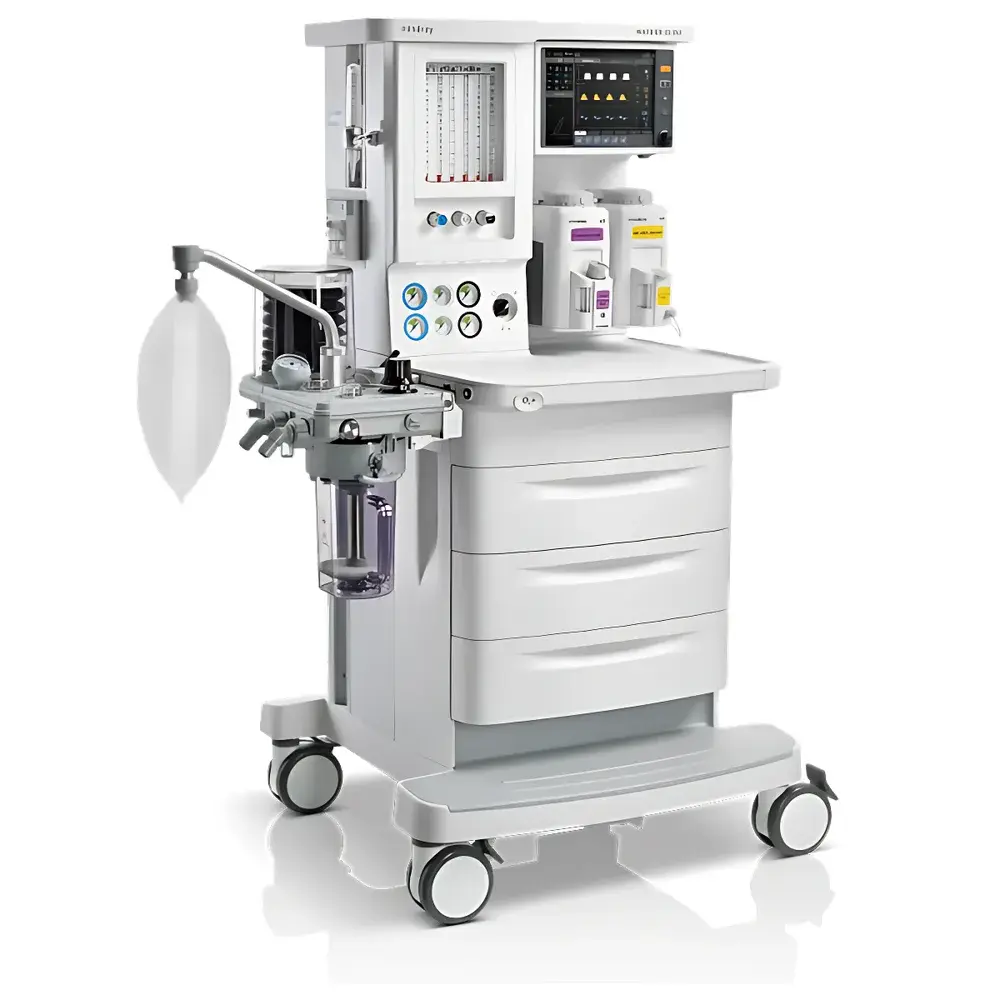
Mindray WATO EX-35Vet Veterinary Anesthesia Workstation
| Brand | Mindray |
|---|---|
| Origin | Shanghai, China |
| Manufacturer Type | Authorized Distributor |
| Country of Origin | China |
| Model | WATO EX-35Vet |
| Instrument Type | Veterinary Anesthesia and Monitoring System |
| Display | 10.4-inch TFT high-resolution touchscreen |
| Ventilation Modes | Volume-Controlled (VCV), Pressure-Controlled (PCV), Pressure-Controlled Ventilation with Volume Guarantee (PCV-VG), Spontaneous Breathing Support |
| Minimum Tidal Volume | 5 mL |
| Gas Monitoring Options | EtCO₂, Oxygen (O₂), Nitrous Oxide (N₂O), Halogenated Anesthetics (e.g., Isoflurane, Sevoflurane) |
| Vaporizer | Precision V60 calibrated halogenated anesthetic vaporizer (CE & FDA cleared) |
| Breathing Circuit | Integrated dual-mode (rebreathing/non-rebreathing), tool-free soda lime canister replacement |
| Leak Test | Automated self-test with graphical troubleshooting guidance |
| Waste Gas Scavenging | Optional passive or active scavenging system |
| Compliance | Designed to meet IEC 60601-1, IEC 60601-2-13, ISO 80601-2-13, and applicable veterinary medical device regulatory requirements |
Overview
The Mindray WATO EX-35Vet Veterinary Anesthesia Workstation is a CE- and FDA-cleared integrated anesthesia delivery and physiological monitoring system engineered for precision, safety, and operational efficiency in preclinical research, academic veterinary teaching hospitals, and clinical animal care facilities. Built upon Mindray’s clinically validated anesthesia platform architecture, the EX-35Vet implements dual-sensor flow measurement, real-time gas concentration analysis, and adaptive pressure–volume ventilation control to ensure stable anesthetic gas delivery and reproducible respiratory support across species ranging from neonatal rodents and rabbits to large canines and felines. Its core design adheres to fundamental principles of veterinary anesthesiology: maintaining alveolar ventilation integrity, minimizing barotrauma risk through pressure-limited modes, and enabling continuous assessment of anesthetic depth via end-tidal agent concentration (EtAG) and capnography (EtCO₂). The workstation operates within the framework of Good Laboratory Practice (GLP) and veterinary clinical standards, supporting traceable data acquisition and audit-ready configuration logs.
Key Features
- Integrated dual-mode breathing circuit with one-touch switching between rebreathing and non-rebreathing configurations—eliminating manual tube reconfiguration and reducing cross-contamination risk.
- PCV-VG (Pressure-Controlled Ventilation with Volume Guarantee) mode delivers precise tidal volumes as low as 5 mL while dynamically adjusting inspiratory pressure to prevent airway overdistension—critical for small-animal and pediatric veterinary applications.
- V60 precision halogenated anesthetic vaporizer with automatic temperature, pressure, and fresh gas flow compensation—ensuring ±5% output accuracy across ambient conditions per ISO 8185 and ASTM F1161 specifications.
- Automated leak test with on-screen graphical workflow guidance—validates circuit integrity prior to induction without requiring external calibration tools or manual pressure application.
- 10.4-inch high-resolution TFT capacitive touchscreen with icon-driven interface—designed for glove-compatible operation and rapid protocol navigation by veterinary technicians and researchers with minimal training.
- Modular expandability: Optional EtCO₂, O₂, N₂O, and volatile anesthetic agent monitoring modules integrate seamlessly via hot-swappable slots—supporting longitudinal studies requiring multi-parameter trend analysis.
Sample Compatibility & Compliance
The WATO EX-35Vet accommodates intubated and mask-based anesthesia across diverse species including mice, rats, guinea pigs, rabbits, ferrets, cats, dogs, and non-human primates. Its ventilator supports weight-based parameter scaling and includes adjustable rise time, inspiratory pause, and expiratory sensitivity settings to match species-specific respiratory mechanics. All gas monitoring modules are calibrated against NIST-traceable reference standards. The system complies with IEC 60601-1 (general safety), IEC 60601-2-13 (anesthesia equipment particular requirements), and ISO 80601-2-13. It supports GLP-compliant data export (CSV/Excel) with time-stamped event logs, user authentication, and configurable audit trails—facilitating regulatory submissions under FDA 21 CFR Part 58 and EMA Guideline on Good Clinical Practice for Veterinary Medicinal Products.
Software & Data Management
The embedded operating system provides real-time waveform display (airway pressure, flow, volume), numeric parameter overlays, and customizable alarm thresholds with priority-level classification (high/medium/low). Trend data—including minute ventilation, peak inspiratory pressure, EtCO₂, and anesthetic agent MAC multiples—is stored locally for ≥72 hours and exportable via USB or network interface. Optional software packages enable integration with institutional PACS or LIMS platforms using HL7 v2.5.3 or DICOM SR standards. All configuration changes, alarm events, and calibration actions are recorded with ISO/IEC 17025-aligned metadata (user ID, timestamp, action type), satisfying traceability requirements for AAALAC-accredited facilities.
Applications
- Preclinical pharmacology studies requiring controlled anesthesia depth during imaging (MRI, PET, ultrasound) or electrophysiological recording.
- Surgical training programs for veterinary students—standardizing anesthetic protocols across species and procedure types.
- Longitudinal toxicology assessments where consistent anesthetic management minimizes inter-subject physiological variability.
- Cardiopulmonary research involving acute lung injury models, requiring precise PEEP titration and dynamic compliance calculation.
- Regulatory submission support—providing documented, repeatable anesthesia delivery for OECD 407, 422, and 452 study designs.
FAQ
Does the WATO EX-35Vet support rodent-specific ventilation parameters?
Yes—the ventilator allows manual or weight-based parameter initialization down to 5 mL tidal volume, with adjustable I:E ratio (1:1 to 1:4), respiratory rate (2–150 bpm), and pressure limits (0–100 cmH₂O), optimized for murine and lagomorph physiology.
Can EtCO₂ and volatile agent concentrations be displayed simultaneously?
Yes—up to four real-time gas parameters (O₂, CO₂, N₂O, and one halogenated agent) appear concurrently on the main screen with independent alarm thresholds and trend history.
Is the system compatible with existing veterinary PACS infrastructure?
Through optional HL7 or DICOM SR connectivity modules, waveform and numeric data can be routed to central veterinary information systems for centralized review and archival.
What documentation is provided for regulatory audits?
Mindray supplies a full Technical File compliant with MDR Annex II, including risk management reports (ISO 14971), verification/validation summaries, and software lifecycle documentation—available upon request to authorized distributors.
How frequently does the soda lime canister require replacement?
Dependent on fresh gas flow, animal metabolic rate, and duration of use; typical replacement intervals range from 4–12 hours in high-flow non-rebreathing circuits, with colorimetric indicators and optional CO₂ bypass alerts for proactive maintenance.






