MiniPRI Plant Photochemical Reflectance Index Meter
| Origin | Imported |
|---|---|
| Manufacturer Type | Authorized Distributor |
| Model | MiniPRI |
| Measurement Principle | PRI = (R₅₃₁ − R₅₇₀) / (R₅₃₁ + R₅₇₀) |
| Detection Wavelength Range | 500–600 nm |
| Light Sources | Integrated dual-wavelength LEDs at 531 nm and 570 nm |
| Operating Temperature | 0–55 °C |
| Relative Humidity | 0–95% RH (non-condensing) |
| Storage Conditions | −10–60 °C, 0–95% RH (non-condensing) |
| Wireless Communication | Bluetooth 1.1 |
| Onboard Memory | 4 MB |
| External Storage | Compatible with PDA devices for extended logging |
| Power Supply | 4 × AA rechargeable or alkaline batteries (70 h continuous operation) |
| Auto Power-Off | After 5 min inactivity |
| Weight | 180 g |
| Software Suite | FluorPen / PlantPen 2.0 |
Overview
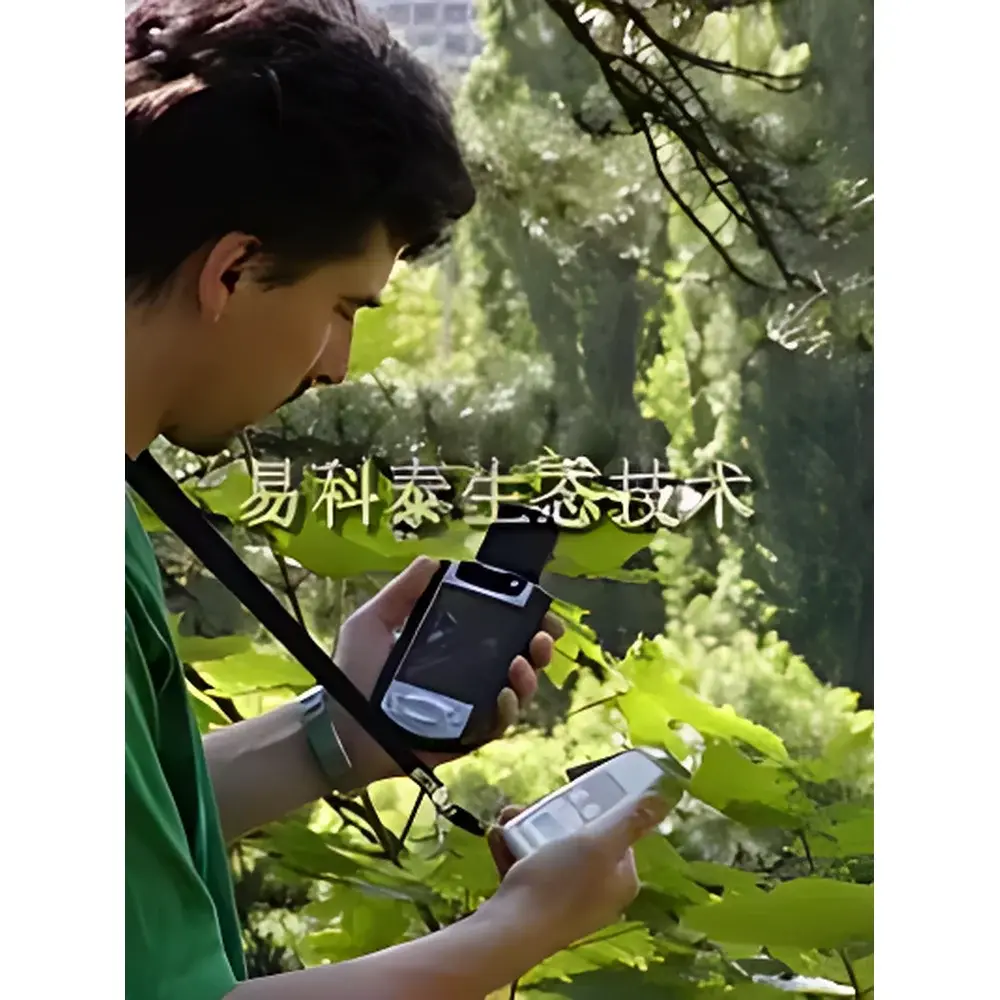
The MiniPRI Plant Photochemical Reflectance Index Meter is a compact, field-deployable optical sensor engineered for non-destructive, real-time assessment of plant physiological status through the Photochemical Reflectance Index (PRI). Based on the well-established radiometric principle defined by Gamon et al. (1992), PRI quantifies the differential reflectance between two narrow spectral bands—531 nm (sensitive to xanthophyll cycle pigment dynamics) and 570 nm (a reference band minimally affected by pigment shifts)—yielding the dimensionless index: PRI = (R₅₃₁ − R₅₇₀) / (R₅₃₁ + R₅₇₀). This index serves as a robust proxy for the fraction of absorbed photosynthetically active radiation (PAR) allocated to photochemistry versus thermal dissipation, thereby reflecting dynamic adjustments in light-use efficiency under varying environmental conditions—including drought stress, nutrient limitation, ozone exposure, and diurnal light fluctuations. Unlike chlorophyll fluorescence systems requiring dark adaptation, the MiniPRI operates under ambient illumination, enabling rapid, high-throughput screening across heterogeneous canopies without experimental interruption.
Key Features
- Integrated dual-wavelength LED excitation system precisely centered at 531 nm and 570 nm, calibrated to NIST-traceable spectral standards
- Optimized photodiode detection architecture covering 500–600 nm with <±0.5 nm center wavelength tolerance and <2 nm full-width-at-half-maximum (FWHM)
- Ultra-portable form factor (180 g) with ergonomic handheld design, IP54-rated enclosure for dust and splash resistance
- Onboard 4 MB flash memory supporting timestamped PRI logging at user-defined intervals (1 Hz to 1 sample/minute)
- Multi-modal data export: Bluetooth 1.1 (Class 2, up to 10 m range), USB 2.0 micro-B interface, and RS-232 serial output for legacy integration
- Battery-powered operation using standard or rechargeable AA cells; verified 70-hour runtime under typical field measurement protocols (10 s/sample, 100 samples/day)
- Automatic power management with configurable auto-shutdown (default: 5 min inactivity) and low-battery warning indicator
Sample Compatibility & Compliance
The MiniPRI is validated for direct leaf-level measurements on broadleaf and needle-type species across agricultural, silvicultural, and ecological research contexts. It accommodates leaf thicknesses from 0.1 mm to 3 mm and surface reflectance ranges of 5–85% within the target spectral window. No contact or clipping is required—measurements are acquired via perpendicular 1 cm² field-of-view sampling at 10–15 cm standoff distance. The device conforms to IEC 61000-4-2 (ESD immunity), IEC 60529 (IP54 ingress protection), and meets CE marking requirements for electromagnetic compatibility (EMC Directive 2014/30/EU) and low-voltage safety (LVD Directive 2014/35/EU). While not a medical or diagnostic instrument, its output supports GLP-aligned experimental workflows when paired with documented calibration logs and metadata annotation in FluorPen/PlantPen 2.0.
Software & Data Management
FluorPen/PlantPen 2.0 is a cross-platform desktop application (Windows/macOS/Linux) designed for scientific data curation and analysis. It provides synchronized visualization of PRI time-series, batch processing of multi-sample datasets, and export to CSV, Excel (.xlsx), and HDF5 formats for downstream statistical modeling (e.g., R, Python pandas, MATLAB). The software implements audit-trail functionality compliant with ALCOA+ principles: each data file retains embedded timestamps, instrument ID, firmware version, operator ID (user-defined), GPS coordinates (if connected via Bluetooth-enabled mobile device), and measurement context tags. Raw spectral response curves are stored alongside calculated PRI values, enabling retrospective recalibration or reprocessing under updated algorithms. Exported files include MD5 checksums for data integrity verification—critical for long-term ecological monitoring programs subject to peer-reviewed publication or regulatory reporting.
Applications
- Early detection of water deficit stress in irrigation scheduling trials (e.g., vineyards, orchards, row crops)
- Phenotyping of drought-tolerant cultivars in breeding programs under controlled-environment or field conditions
- Monitoring seasonal xanthophyll cycle activity in forest canopies to assess carbon assimilation capacity
- Calibration and validation of hyperspectral remote sensing products (e.g., Sentinel-2, PRISMA) at plot scale
- Teaching laboratories in plant ecophysiology, agronomy, and environmental science curricula
- Long-term ecological research (LTER) sites tracking vegetation functional responses to climate variability
FAQ
What is the spectral accuracy of the MiniPRI’s 531 nm and 570 nm channels?
The LED peak wavelengths are factory-calibrated to ±0.3 nm tolerance, with spectral stability maintained over 10,000 operating hours per LED module.
Can the MiniPRI be used under direct sunlight?
Yes—the optical design includes ambient-light rejection filters and synchronous detection logic to suppress solar irradiance interference during daytime measurements.
Is firmware upgradable in the field?
Yes, firmware updates are delivered via FluorPen/PlantPen 2.0 and applied over USB or Bluetooth; update logs are archived in the software’s maintenance history.
Does the device support ISO/IEC 17025-compliant calibration?
While the MiniPRI itself is not a certified reference standard, it may be included in laboratory scope under ISO/IEC 17025:2017 when operated within a documented calibration hierarchy traceable to NIST SRM 2036 or equivalent reflectance standards.
How is temperature drift compensated during extended field deployments?
Internal thermistor readings are logged with each PRI measurement; FluorPen/PlantPen 2.0 applies optional empirical temperature-correction models derived from published species-specific coefficients (e.g., Gitelson et al., 2006).