
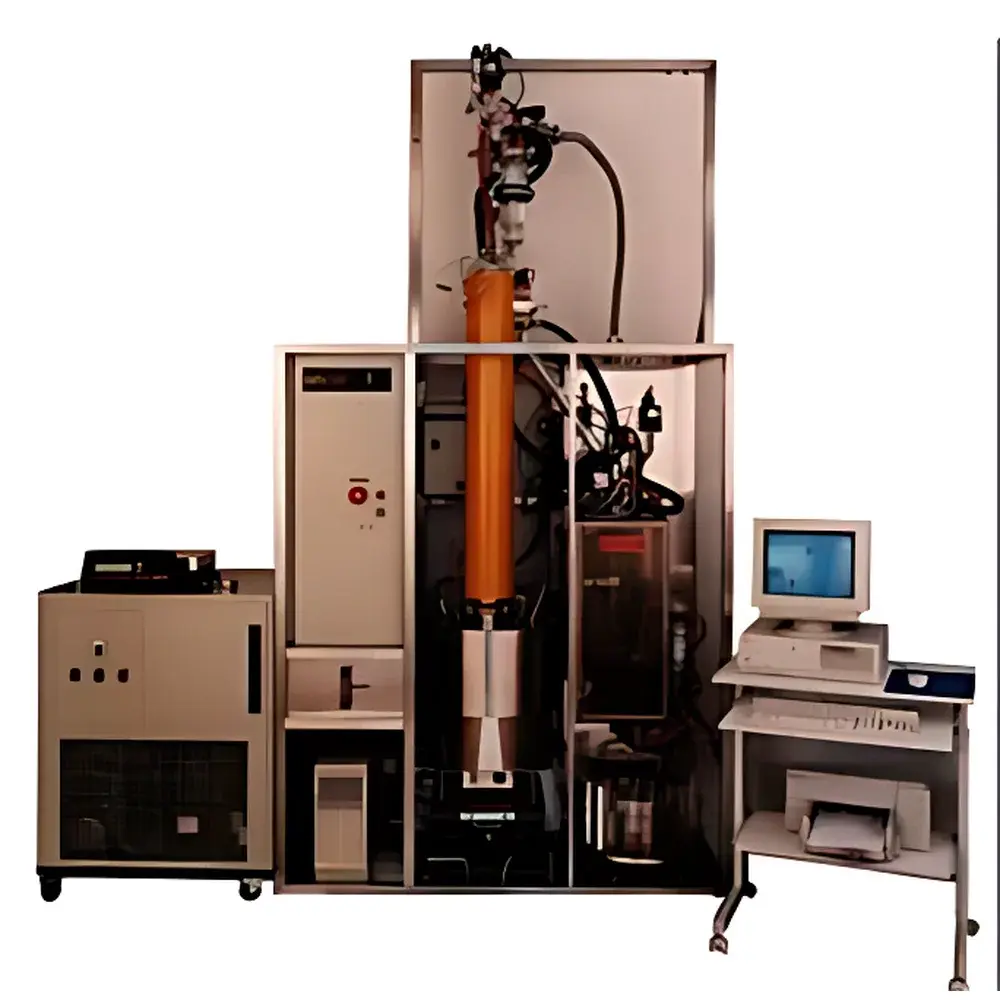
MINITOP COMBI True Boiling Point (TBP) & Pot Still Distillation Apparatus
| Origin | France |
|---|---|
| Manufacturer Type | Authorized Distributor |
| Origin Category | Imported |
| Model | MINITOP COMBI |
| Price | Upon Request |
Overview
The MINITOP COMBI True Boiling Point (TBP) & Pot Still Distillation Apparatus is a fully integrated, dual-mode laboratory distillation system engineered for precise, standardized characterization of crude oil and heavy petroleum fractions. It implements two complementary distillation methodologies—True Boiling Point (TBP) distillation per ASTM D2892 and Pot Still distillation per ASTM D5236—within a single, unified platform. The system operates under controlled vacuum and temperature conditions to deliver high-reproducibility boiling point distribution data across the full volatility range, from initial boiling point (IBP) up to 570 °C atmospheric equivalent temperature (AET), extendable to 600 °C AET under optimized operational parameters. Its modular architecture enables seamless switching between TBP and Pot Still modes without hardware reconfiguration, ensuring compliance with refinery feedstock evaluation, assay development, and process simulation requirements.
Key Features
- Dual-standard compliance: Fully validated for ASTM D2892 (TBP) and ASTM D5236 (Pot Still), supporting both batch and semi-continuous distillation protocols.
- Integrated vacuum control: Dual-range vacuum measurement (0–1000 Torr for system monitoring; 0–10 Torr for high-resolution column pressure control), with cryogenic cold trap (–70 °C) for pump protection and condensable vapor capture.
- Temperature-regulated fraction collection: Fully insulated, programmable fraction collector operating from –25 °C to +90 °C—preventing loss of light ends and solidification of waxy fractions during collection.
- Automated refrigeration management: Independent cryogenic bath for TBP condensation (–25 °C setpoint) and high-temperature water bath for Pot Still reflux (up to 90 °C); integrated heat exchanger cools condenser lines to ≤40 °C post-distillation to safeguard compressor integrity.
- Fail-safe mechanical framework: Rigid structural support with interlocked access panels, explosion-resistant design, and restricted operator interaction—only distillation flasks and funnels are manually removable.
- Remote operation capability: Standalone control panel with lockable interface permits semi-automatic operation independent of PC; full remote supervision and sequence execution via Ethernet-connected host computer.
Sample Compatibility & Compliance
The MINITOP COMBI accommodates crude oils, atmospheric and vacuum residues, deasphalted oils, and other complex hydrocarbon mixtures with boiling ranges exceeding 550 °C. Its design adheres to international regulatory expectations for refinery assay instrumentation, including traceability of calibration records, audit-ready parameter logging, and configurable user access levels. While not inherently 21 CFR Part 11 compliant, the system supports integration with validated LIMS or ELN platforms that enforce electronic signature, change control, and audit trail requirements. All thermal and vacuum subsystems are calibrated against NIST-traceable references, and operational logs—including temperature profiles, pressure readings, fraction weights, and collection timestamps—are stored in timestamped, non-erasable binary files.
Software & Data Management
The proprietary MINITOP Control Suite runs on Windows-based host PCs and provides real-time visualization of column temperature gradients, vacuum stability, condenser temperatures, and fraction collection status. Users define distillation protocols—including cut-point schedules, hold times, and ramp rates—via intuitive graphical workflow editors. Raw sensor data (±0.1 °C thermal resolution; ±0.05 Torr vacuum resolution) is logged at 1 Hz and exportable in CSV, XML, or ASTM D7169-compliant .ast format. Optional UPS integration ensures uninterrupted power during critical late-stage distillations. Data integrity safeguards include automatic backup to network drives, cyclic buffer overwrite protection, and checksum-verified file transfers.
Applications
- Crude assay development for refinery process modeling (e.g., LP/NLP simulations)
- Characterization of vacuum gas oils (VGO) and residua for FCC and hydroprocessing unit feed evaluation
- Boiling point distribution analysis for ASTM D2887/D7169 correlation and method validation
- Wax appearance temperature (WAT) and pour point estimation via low-temperature fraction recovery
- Quality control of blending components in pipeline specification compliance testing
- Research into thermal stability and cracking behavior of heavy fractions under controlled distillation stress
FAQ
Can the MINITOP COMBI perform both TBP and Pot Still distillations without hardware modification?
Yes—the system features physically separate but co-located TBP and Pot Still columns, each with dedicated condensers, vacuum manifolds, and temperature control zones. Switching modes is accomplished entirely through software configuration and valve actuation sequences.
What is the lowest achievable condenser temperature for light-end recovery?
The cryogenic bath achieves –25 °C at ambient 25 °C, enabling quantitative recovery of C5–C10 hydrocarbons without significant volatilization loss.
Is nitrogen purging integrated into standard operation?
Yes—a dedicated nitrogen supply manifold with precision needle valves, pressure regulators, and mass flow meters is included for inert atmosphere maintenance during sample loading and low-pressure operation.
How is fraction mass quantified during automated collection?
An optional ISO/IEC 17025-calibrated analytical balance can be mounted within the frame; it interfaces directly with the control software to record weight increments in real time and auto-calculate volumetric cut yields based on density inputs.
Does the system support GLP/GMP-aligned documentation practices?
While the base configuration does not include electronic signatures or role-based permissions, its deterministic data logging architecture—combined with external validation of software and hardware—enables qualification under GLP (OECD 1998) and GMP (ICH Q7) frameworks when deployed with compliant IT infrastructure.
Related Products





