
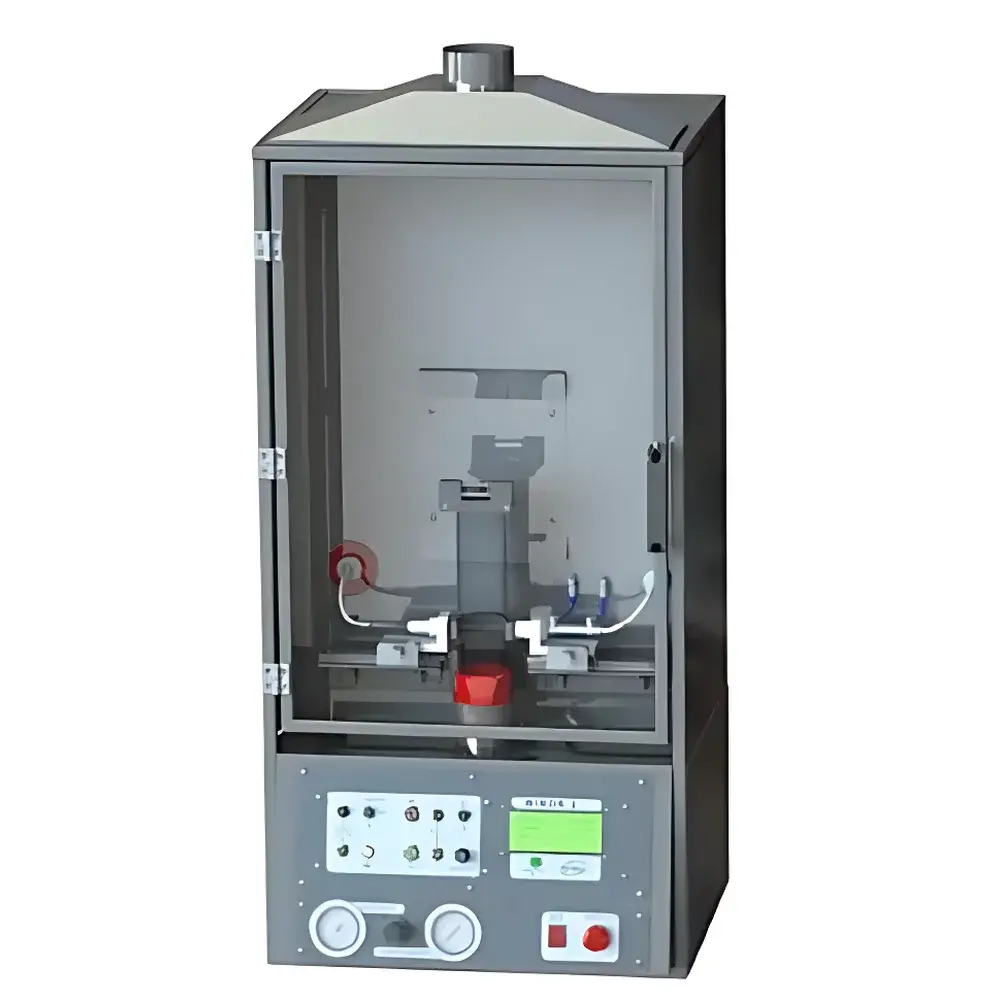
MINOR 3.1 Minimum Ignition Energy Analyzer
| Origin | Poland |
|---|---|
| Manufacturer Type | Authorized Distributor |
| Origin Category | Imported |
| Model | MINOR 3.1 |
| Price Range | USD 27,000 – 68,000 (FOB) |
| Compliance Standards | EN 13281-1:2015, ASTM E2019-22, IEC 61241-2-3:2003, ISO/IEC 80079-20-2:2016 |
| Ignition Energy Range | 1–1000 mJ (standard), 2000–3000 mJ (optional) |
| Ignition Delay | 20–350 ms (adjustable in 1 ms increments) |
| Ignition Vessel | Hartmann-type glass tube (ID 30 mm, L 150 mm) |
| Control System | Microprocessor-based with LCD interface, real-time delay monitoring, energy activation feedback, and USB 2.0 data export |
| Calibration | Integrated pressure reference gauge for system integrity verification |
| Configuration | Single-unit standard configuration |
Overview
The MINOR 3.1 Minimum Ignition Energy (MIE) Analyzer is a precision-engineered laboratory instrument designed for the quantitative determination of the lowest electrical spark energy capable of igniting a combustible dust cloud under standardized atmospheric conditions. Developed by Anko Sp. z o.o. (Poland) and distributed globally under strict quality assurance protocols, the system operates on the principle of controlled capacitive discharge through a defined electrode gap within a Hartmann-type glass ignition vessel. This methodology aligns with fundamental electrostatic ignition theory and adheres to the physical boundary conditions specified in internationally recognized test standards—including EN 13281-1:2015 (Explosive atmospheres — Dust clouds — Determination of minimum ignition energy), ASTM E2019-22 (Standard Test Method for Minimum Ignition Energy of a Dust Cloud in Air), and ISO/IEC 80079-20-2:2016 (Explosive atmospheres — Part 20-2: Material characteristics — Combustible dusts test methods). The analyzer provides traceable, repeatable results essential for hazard classification (e.g., St 1 / St 2 / St 3 dust classification per IEC 61241-1-1), safety data sheet (SDS) development, and process safety management (PSM) documentation required under OSHA 1910.119 and EU ATEX Directive 2014/34/EU.
Key Features
- Calibrated capacitive discharge circuit delivering discrete energy levels: 1, 3, 10, 30, 100, 300, and 1000 mJ — all traceable to national metrology institutes; optional extended range (2000–3000 mJ) available for high-energy-resistant materials.
- Hartmann-type glass ignition tube (30 mm internal diameter × 150 mm length) manufactured to dimensional tolerances compliant with EN 13281 Annex B, ensuring consistent dust dispersion geometry and turbulence profile.
- Microprocessor-controlled ignition sequence with real-time display of selected energy level, actual delivered energy (compensated for capacitor aging and voltage drift), and programmable ignition delay (20–350 ms in 1-ms steps).
- Integrated pressure reference gauge for pre-test verification of vessel integrity and ambient pressure stabilization—critical for eliminating false negatives due to leakage or barometric variation.
- LCD-based human-machine interface (HMI) with intuitive menu navigation, no external PC dependency for basic operation, and built-in test logging (timestamped energy value, delay setting, operator ID placeholder).
- USB 2.0 interface supporting raw data export (CSV format) for post-test statistical analysis, audit trail generation, and integration into enterprise LIMS or QMS platforms.
Sample Compatibility & Compliance
The MINOR 3.1 supports testing of dry, non-agglomerating dusts with particle size distributions typically ranging from 500 µm (D50 recommended between 20–80 µm for optimal cloud homogeneity). It accommodates organic powders (e.g., sugar, flour, cellulose), metal dusts (Al, Mg, Ti), polymer granules, and pharmaceutical excipients. All operational procedures conform to Good Laboratory Practice (GLP) requirements, and the system architecture enables full compliance with FDA 21 CFR Part 11 when paired with validated software (e.g., Anko DataSuite v3.x) for electronic signatures and audit-trail retention. Test reports generated meet ISO/IEC 17025 accreditation criteria for calibration laboratories performing MIE determinations.
Software & Data Management
While standalone operation is fully functional, the MINOR 3.1 is compatible with Anko’s optional DataSuite software—a Windows-based application that automates test sequencing, applies statistical outlier detection (per ASTM E178), calculates 50% ignition probability thresholds using probit analysis, and generates PDF reports compliant with EN 13281 reporting templates. Data encryption, user role management (admin/operator/auditor), and electronic signature workflows satisfy regulatory expectations for data integrity in GMP and chemical manufacturing environments. Raw voltage/time waveforms and energy decay profiles are stored for forensic review during incident investigations or regulatory audits.
Applications
- Determination of MIE values for UN Transport Classification (UN 4.1, Class 1.1–1.4) and SDS Section 9 (Physical and Chemical Properties).
- Verification of electrostatic hazard mitigation strategies—including grounding efficacy, ionizer performance, and conductive footwear validation.
- Supporting ATEX/IECEx equipment certification by providing input data for maximum permissible surface temperature and enclosure protection level selection.
- Process hazard analysis (PHA) inputs for HAZOP and Layer of Protection Analysis (LOPA) studies in chemical, food, and pharmaceutical facilities.
- Research into dust explosion mechanisms, including effects of humidity, particle morphology, and inertant addition on ignition sensitivity.
FAQ
What standards does the MINOR 3.1 directly support?
EN 13281-1:2015, ASTM E2019-22, IEC 61241-2-3:2003, and ISO/IEC 80079-20-2:2016 — with full alignment to apparatus specifications, procedural sequences, and reporting requirements.
Is the Hartmann tube supplied with the system?
Yes — one certified Hartmann-type glass tube (30 mm ID × 150 mm L) is included in the standard configuration; replacement tubes are available as consumables with batch-specific calibration certificates.
Can the instrument be integrated into an existing LIMS?
Yes — via USB CDC serial emulation mode or optional RS-232 interface; CSV export format ensures compatibility with major LIMS vendors (LabWare, Thermo Fisher SampleManager, STARLIMS).
What maintenance is required for long-term accuracy?
Annual verification of capacitor discharge energy (using NIST-traceable calorimetric sensor), biannual inspection of electrode tip wear, and quarterly validation of pressure reference gauge against certified deadweight tester.
Does the system support automated dust dispersion?
No — manual dispersion via standardized puff bottle (per EN 13281 Annex C) is required to maintain inter-laboratory reproducibility; automated dispersion modules are not part of the MINOR 3.1 platform and would invalidate standard compliance.





