
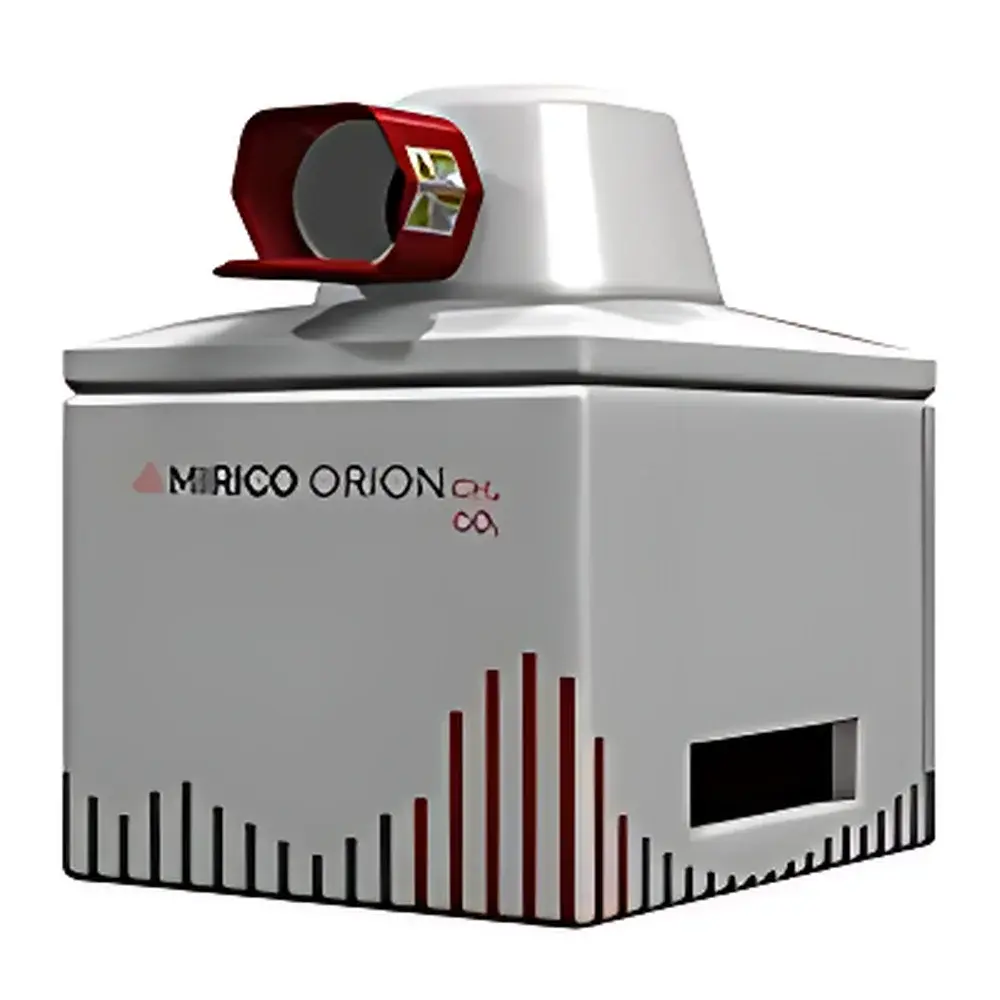
MIRICO ORION Open-Path CO₂ and CH₄ Analyzer
| Origin | UK |
|---|---|
| Manufacturer Type | Authorized Distributor |
| Origin Category | Imported |
| Model | ORION CO₂ CH₄ |
| Pricing | Available Upon Request |
Overview
The MIRICO ORION Open-Path CO₂ and CH₄ Analyzer is an advanced, field-deployable gas sensing system engineered for high-fidelity, simultaneous, real-time quantification of carbon dioxide (CO₂) and methane (CH₄) column concentrations across open atmospheric paths. It employs mid-infrared (MIR) laser dispersion spectroscopy—a physics-based, absorption-free optical technique that eliminates interference from particulate scattering, humidity-induced spectral broadening, and pressure-dependent line shape artifacts common in traditional tunable diode laser absorption spectroscopy (TDLAS) or non-dispersive infrared (NDIR) systems. Unlike closed-path analyzers requiring sample extraction, pump-driven flow control, and conditioning hardware, the ORION operates in true open-path configuration: its beam traverses the ambient atmosphere directly between a transmitter and retroreflector (or natural scatterers), enabling path-integrated concentration measurements with minimal instrumental drift and no inlet-related biases. This architecture is particularly suited for eddy covariance (EC) flux studies, where temporal resolution, long-term stability, and immunity to precipitation, fog, or wind-induced turbulence are critical.
Key Features
- Simultaneous dual-gas detection of CO₂ and CH₄ using patented mid-infrared laser dispersion spectroscopy (LDS), delivering inherent immunity to water vapor cross-sensitivity and aerosol attenuation.
- True open-path design with no sampling lines, pumps, or calibration gases required—reducing maintenance burden and eliminating flow-induced time lags.
- Configurable measurement path length from 50 m to 400 m, optimized per site geometry and target flux magnitude.
- Full 360° horizontal scanning capability and ±10° vertical angular range, enabling spatially resolved mapping of emission plumes and heterogeneous source zones.
- Integrated self-diagnostic routines—including laser wavelength stability monitoring, optical alignment verification, and signal-to-noise ratio (SNR) tracking—to ensure data integrity and reduce unscheduled service interventions.
- Onboard automatic co-location calibration via built-in reference cell and dynamic zero/span validation against ambient background conditions.
Sample Compatibility & Compliance
The ORION analyzer is designed for unattended, continuous operation in diverse environmental settings—including wetlands, agricultural fields, landfill perimeters, forest margins, and aquatic ecosystems—without modification or protective housing. Its optical path remains functional under rain, snow, and high-humidity conditions due to the LDS technique’s insensitivity to Mie scattering. The system complies with ISO 14064-3 guidance for greenhouse gas (GHG) quantification methodologies and supports traceability frameworks aligned with WMO GAW (World Meteorological Organization Global Atmosphere Watch) station requirements. Data output formats and metadata tagging conform to CF (Climate and Forecast) conventions, facilitating ingestion into FLUXNET, ICOS, and national GHG inventory reporting platforms. While not certified for regulatory emissions compliance under EPA Method TO-15 or EN 15267, it meets performance criteria for scientific research-grade flux attribution as defined in AmeriFlux Best Practices and the EU ICOS Tier-1 specification.
Software & Data Management
The ORION is managed through a secure, browser-based web interface accessible via Wi-Fi or Ethernet, supporting remote configuration, real-time spectral visualization, and diagnostic logging. Firmware includes embedded time synchronization (PTPv2/IEEE 1588) for precise alignment with 3D sonic anemometers in eddy covariance setups. Raw absorbance spectra and derived gas concentrations are timestamped with microsecond resolution and exported in NetCDF-4 format, including full uncertainty propagation metadata (e.g., path length error, temperature/pressure compensation residuals). Audit trails record all user actions, parameter changes, and calibration events—supporting GLP-aligned data governance. Optional integration with third-party data loggers (e.g., Campbell Scientific CR6, LI-COR EddyPro) enables automated flux computation using standard covariance algorithms.
Applications
- Eddy covariance-based net ecosystem exchange (NEE) and methane flux quantification across terrestrial and aquatic biomes.
- Carbon capture and storage (CCS) site monitoring: detection of subsurface CO₂ leakage and associated CH₄ tracer migration at containment boundaries.
- Urban and peri-urban GHG hotspot identification and source apportionment via mobile scanning or fixed-perimeter deployment.
- Long-term ecological research (LTER) on seasonal and interannual variability in soil-atmosphere gas exchange.
- Validation of satellite-based XCO₂ and XCH₄ retrievals (e.g., OCO-2/3, TROPOMI, GOSAT) using ground-truth path-averaged column density measurements.
FAQ
How does the ORION differ from conventional NDIR or TDLAS open-path analyzers?
It uses laser dispersion spectroscopy instead of absorption spectroscopy—measuring refractive index gradients rather than intensity attenuation—making it inherently insensitive to optical obscuration and water vapor interference.
Can the ORION be used with existing eddy covariance infrastructure?
Yes—it outputs synchronized analog/digital signals compatible with standard EC data loggers and supports PTPv2 time alignment for sub-millisecond latency matching with 3D sonic anemometers.
What is the typical detection limit under field conditions?
5 ppm·m/√Hz for CO₂ and 5 ppb·m/√Hz for CH₄ at >100 m path length and 1 s integration time, corresponding to ~5 ppm CO₂ and ~50 ppb CH₄ sensitivity at 100 m.
Is factory calibration sufficient for multi-year deployments?
The system performs autonomous zero/span checks using internal references and ambient background characterization; however, annual field verification against certified gas standards is recommended for regulatory-grade applications.
Does the ORION require external power or can it operate on solar/battery?
It operates on 12–24 V DC input and consumes <15 W average power—enabling deployment with off-grid solar-charged battery systems typical in remote flux towers.




