
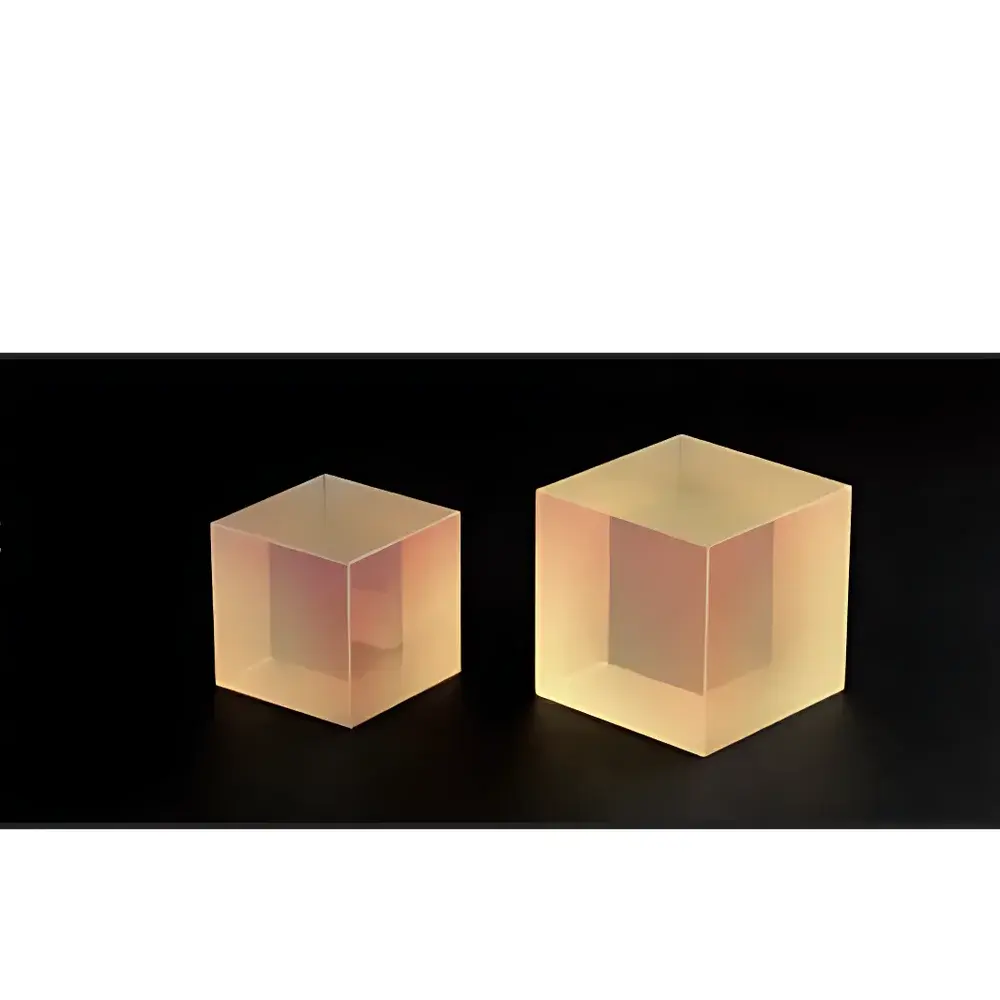
MiXran Meg1048 Microcrystalline Cubic Reference Prism
| Brand | MiXran |
|---|---|
| Model | Meg1048 |
| Type | Precision Optical Reference Prism |
| Material | Synthetic Fused Silica (Microcrystalline Structure) |
| Dimensions (A=B=C) | 10 mm, 15 mm, 20 mm, or 25 mm (cubic) |
| Apex Angle Options | 10°, 15°, 20°, 25° (standard) |
| Coating | Dual-face dielectric high-reflectivity coating (R > 99.5% @ 632.8 nm) |
| Substrate Homogeneity | Δn < 5 × 10⁻⁷ over full aperture |
| Surface Flatness | λ/20 @ 632.8 nm (per face) |
| Surface Quality | 10-5 scratch-dig |
| Wavefront Distortion | < λ/15 RMS (transmitted) |
| Operating Wavelength Range | 350–1100 nm (coating-optimized for HeNe at 632.8 nm) |
| Thermal Expansion Coefficient | 0.52 × 10⁻⁶ /°C |
| Density | 2.20 g/cm³ |
Overview
The MiXran Meg1048 Microcrystalline Cubic Reference Prism is a metrology-grade optical component engineered for high-precision angular calibration, interferometric alignment, and laser cavity stabilization in demanding laboratory and industrial metrology environments. Unlike conventional fused silica prisms, the Meg1048 utilizes a proprietary microcrystalline fused silica substrate—grown under controlled thermal gradient conditions to minimize internal stress birefringence and refractive index inhomogeneity (Δn < 5 × 10⁻⁷). Its cubic geometry (A = B = C) ensures geometric self-referencing capability, enabling bidirectional angle verification without reorientation. The prism operates on the principle of total internal reflection (TIR) or controlled beam deviation depending on apex angle configuration, with angular accuracy traceable to NIST-traceable autocollimation standards. Designed for use in gravitational wave detector alignment subsystems, ultra-stable cavity ring-down spectroscopy (CRDS), and primary-level optical flatness calibration, the Meg1048 serves as a physical realization of angular reference in SI-traceable optical measurement chains.
Key Features
- Microcrystalline fused silica substrate with sub-ppm refractive index homogeneity, reducing thermal drift and polarization-dependent error in long-term alignment applications
- Cubic symmetry (A = B = C) enables three orthogonal reference axes—critical for multi-axis interferometer setup and coordinate metrology
- Dual-face dielectric high-reflectivity coating (R > 99.5% @ 632.8 nm), deposited via ion-beam sputtering for spectral stability and low scatter (< 5 ppm)
- Surface flatness of λ/20 @ 632.8 nm per face, verified via phase-shifting interferometry (PSI) with ZYGO Verifire™ system
- Wavefront distortion < λ/15 RMS (transmitted) across full aperture—validated per ISO 10110-5:2018
- Thermally invariant design: coefficient of thermal expansion matched to Invar mounting interfaces to suppress misalignment under diurnal temperature cycles
Sample Compatibility & Compliance
The Meg1048 is compatible with standard kinematic optical mounts (e.g., Thorlabs KM100, Newport UMB3) and vacuum-compatible stages (up to 10⁻⁷ Torr). All variants comply with ISO 10110-7 (surface imperfections), ISO 14997 (laser damage threshold ≥ 15 J/cm² at 10 ns, 10 Hz, 1064 nm), and MIL-PRF-13830B (scratch-dig 10-5). High-angle variants (100°–250°) meet ASTM E1334-22 requirements for angular reference artifacts used in photogrammetric calibration. Batch-certified test reports include interferometric surface maps, spectral reflectance curves (350–1100 nm), and thermal cycling validation (−20 °C to +60 °C, 5 cycles).
Software & Data Management
Each Meg1048 unit ships with a digital Certificate of Calibration (PDF + XML), containing PSI-measured surface data in Zemax-compatible .ZBF format and traceability metadata compliant with ISO/IEC 17025:2017. The XML certificate embeds machine-readable uncertainty budgets (k = 2) for apex angle (±0.5 arcsec), surface flatness (±0.02 λ), and coating reflectance (±0.15%). Integration with LabArchives ELN and Thermo Fisher SampleManager supports 21 CFR Part 11 audit trails for GxP-aligned labs. No proprietary software is required—raw interferogram exports (TIFF, HDF5) support third-party analysis in MATLAB, Python (OpenCV + PyOptics), or ASAP.
Applications
- Primary angular standard for calibrating autocollimators (e.g., Zygo AccuAngle™, Mitutoyo QM-Height) in ISO/IEC 17025-accredited calibration labs
- Reference element in heterodyne laser interferometer systems (e.g., Keysight 5530) for pitch/yaw motion error compensation
- Stabilization mirror substrate in high-finesse Fabry–Pérot cavities (FSR > 1 GHz) requiring sub-microradian thermal drift
- Alignment fiducial in synchrotron beamline optics where radiation-induced compaction must be minimized
- Benchmark artifact in ISO 10360-8-compliant coordinate measuring machine (CMM) optical probe verification
FAQ
Is the Meg1048 suitable for ultra-high-vacuum (UHV) environments?
Yes—substrate outgassing rate is < 1.2 × 10⁻¹¹ Pa·m³/s·cm² (per ASTM E595), and coatings are fully dense with no columnar microstructure.
Can I specify custom apex angles outside the listed range?
Custom angles from 5° to 270° are available with ±0.2 arcsec tolerance; lead time extends by 6 weeks and requires NDA-covered metrology protocol approval.
What is the maximum incident power density the coated surfaces can withstand?
For continuous-wave (CW) operation at 632.8 nm, the damage threshold is 500 W/cm² (tested per ISO 21254-2:2018); pulsed operation up to 10 J/cm² at 1064 nm is supported with optional AR-overcoat.
Does MiXran provide recalibration services?
Yes—certified recalibration is offered every 24 months with full PSI re-measurement and updated XML certificate; service complies with ISO/IEC 17025 and includes uncertainty budget revision.
Are environmental test reports included with shipment?
All units ship with full environmental compliance dossier: thermal shock (MIL-STD-810G Method 503.5), vibration (MIL-STD-810G Method 514.6), and humidity cycling (IEC 60068-2-30).




