
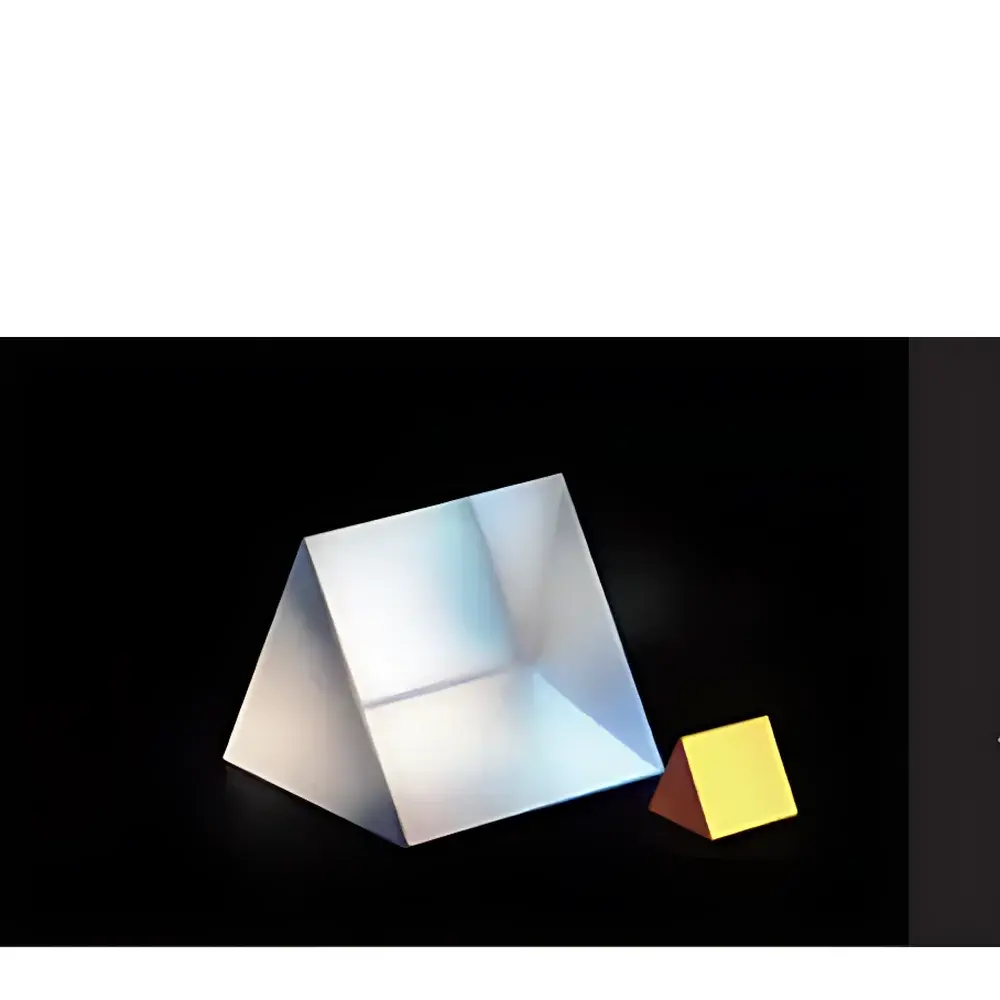
MiXran Meg1054 Dispersive Prism
| Brand | MiXran |
|---|---|
| Origin | Beijing, China |
| Manufacturer Type | Authorized Distributor |
| Product Category | Optical Component |
| Model | Meg1054 |
| Material Options | F4, H-F4, H-ZF13, CaF₂, ZnSe |
| Dimension Range | 10–50 mm (equilateral, A=B=C) |
| Thickness D | 10–40 mm |
| Transmission Range | 180 nm – 16 μm (material-dependent) |
| Polished Faces | 2 (standard) or 3 (ZnSe variants) |
| Compliance | ISO 10110-7, MIL-PRF-13830B surface quality |
Overview
The MiXran Meg1054 Dispersive Prism is a precision-ground equilateral optical prism engineered for controlled angular dispersion in spectroscopic, laser beam steering, and wavelength separation applications. Based on the principle of refraction through a triangular dielectric medium, it operates at the minimum deviation condition—achieved when the internal ray path is parallel to the prism base and the angles of incidence and emergence are equal (α = β). This configuration ensures maximum spectral resolution and minimal beam distortion for monochromatic or broadband sources. The Meg1054 series is fabricated from certified optical-grade materials—including Schott-equivalent F4 and H-F4 crown glasses, high-transmission H-ZF13 dense flint, vacuum-ultraviolet-compatible calcium fluoride (CaF₂), and mid-infrared-transmitting zinc selenide (ZnSe)—each selected and polished to meet stringent wavefront error and surface flatness specifications per ISO 10110-3 and ISO 10110-7. Its design supports collimated beam input and is optimized for use in monochromators, pulse compressors, spectrometer calibration assemblies, and OEM optomechanical subsystems requiring deterministic dispersion without reliance on grating-based alternatives.
Key Features
- Equilateral geometry (A = B = C) with precise apex angle tolerance of ±10 arcseconds, ensuring repeatable dispersion characteristics across production lots
- Material-specific transmission optimization: F4 and H-F4 variants cover 385 nm – 2.0 μm; H-ZF13 extends to 2.3 μm; CaF₂ enables deep-UV throughput down to 180 nm and IR transmission up to 8 μm; ZnSe supports broadband operation from 600 nm to 16 μm
- Surface quality compliant with MIL-PRF-13830B scratch-dig standards (typically 20–10 or better); λ/10 surface flatness (peak-to-valley) over clear aperture
- ZnSe variants feature three-face polishing (including base face) to mitigate total internal reflection at high-index interfaces under minimum-deviation alignment
- AR-coating compatible surfaces (optional): single- or dual-band anti-reflection coatings available upon request for specified wavelength ranges (e.g., 1064 nm + 532 nm, or 3–5 μm MWIR band)
- Traceable metrology: each unit supplied with individual test report including interferometric surface map, spectral transmittance curve (200 nm – 16 μm), and dimensional verification data
Sample Compatibility & Compliance
The Meg1054 prism is compatible with standard kinematic mounts (e.g., Thorlabs KM100, Newport UMB12) and integrates seamlessly into ISO-standard optical tables and breadboard systems. It meets mechanical and environmental stability requirements for laboratory and light industrial environments (operating temperature: −10 °C to +50 °C; humidity: <70% RH non-condensing). All glass variants comply with RoHS Directive 2011/65/EU and REACH Annex XVII restrictions. CaF₂ and ZnSe components are manufactured under cleanroom-controlled conditions (ISO Class 7) and undergo outgassing testing per ASTM E595 for vacuum-compatible applications. Documentation includes material certification (CDGM batch traceability), surface quality inspection records, and spectral transmission validation per ISO 9050.
Software & Data Management
While the Meg1054 is a passive optical component, its integration into automated optical systems benefits from standardized metadata handling. Each prism is assigned a unique serial number linked to a digital product dossier containing: (i) measured refractive index vs. wavelength (n(λ)) data referenced to Schott catalog values; (ii) calculated minimum deviation angle and dispersion dθ/dλ across operational bands; (iii) interferometric surface error maps (Zernike coefficients provided upon request); and (iv) compliance certificates exportable in PDF/A-1b format. For customers implementing LIMS or QMS platforms (e.g., LabWare, TrackWise), MiXran provides structured CSV exports supporting GLP/GMP audit trails—including operator ID, calibration date, and measurement uncertainty budgets per GUM (JCGM 100:2018).
Applications
- Spectral calibration of UV-Vis-NIR spectrophotometers (e.g., PerkinElmer Lambda 950, Agilent Cary 6000i)
- Beam combining and separation in ultrafast Ti:sapphire and Yb-fiber laser systems
- Reference dispersive element in Fourier-transform infrared (FTIR) auxiliary optics
- Collimated white-light source conditioning for colorimetric sensor validation
- OEM integration into portable Raman spectrometers and handheld NIR analyzers
- Education and research labs: demonstration of Snell’s law, Cauchy dispersion modeling, and Sellmeier coefficient fitting
FAQ
What is the significance of minimum deviation in prism operation?
Minimum deviation occurs when the light path inside the prism is symmetric relative to the apex angle, yielding the most stable and reproducible dispersion angle—critical for calibration-grade instruments where angular repeatability must be within ±0.5 arcminutes.
Why do ZnSe prisms require three polished faces?
Due to ZnSe’s high refractive index (~2.4 at 10.6 μm), the critical angle at the prism base interface falls below the internal ray angle under standard minimum-deviation geometry, causing total internal reflection. Polishing the base face allows controlled output coupling and preserves beam integrity.
Can the Meg1054 be used in vacuum or high-humidity environments?
CaF₂ and ZnSe variants are vacuum-compatible (outgassing rate <1.0 × 10⁻⁵ g/(cm²·h) per ASTM E595); all glass versions are rated for non-condensing humidity up to 70% RH. Optional hermetic sealing is available for extended environmental duty.
Is spectral transmittance data provided for each unit?
Yes—each shipped Meg1054 includes a calibrated UV-Vis-NIR-MIR transmittance curve (200 nm – 16 μm) acquired on a PerkinElmer Lambda 1050+ spectrophotometer with integrating sphere accessory, traceable to NIST SRM 2036.
Do you offer custom apex angles or non-equilateral geometries?
Custom designs—including 30°–75° apex angles, right-angle prisms, and Brewster-angle variants—are available under MiXran’s OEM engineering program (lead time: 8–12 weeks; MOQ: 5 units).




