
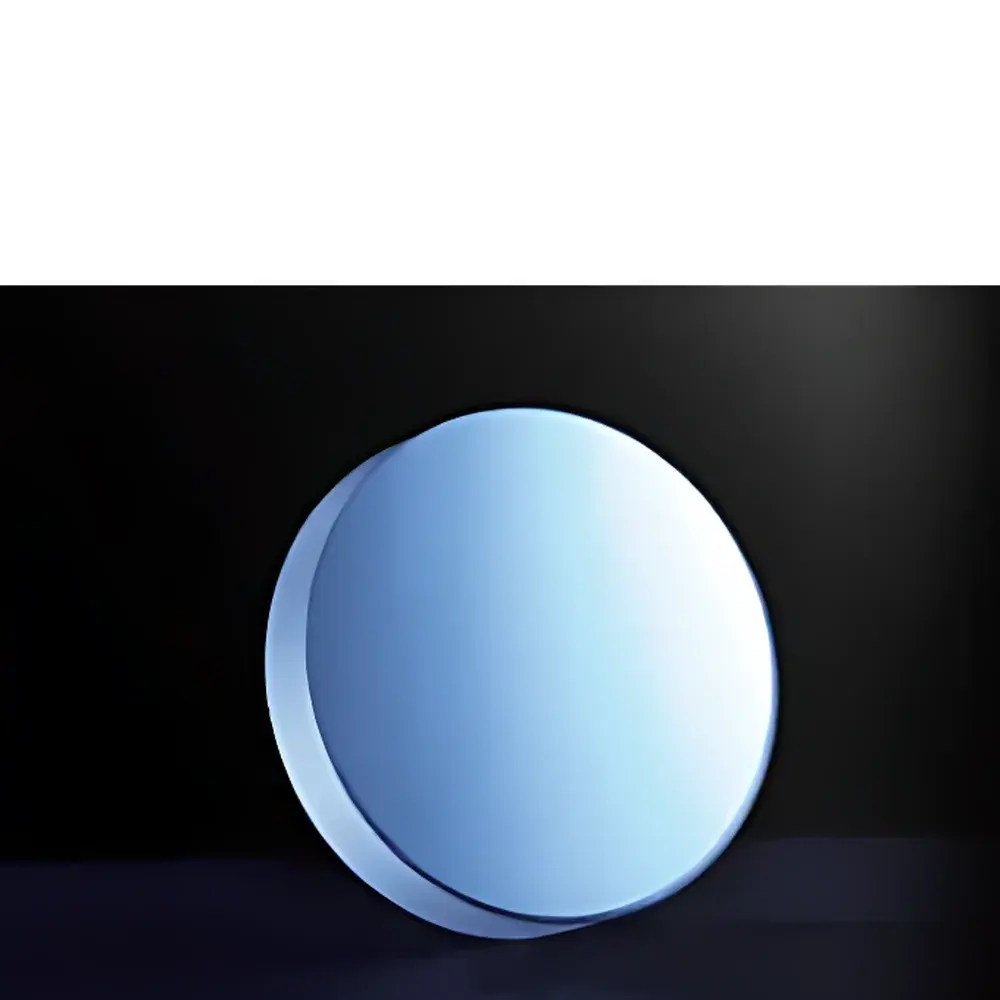
MiXran Meg1095 UV-Fused Silica Broadband Beamsplitter Wedge
| Brand | MiXran |
|---|---|
| Model | Meg1095 |
| Substrate | UV-grade fused silica |
| Surface 1 (S1) | Broadband dielectric beamsplitter coating (R/T tolerance ±10% over specified band) |
| Surface 2 (S2) | Broadband anti-reflection coating (Ravg <1% over designated spectral range) |
| Available configurations | Φ12.5 mm, 12.5×12.5 mm, Φ25 mm, 25×25 mm, Φ50 mm, 50×50 mm |
| Thickness options | 3 mm, 5 mm, 8 mm |
| Beamsplitting ratios | 30R/70T, 50R/50T, 70R/30T |
| AR coating bands | UV (250–400 nm), VIS (400–700 nm), NIR (700–1100 nm) |
| Compliance | ISO 10110 optical surface specifications, RoHS-compliant materials |
Overview
The MiXran Meg1095 is a precision-engineered broadband beamsplitter wedge fabricated from high-purity UV-grade fused silica. Designed for demanding optical systems requiring minimal wavefront distortion and high transmission stability across wide spectral ranges, this component leverages the exceptional homogeneity, low thermal expansion (5.5 × 10⁻⁷ /°C), and deep-UV transparency of synthetic fused silica. Unlike standard BK7 or N-BK7 wedges, the Meg1095 maintains consistent performance down to 250 nm — critical for applications in UV spectroscopy, ultrafast laser pulse division, fluorescence excitation pathways, and broadband interferometry. Its wedge geometry eliminates ghost reflections by angularly separating residual back-reflections from the primary optical path, while the precisely controlled thickness gradient ensures predictable beam displacement without introducing significant lateral shear. The device operates on the principle of partial reflection/transmission via thin-film interference coatings deposited using ion-assisted e-beam evaporation, enabling spectrally tailored splitting behavior with tight control over polarization dependence.
Key Features
- UV-grade fused silica substrate with OH-content <1 ppm, ensuring high transmission from 185 nm to 2.1 µm
- S1 face coated with robust, adhesion-optimized dielectric beamsplitter film; R/T ratio tolerance maintained within ±10% across full nominal bandwidth
- S2 face featuring multi-layer broadband anti-reflection (BBAR) coating: Ravg <1% over UV (250–400 nm), VIS (400–700 nm), or NIR (700–1100 nm) bands — selected per configuration
- Surface quality: 20–10 scratch-dig per MIL-PRF-13830B; surface flatness λ/10 @ 633 nm (verified interferometrically)
- Wedge angle precision: ±2 arcsec, minimizing beam deviation error in collimated setups
- Environmental durability: Coatings qualified to ISO 9211-3 (adhesion, humidity, abrasion) and MIL-C-48497A (laser damage threshold >5 J/cm² at 1064 nm, 10 ns, 20 Hz)
Sample Compatibility & Compliance
The Meg1095 is compatible with standard optomechanical mounts including SM1 (1.035″-40), SM2 (2.035″-56), and kinematic cage systems. Its substrate material and coating architecture meet ISO 10110-7 cleanliness standards for cleanroom-integrated instrumentation. All units are manufactured under documented process controls aligned with ISO 9001:2015 requirements. While not a medical or safety-critical device, the component supports system-level compliance with IEC 61000-4 electromagnetic immunity standards when integrated into shielded optical enclosures. For regulated analytical instruments (e.g., UV-Vis spectrophotometers compliant with USP or ASTM E275), the Meg1095’s certified spectral performance data — including measured R/T curves and wavefront error maps — are provided in the Certificate of Conformance accompanying each shipment.
Software & Data Management
No embedded firmware or driver software is associated with the Meg1095, as it is a passive optical component. However, MiXran provides downloadable spectral performance datasets (CSV and SDF format) for all standard configurations, compatible with Zemax OpticStudio, CODE V, and FRED optical design platforms. Each product shipment includes a traceable calibration report listing measured reflectance/transmittance spectra (±0.3 nm wavelength accuracy), surface flatness interferograms, and coating adhesion test results. Raw measurement data is archived for 10 years and available upon request for GLP/GMP audit support. All documentation conforms to ISO/IEC 17025 clause 7.6 requirements for measurement traceability.
Applications
- UV-resolved Raman spectroscopy beam routing, where deep-UV throughput and low autofluorescence are essential
- Multi-channel fluorescence detection systems requiring simultaneous excitation and emission path separation
- Ultrafast Ti:sapphire and Yb:fiber laser systems operating at 800 nm or 1030 nm, benefiting from low group delay dispersion (GDD) introduced by fused silica
- Fourier-transform infrared (FTIR) reference arms requiring stable, broadband splitting without spectral ripple
- Custom optical coherence tomography (OCT) interferometers utilizing dual-band (VIS+NIR) illumination schemes
- Space-qualified Earth observation sensor breadboards, leveraging the radiation hardness and vacuum stability of UV fused silica
FAQ
What spectral bands are supported by the S2 anti-reflection coating?
The Meg1095 is available with three distinct BBAR options: UV (250–400 nm), VIS (400–700 nm), or NIR (700–1100 nm). Each is optimized independently; no single coating covers the full 250–1100 nm range.
Is the wedge angle customizable?
Standard production uses a fixed wedge angle of 0.5°. Custom angles between 0.1° and 3.0° are available under OEM agreement with minimum order quantities.
Can the Meg1095 be used in high-power CW laser applications?
Yes — when operated within its specified power density limits (≤1 kW/cm² for 1064 nm CW, derated for shorter wavelengths), and with proper heat sinking of the mount. LDT testing data is included in the CoC.
Are mounting fixtures included?
No. The Meg1095 is supplied as a bare optic. Compatible lens tubes, retaining rings, and kinematic mounts are listed in the MiXran Optical Mounting Accessories Catalog.
How is coating durability verified?
Each batch undergoes salt-spray (ASTM B117), tape-adhesion (ASTM D3359), and humidity cycling (IEC 60068-2-78) per ISO 9211-3. Full test reports are available upon request.





