
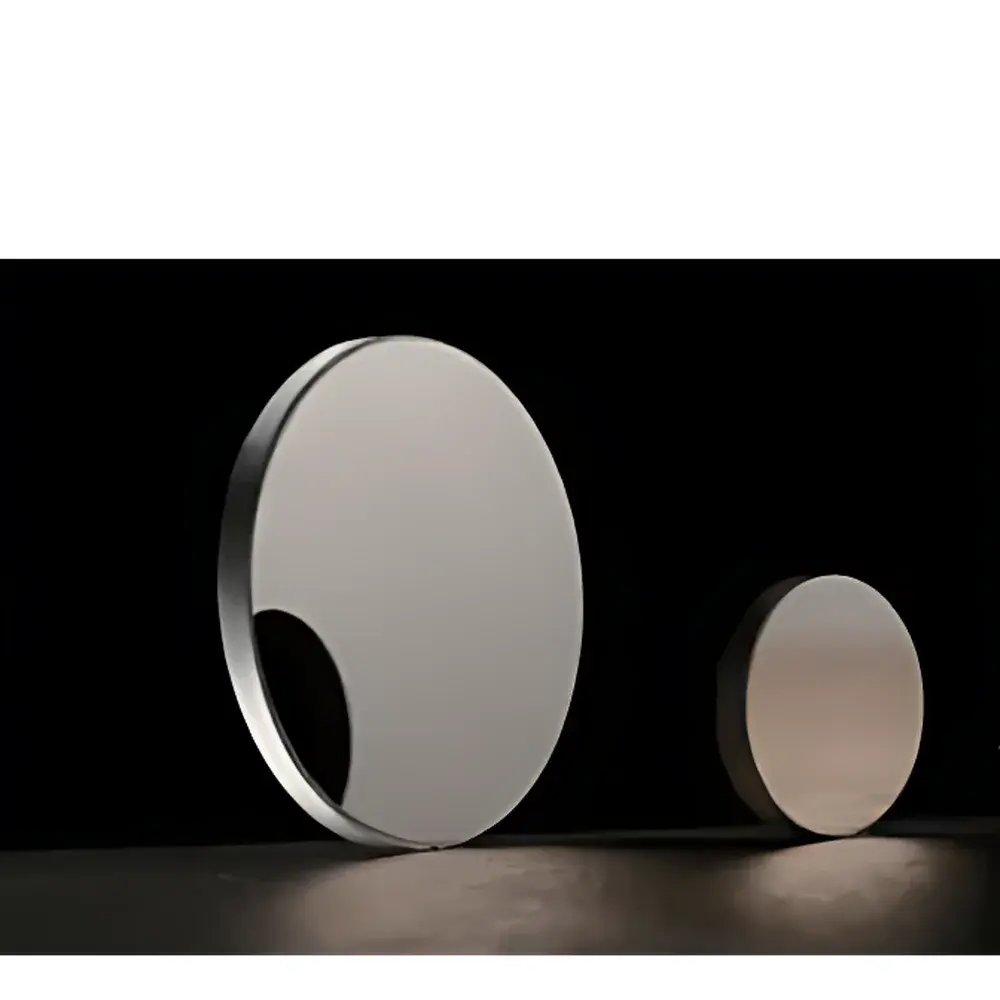
MiXran Meg1114 Reflective Neutral Density Filter (UV–NIR)
| Brand | MiXran |
|---|---|
| Origin | Beijing, China |
| Model | Meg1114 |
| Component Category | Optical Element |
| Available Diameters | Φ12.5 mm, Φ25 mm, Φ50 mm |
| Design Wavelength | 300 nm |
| Optical Density (OD) | 0.1–3.0 (10-step series) |
| Transmission (T) | 79%–0.10% |
| Coating Type | Vacuum-deposited reflective metal-dielectric stack |
| Spectral Range | 200–1100 nm |
| Surface Quality | 60-40 scratch-dig |
| Flatness | λ/4 @ 633 nm |
| Substrate Material | UV-grade fused silica |
| Mounting Compatibility | Standard SM1 (1.035"-40) and SM2 (2.035"-40) lens tubes |
Overview
The MiXran Meg1114 is a precision-engineered reflective neutral density (ND) filter designed for stable, wavelength-independent attenuation across the ultraviolet to near-infrared spectrum (200–1100 nm). Unlike absorptive ND filters—whose transmission characteristics shift with angle of incidence and exhibit thermal drift under high-intensity illumination—the Meg1114 employs a multi-layer vacuum-deposited metal-dielectric coating on UV-grade fused silica substrate. This reflective architecture ensures minimal absorption, negligible heating, and exceptional power handling capability—critical for laser applications, spectrophotometer calibration, and optical power management in demanding laboratory and industrial environments. Each filter is specified at 300 nm (a key reference point for UV-sensitive instrumentation), with calibrated optical density (OD) values ranging from OD 0.1 (T = 79%) to OD 3.0 (T = 0.10%), traceable to NIST-traceable spectrophotometric measurement protocols.
Key Features
- Vacuum-deposited reflective coating architecture enabling low thermal load, high damage threshold (>5 J/cm² @ 10 ns, 1064 nm), and angular insensitivity up to ±10°
- UV-grade fused silica substrate with high transmission below 200 nm and excellent homogeneity (Δn < 5 × 10⁻⁶)
- Optical density tolerance: ±0.03 OD across the full 200–1100 nm band, verified via double-beam UV-Vis-NIR spectrophotometry
- Surface flatness λ/4 @ 633 nm and surface quality 60-40 scratch-dig per MIL-PRF-13830B
- Three standardized diameters (Φ12.5 mm, Φ25 mm, Φ50 mm) compatible with industry-standard kinematic mounts, lens tubes (SM1/SM2), and filter wheels
- Individually serialized and supplied with a calibration certificate listing measured OD vs. wavelength data (200–1100 nm, 1 nm resolution)
Sample Compatibility & Compliance
The Meg1114 is suitable for integration into optical paths requiring precise, repeatable attenuation without spectral distortion—including laser cavity dumping, beam profiling, photodetector linearity testing, and radiometric calibration setups. Its reflective design avoids fluorescence or outgassing issues common with polymer-based absorptive filters, making it compliant with ultra-high-vacuum (UHV) compatible optical systems when mounted in appropriate holders. The product meets ISO 9022-3:2015 (optical instruments — environmental testing — mechanical shock) and conforms to RoHS Directive 2011/65/EU. While not certified to FDA or IEC 61000 standards (as passive optical components are exempt), its material composition and coating process documentation support GLP/GMP audit readiness for regulated analytical laboratories.
Software & Data Management
Each Meg1114 filter ships with a digital calibration report in PDF and CSV formats, containing spectral transmittance data (wavelength vs. %T) measured on a PerkinElmer Lambda 1050+ spectrophotometer equipped with a 150 mm integrating sphere and deuterium/halogen/Xenon light sources. The CSV file is structured for direct import into MATLAB, Python (NumPy/Pandas), or LabVIEW for automated system characterization and correction algorithms. No proprietary software is required; spectral data may be used to generate custom attenuation lookup tables in instrument firmware or control software complying with IEEE 1584-2020 (standard for spectral data exchange).
Applications
- Laser power stabilization and pulse energy attenuation in Ti:sapphire, Nd:YAG, and excimer laser systems
- Reference-grade attenuation in UV-Vis-NIR spectrophotometers for photometric accuracy verification (per ASTM E275 and ISO 6246)
- Calibration of CCD/CMOS-based imaging systems, especially in fluorescence microscopy where stray light suppression is critical
- Beam splitter alternatives in interferometric setups requiring fixed, non-polarizing attenuation
- Optical density standardization in environmental monitoring sensors operating under solar-simulated irradiance
- Integration into automated optical test benches compliant with MIL-STD-810H optical subsystem validation protocols
FAQ
Is the Meg1114 polarization-sensitive?
No. The reflective metal-dielectric stack is engineered for <1% polarization-dependent loss (PDL) across 200–1100 nm at normal incidence.
Can Meg1114 filters be cleaned using standard optical procedures?
Yes. Use spectroscopic-grade acetone followed by methanol, applied with lint-free polyester wipes (e.g., Texwipe TX609); avoid ultrasonic cleaning due to potential coating delamination.
What is the maximum incident power density the Meg1114 can withstand?
Continuous-wave: 500 W/cm² @ 532 nm (measured on Ø25 mm variant, 10 mm beam diameter); pulsed: 5 J/cm² @ 10 ns, 10 Hz, 1064 nm (tested per ISO 21254-1).
Are custom OD values or diameters available?
Yes. MiXran offers OEM customization including non-standard diameters (up to Ø100 mm), OD interpolation (e.g., OD 1.75), and AR-coated back surfaces—lead time: 6–8 weeks.
Does the calibration certificate include uncertainty budgets?
Yes. Each certificate reports expanded uncertainty (k = 2) for OD at 300 nm, typically ±0.015 OD, derived from spectrophotometer repeatability, reference standard traceability, and environmental stability during measurement.



