
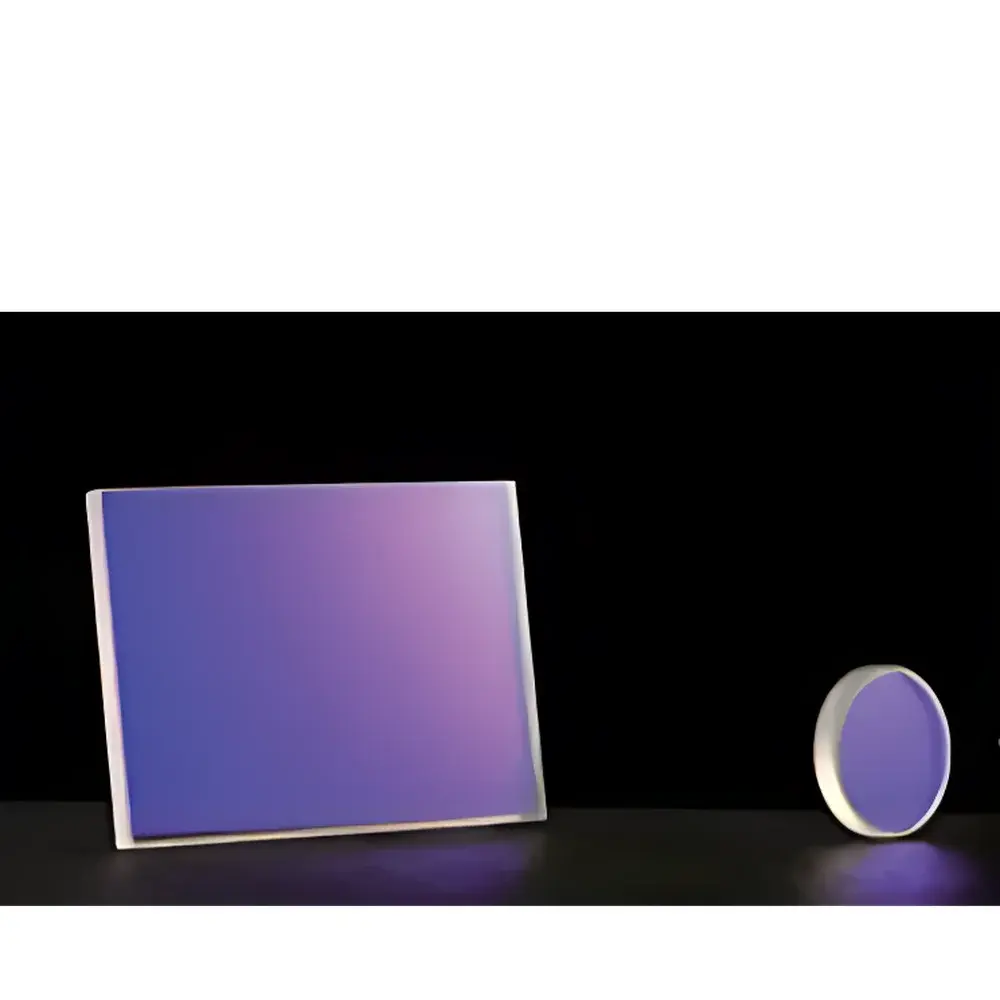
MiXran Meg1120 Dichroic Short-Wave Pass Beamsplitter
| Brand | MiXran |
|---|---|
| Model | Meg1120 |
| Component Type | Optical Element |
| Substrate Material | Fused Silica (Standard) |
| Surface Flatness | λ/4 @ 633 nm |
| Surface Quality | 20–10 Scratch-Dig |
| Coating Type | Hard Dielectric Multilayer |
| Incident Angle | 45° ± 1° |
| Transmission Bandwidth (FWHM) | 370–820 nm (varies by center wavelength) |
| Reflection Bandwidth (FWHM) | 470–1110 nm (complementary to transmission) |
| Available Apertures | Ø12.5 mm, Ø25 mm, 12.5 × 17.5 mm, 25 × 36 mm |
| Optical Density (OD) in Blocking Regions | ≥ OD4.0 (typ. @ 532 nm blocking for 500 nm CWL variant) |
| Laser Damage Threshold | > 500 mJ/cm² @ 10 ns, 10 Hz, 1064 nm (tested per ISO 21254-1) |
Overview
The MiXran Meg1120 is a high-performance dichroic short-wave pass beamsplitter engineered for precision optical path management in fluorescence microscopy, spectral separation systems, laser combiners, and multi-channel detection setups. Unlike conventional absorptive or interference-based long-wave or short-wave pass filters designed for near-normal incidence (0°), the Meg1120 employs a rigorously optimized hard-dielectric multilayer coating deposited on high-grade fused silica substrates, specifically tailored for operation at a nominal 45° angle of incidence. This geometry enables spatial separation of transmitted and reflected spectral bands—transmitting shorter wavelengths while reflecting longer ones—thereby facilitating compact, alignment-stable beam routing without chromatic aberration or polarization-dependent loss beyond specified tolerances. Its design adheres to fundamental principles of thin-film interference and phase-matching criteria for s- and p-polarized components, ensuring predictable performance across broadband visible and near-infrared spectra.
Key Features
- Engineered for 45° AOI operation with minimal wavefront distortion (λ/4 surface flatness over clear aperture)
- Hard dielectric coatings provide excellent environmental stability, humidity resistance, and long-term spectral fidelity (no bleaching or drift under standard lab conditions)
- Multiple center wavelength options (450 nm to 850 nm) with precisely defined transmission and reflection bands; each variant maintains ≥ OD4.0 blocking in designated rejection regions
- Available in round (Ø12.5 mm, Ø25 mm) and rectangular (12.5 × 17.5 mm, 25 × 36 mm) formats to accommodate OEM integration and modular optical breadboard configurations
- Fused silica substrate ensures low autofluorescence, high UV-VIS-NIR transmission, and thermal expansion coefficient matched to common optomechanical mounts
- Compliant with ISO 10110-7 surface quality standards (20–10 scratch-dig) and RoHS directive for hazardous substances
Sample Compatibility & Compliance
The Meg1120 is compatible with standard kinematic mounts, cage systems (e.g., Thorlabs 30 mm and 60 mm), and custom-designed filter holders requiring 45° beam folding. It supports both continuous-wave and pulsed laser sources—including 405 nm, 488 nm, 532 nm, 640 nm, and 785 nm diodes and solid-state lasers—provided fluence remains within specified damage thresholds. Spectral performance is validated using calibrated spectrophotometers traceable to NIST standards. The component meets requirements for use in ISO/IEC 17025-accredited laboratories and aligns with optical safety classifications per IEC 60825-1 when integrated into Class 1 or Class 3R systems. No special handling or inert atmosphere storage is required; standard cleanroom protocols (Class 1000 or better) are sufficient for maintenance.
Software & Data Management
While the Meg1120 is a passive optical component and requires no firmware or driver software, its spectral specifications are fully documented in machine-readable format (CSV and JSON) for integration into optical design workflows. Manufacturer-provided Zemax OpticStudio and CODE V coating files include full dispersion models and polarization-resolved reflectance/transmittance curves. All product variants are assigned unique GTIN/EAN codes and serialized batch identifiers traceable through MiXran’s quality management system, supporting GLP-compliant recordkeeping and audit-ready documentation packages upon request.
Applications
- Fluorescence excitation/emission separation in epifluorescence and confocal microscopes
- Multi-laser beam combining in flow cytometry and Raman spectroscopy excitation paths
- Spectral channel routing in hyperspectral imaging engines and OCT reference arms
- UV-VIS-NIR beam conditioning for photoluminescence quantum yield measurement systems
- Alignment-free optical cavity construction in tunable laser cavities and external cavity diode lasers (ECDLs)
- Industrial machine vision systems requiring simultaneous visible and NIR inspection channels
FAQ
What is the maximum incident power density this beamsplitter can handle?
The Meg1120 exhibits a laser-induced damage threshold (LIDT) of >500 mJ/cm² at 1064 nm (10 ns pulse width, 10 Hz repetition rate), as verified per ISO 21254-1. For CW applications, thermal loading limits depend on mounting configuration and ambient airflow; contact technical support for application-specific derating guidance.
Is polarization sensitivity characterized for all center wavelengths?
Yes—polarization-dependent transmittance (PDT) and reflectance (PDR) data are available for all standard variants, showing ≤ ±3% variation between s- and p-states within the specified passbands.
Can the Meg1120 be used at angles other than 45°?
Performance deviates significantly outside ±1° of nominal 45° incidence due to coating design constraints; angular tuning is not supported. For variable-angle applications, consider custom-designed tunable dichroics.
Are custom sizes or non-standard center wavelengths available?
Yes—MiXran offers OEM coating services with lead times of 8–12 weeks for non-standard geometries, substrates (e.g., BK7, CaF₂), or spectral targets meeting minimum order quantities.
Does the product include calibration certificates?
Standard shipments include a Certificate of Conformance (CoC) with lot-specific spectral scan reports. NIST-traceable calibration certificates are available as an optional add-on for regulated environments.




