
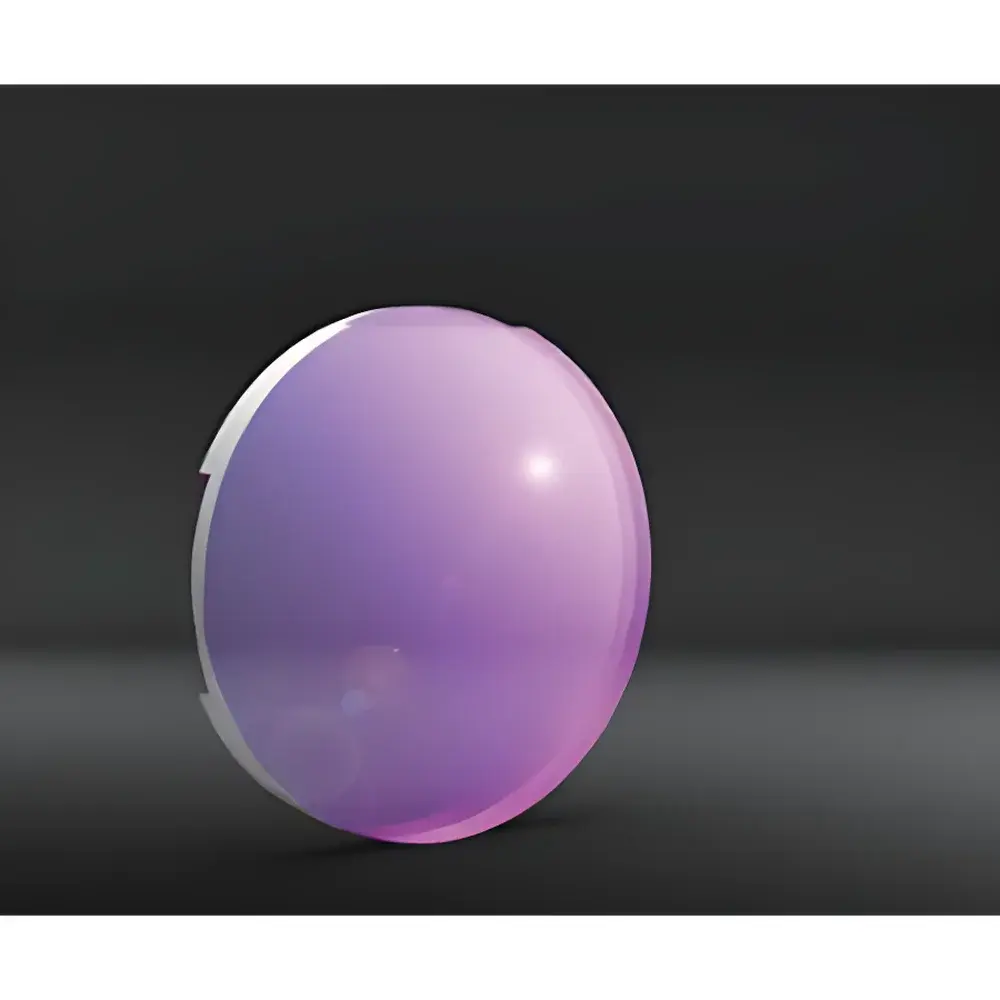
MiXran Meg1121 Zero-Order Glued Waveplate
| Brand | MiXran |
|---|---|
| Model | Meg1121 |
| Optical Component Type | Zero-Order Waveplate |
| Mounting Diameter | 12.7 mm or 25.4 mm |
| Center Wavelength (CWL) | 355–1550 nm |
| Retardation | λ/4 or λ/2 |
| Substrate Material | Crystalline Quartz |
| Construction | Cemented Zero-Order Design |
| Surface Quality | 20–10 scratch-dig |
| Wavefront Distortion | < λ/8 @ 633 nm |
| Extinction Ratio | > 300:1 |
| Damage Threshold | > 500 MW/cm² (10 ns, 1064 nm, pulsed) |
| Operating Temperature Range | –40 °C to +80 °C |
Overview
The MiXran Meg1121 is a precision-engineered zero-order glued waveplate designed for high-stability polarization control in demanding optical systems. Unlike true zero-order waveplates fabricated from a single thick quartz crystal—which are mechanically fragile and thermally sensitive—the Meg1121 employs a cemented dual-element architecture: two precisely oriented quartz plates bonded with an optically matched, low-birefringence adhesive layer. This construction yields a net retardation equivalent to a true zero-order device while significantly improving thermal stability, mechanical robustness, and spectral flatness across its operational bandwidth.
Operating on the principle of birefringent phase retardation, the Meg1121 introduces a controlled, wavelength-dependent phase shift (Δφ = 2π·Δn·d/λ) between orthogonal polarization components propagating through the extraordinary and ordinary axes of the quartz crystal. Its zero-order design ensures minimal temperature-induced drift (< 0.002λ/°C), making it suitable for applications requiring long-term polarization fidelity—such as cavity-dumped lasers, interferometric metrology, ellipsometry, and quantum optics setups where residual dispersion and thermal hysteresis must be rigorously minimized.
Key Features
- Cemented zero-order architecture delivering true λ/4 or λ/2 retardation with < ±0.5% deviation across specified CWL range
- Available in standard diameters: 12.7 mm (0.5″) and 25.4 mm (1.0″), both with precision ground and polished parallel faces (≤ 10 arcsec wedge)
- Center wavelength options spanning UV to IR: 355 nm, 400 nm, 488 nm, 532 nm, 632.8 nm, 670 nm, 780 nm, 808 nm, 850 nm, 980 nm, 1064 nm, and 1550 nm
- High laser damage threshold (>500 MW/cm² at 1064 nm, 10 ns pulse width), validated per ISO 21254-1
- Surface quality compliant with MIL-PRF-13830B: 20–10 scratch-dig specification; AR-coated variants available upon request (R<0.25% per surface)
- Wavefront distortion ≤ λ/8 @ 633 nm, measured via Zygo GPI interferometry
Sample Compatibility & Compliance
The Meg1121 is compatible with free-space beam paths in collimated or mildly focused configurations (beam diameter ≤ 80% of clear aperture). It is not intended for use in high-power fiber-coupled systems without appropriate mode conditioning. The quartz substrate meets ASTM F263-22 specifications for synthetic crystalline silica used in precision optical components. All units undergo 100% spectral verification using a calibrated JASCO V-770 UV/Vis/NIR spectrophotometer equipped with a Glan-Taylor polarizer and rotating analyzer configuration. Traceable calibration certificates (NIST-traceable reference standards) are supplied with each batch. The product conforms to RoHS Directive 2011/65/EU and REACH Regulation (EC) No. 1907/2006.
Software & Data Management
While the Meg1121 is a passive optical component and requires no embedded firmware or driver software, MiXran provides downloadable technical documentation packages including: (1) spectral retardation curves (Δφ vs. λ) for each CWL variant, (2) temperature-dependent retardation coefficients (dΓ/dT), (3) angular acceptance maps (retardation uniformity vs. incidence angle up to ±5°), and (4) interferometric surface flatness reports. These files are delivered in standardized formats (CSV, PDF, and Zemax-compatible .ZBF files) for integration into optical design workflows (e.g., Zemax OpticStudio, CODE V, FRED). Batch-specific test data is archived for 10 years and accessible via MiXran’s secure customer portal under unique serial-number authentication.
Applications
- Polarization state generation and analysis in ellipsometers and Mueller matrix polarimeters
- Q-switching and mode-locking control in solid-state and fiber laser cavities
- Optical isolation enhancement when paired with Faraday rotators
- Compensation of birefringence in ultrafast amplifier chains (e.g., Ti:sapphire, Yb:fiber)
- Quantum key distribution (QKD) systems requiring deterministic half-wave or quarter-wave transformations
- Calibration standards for polarization-sensitive detectors and camera-based Stokes imaging systems
FAQ
What distinguishes a cemented zero-order waveplate from a multi-order or true zero-order design?
Cemented zero-order devices combine two oppositely oriented birefringent plates to cancel higher-order interference effects while retaining the thermal and spectral advantages of near-zero-order operation. They offer superior temperature stability compared to multi-order plates and greater mechanical reliability than single-crystal true zero-order equivalents.
Can the Meg1121 be used at wavelengths other than its specified CWL?
Yes—retardation scales inversely with wavelength. A λ/2 plate at 1064 nm functions as ~λ/2.5 at 808 nm. For broadband or tunable-source applications, consult the provided spectral retardation curve to determine effective order and tolerance limits.
Is custom coating or mounting available?
Standard units ship uncoated. Anti-reflection coatings optimized for specific wavelength bands (e.g., 1030–1080 nm for Yb amplifiers) and kinematic mounts with SM1-threaded housings are available as OEM options with lead times of 4–6 weeks.




