
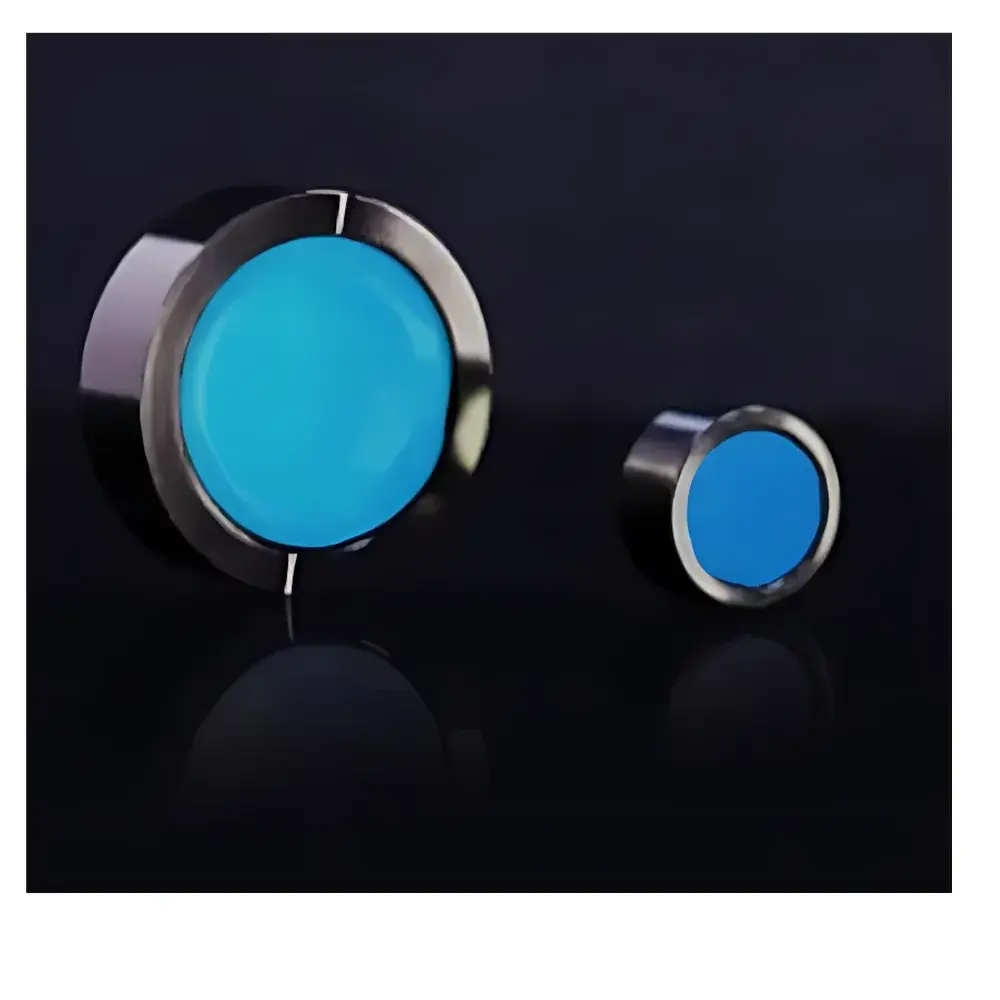
MiXran Meg1135 Achromatic Waveplate
| Brand | MiXran |
|---|---|
| Model | Meg1135 |
| Type | Achromatic Quarter- and Half-Wave Plate |
| Diameter | 25.4 mm |
| Thickness | 6.35 mm |
| Clear Aperture | ≥18.0 mm |
| Incident Angle | 0° |
| Wavelength Ranges | VIS (450–650 nm), NIR (650–1100 nm), SWIR (900–2100 nm) |
| Retardation Accuracy | λ/150 (VIS/NIR), λ/50 (SWIR) |
| Surface Reflectivity | R < 0.5% (VIS/NIR), R < 0.75% (SWIR) |
| Coating | Broadband Anti-Reflection (AR) |
| Material | Fused Silica / MgF₂ / Crystal Quartz Composite Stack |
Overview
The MiXran Meg1135 Achromatic Waveplate is a precision optical component engineered for stable, wavelength-insensitive polarization control across broad spectral bands. Unlike single-material zero-order or multi-order waveplates—whose retardation varies quadratically with wavelength—the Meg1135 employs a bonded achromatic design consisting of two birefringent materials (typically fused silica and crystalline quartz, or quartz and magnesium fluoride) with opposing dispersion characteristics. This composite architecture compensates for wavelength-dependent phase shift, delivering near-constant retardation (λ/4 or λ/2) over defined spectral windows: 450–650 nm (visible), 650–1100 nm (near-infrared), and 900–2100 nm (short-wave infrared). The device operates at normal incidence (0°), ensuring minimal beam deviation and polarization distortion, and is optimized for integration into laser systems, interferometers, ellipsometers, and polarization-sensitive spectroscopy platforms requiring high reproducibility under thermal and mechanical stress.
Key Features
- Achromatic design validated for ±λ/150 retardation accuracy in VIS and NIR bands, and ±λ/50 in SWIR—meeting ISO 10110-5 surface figure and retardation uniformity specifications.
- 25.4 mm clear aperture with ≥18.0 mm usable clear aperture, supporting collimated beams up to 15 mm diameter without vignetting.
- 6.35 mm total thickness with precision-ground parallelism (<1 arcsec) and surface flatness λ/10 @ 633 nm (verified via interferometry).
- Broadband anti-reflection coating applied on both faces: R < 0.5% average across 450–650 nm and 650–1100 nm; R < 0.75% across 900–2100 nm—reducing ghost reflections and improving system throughput.
- Zero-order equivalent performance achieved without air-gap construction, eliminating sensitivity to temperature-induced cavity shifts and enabling operation in vacuum or high-humidity environments.
- Mounted compatibility: Designed for standard SM1-threaded lens tubes (1.035″-40) and kinematic mounts; optional housed versions available with engraved orientation marks and NIST-traceable calibration report.
Sample Compatibility & Compliance
The Meg1135 is compatible with continuous-wave (CW) and pulsed laser sources operating within its specified wavelength ranges—including Ti:sapphire, Nd:YAG (fundamental and harmonics), fiber lasers (e.g., Yb-doped, Er-doped), and supercontinuum sources. It withstands power densities up to 500 MW/cm² (10 ns, 10 Hz) in nanosecond-pulsed regimes and >10 kW/cm² for CW applications when properly cooled. All units comply with RoHS 2015/863/EU and REACH SVHC regulations. Optical coatings meet MIL-C-48497A durability standards (Class 3 adhesion, abrasion resistance per ASTM D3359). Retardation calibration data is traceable to NIST SRM 2085 (polarization reference standard), supporting GLP-compliant documentation workflows.
Software & Data Management
While the Meg1135 is a passive optical element, its integration into automated systems is supported via standardized mounting interfaces and alignment fiducials. For metrology-grade deployment, MiXran provides optional digital calibration certificates (PDF + CSV) including measured retardation vs. wavelength curves (scanned at 1 nm resolution using a calibrated rotating analyzer polarimeter), spatial uniformity maps (10×10 grid), and environmental stability test logs (±0.5°C, 30–70% RH, 24 h). These files are structured to interface with LabVIEW, MATLAB, and Python-based optical modeling pipelines (e.g., PyOptica, LightPipes) and satisfy audit requirements under FDA 21 CFR Part 11 when paired with electronic lab notebooks (ELNs) that enforce user authentication and change logging.
Applications
- Polarization state generation and analysis in Mueller matrix ellipsometry for thin-film metrology (SiO₂, SiNₓ, photoresists).
- Optical isolation in high-power laser cavities using λ/4 + Faraday rotator configurations.
- Compensation of birefringence in ultrafast pulse compressors and stretcher–compressor setups.
- Phase modulation in quantum optics experiments involving entangled photon pairs (SPDC sources).
- Real-time polarization control in adaptive optics systems for astronomy and ophthalmic imaging.
- Calibration reference in field-deployable spectropolarimeters used for remote sensing and vegetation stress monitoring.
FAQ
What is the difference between an achromatic waveplate and a zero-order waveplate?
An achromatic waveplate uses multiple birefringent layers to flatten the wavelength dependence of retardation, whereas a zero-order waveplate achieves nominal λ/4 or λ/2 retardation by combining two multi-order plates with opposite sign—offering better bandwidth than single-plate designs but still exhibiting significant dispersion outside its design wavelength.
Can the Meg1135 be used at non-normal incidence?
No—it is optimized for 0° incidence. Tilting introduces ellipticity, spatially varying retardation, and beam walk-off; custom wedged variants for oblique use are available upon request.
Is there a version with higher damage threshold for ultrafast lasers?
Yes—MiXran offers a fused-silica–calcite hybrid variant (Meg1135-ULP) rated for >1 J/cm² at 800 nm, 35 fs, 1 kHz, with ion-beam-sputtered AR coatings meeting ISO 11254-1 LIDT Class 3 requirements.
Do you provide spectral retardation data for individual units?
Yes—each shipped unit includes a unique serial-numbered calibration report with full spectral retardation curve, uniformity map, and coating reflectance scan.
How is thermal stability characterized?
Retardation drift is ≤±0.005λ/°C from −20°C to +70°C, verified per ISO 10110-10 thermal cycling protocol (3 cycles, 2 h dwell per step).





