
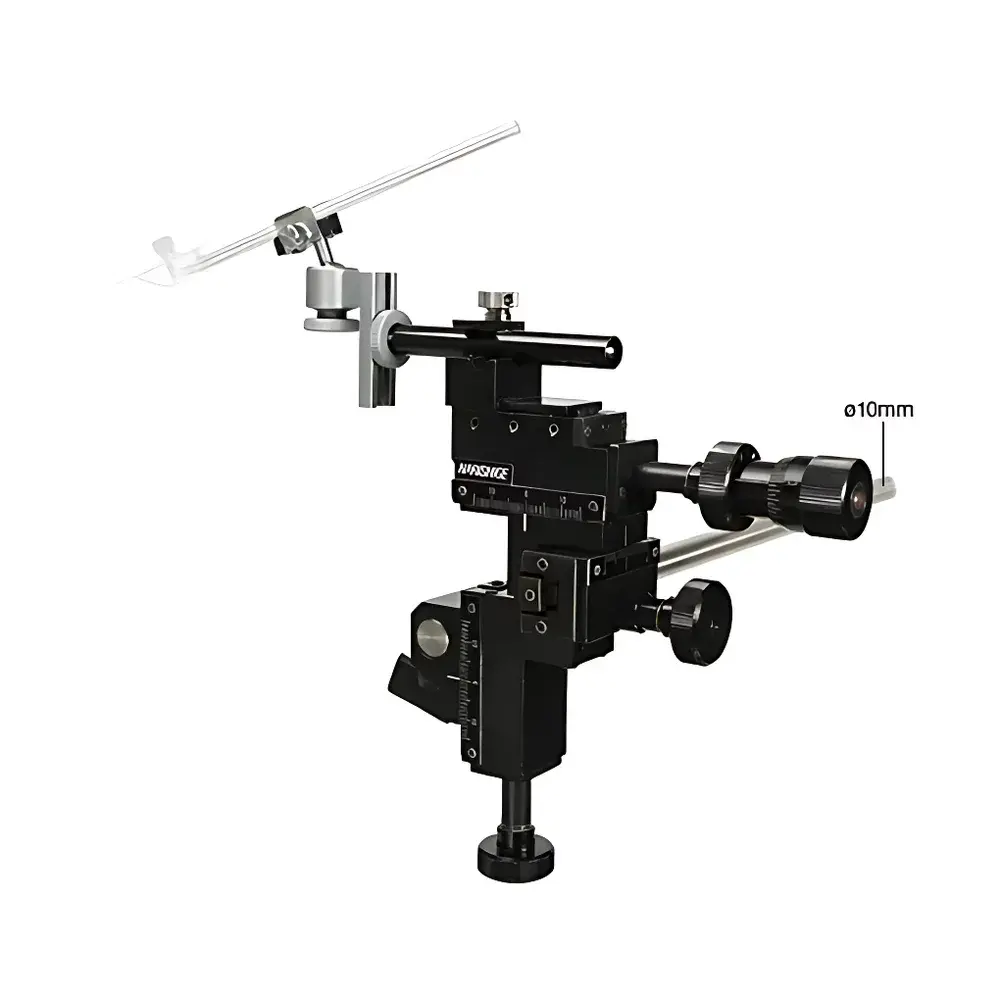
MN-153 Micromanipulator by NARISHIGE
| Brand | NARISHIGE |
|---|---|
| Origin | Japan |
| Model | MN-153 |
| Coarse Motion Range (X/Y/Z) | 25 mm / 20 mm / 25 mm |
| Fine Motion Range (X) | 8 mm |
| Micrometer Rotation per Full Turn | 500 µm |
| Dimensions (W×D×H) | 121 × 36 × 145 mm |
| Weight | 330 g |
| Mounting Interface | B-8B Spherical Joint, P-1A Height Adjustment Plate, H-7 Pipette Holder |
Overview
The MN-153 Micromanipulator is a precision mechanical positioning system engineered by NARISHIGE (Japan) for high-fidelity manual micro-positioning in life science and electrophysiology laboratories. Building upon the proven architecture of the M-152 platform, the MN-153 introduces enhanced X-axis fine-motion capability—enabling sub-micron linear approach control without mechanical shock or sample deformation. Its operation relies on a dual-stage motion design: coarse adjustment via rack-and-pinion translation and fine positioning via calibrated micrometer-driven screws with 500 µm per revolution resolution. This hybrid actuation strategy ensures both wide-range accessibility and stable, backlash-free final placement—critical when approaching delicate biological specimens such as oocytes, neurons, or battery electrode interfaces during in situ characterization.
Key Features
- Enhanced X-axis fine-motion stage with 8 mm travel range and 500 µm/rev micrometer graduation—optimized for controlled, non-destructive linear approach to sensitive targets.
- Modular mounting architecture featuring the B-8B spherical joint, enabling full 360° rotational freedom and ±20° tilt adjustment for multi-angle alignment.
- Integrated P-1A height-adjustable base plate for rapid vertical repositioning and ergonomic workspace optimization across inverted or upright microscope configurations.
- Dedicated H-7 pipette holder with adjustable clamping force and low-profile geometry—designed for secure retention of glass micropipettes (OD 1.0–1.5 mm) without slippage or torsional drift.
- Compact footprint (121 × 36 × 145 mm) and lightweight construction (330 g) facilitate integration into confined spaces including Faraday cages, cryostat chambers, and multi-manipulator rigs.
- Machined aluminum alloy body with anodized surface finish—providing dimensional stability, corrosion resistance, and compatibility with cleanroom and electrophysiology-grade environments.
Sample Compatibility & Compliance
The MN-153 supports direct manipulation of a broad spectrum of microscale objects, including patch-clamp electrodes, microinjection needles, optical fibers, AFM probes, and miniature electrochemical cells. Its mechanical design conforms to standard laboratory safety practices for manual micromanipulation under optical guidance (e.g., DIC, IR-DIC, or fluorescence microscopy). While the device itself contains no electronic components or software, its mechanical repeatability and static rigidity meet typical requirements for GLP-compliant experimental setup documentation. When used in conjunction with regulated workflows—such as single-cell electrophysiology or battery interface probing—the manipulator’s traceable positioning capability supports audit-ready protocol execution under ISO/IEC 17025-aligned quality systems.
Software & Data Management
The MN-153 operates entirely manually and does not incorporate embedded electronics, digital encoders, or software interfaces. All positioning data—including coarse/fine axis coordinates and angular orientation—is recorded manually by the user via scale reading and documented in laboratory notebooks or LIMS-integrated electronic lab notebooks (ELNs). For users requiring digital position logging, the MN-153 is mechanically compatible with third-party encoder retrofits (e.g., Heidenhain LS-series linear scales) and can be integrated into custom LabVIEW or Python-controlled motion platforms via standardized mounting interfaces (M4 threaded holes on base and arm). No firmware, drivers, or cloud connectivity are provided or required.
Applications
- Whole-cell patch-clamp recordings in acute brain slices and cultured neurons, where precise X-axis approach prevents membrane rupture during seal formation.
- Microinjection of CRISPR-Cas9 ribonucleoprotein complexes into zygotes or embryonic stem cells, leveraging spherical-joint flexibility for oblique needle insertion angles.
- In situ electrochemical probing of solid-state battery cross-sections, using the H-7 holder to stabilize tungsten microelectrodes while maintaining thermal and vibrational isolation.
- Alignment of optical waveguides and photonic devices in optogenetics setup calibration, aided by repeatable coarse/fine motion staging.
- Manual positioning of FIB-SEM lift-out needles during TEM lamella preparation, where mechanical stability and minimal thermal drift are essential.
FAQ
Is the MN-153 compatible with inverted microscopes?
Yes—the P-1A height adjustment plate allows vertical positioning over a 20 mm range, accommodating standard inverted microscope stages and objective working distances.
Can the B-8B spherical joint support lateral load during pipette penetration?
The B-8B joint is rated for axial loads up to 1.5 kg and provides torsional rigidity sufficient for standard glass pipette penetration into soft tissue; however, lateral shear forces exceeding 0.3 N should be minimized to preserve long-term joint integrity.
What is the recommended maintenance schedule?
NARISHIGE recommends cleaning the micrometer threads with isopropyl alcohol and light lubrication with silicone-based grease every 6 months of active use; no recalibration is required under normal operating conditions.
Does the MN-153 meet FDA or CE regulatory requirements?
As a Class I non-powered mechanical instrument, the MN-153 falls outside the scope of FDA 21 CFR Part 820 or EU MDR classification; it carries CE marking under Directive 2006/42/EC (Machinery Directive) for general laboratory equipment.
Is there a motorized version available?
NARISHIGE offers the MMO-202 and MN-153M variants with stepper-motor integration and RS-232/USB control—however, the standard MN-153 remains purely manual to maximize mechanical fidelity and eliminate electromagnetic interference in sensitive measurements.



