
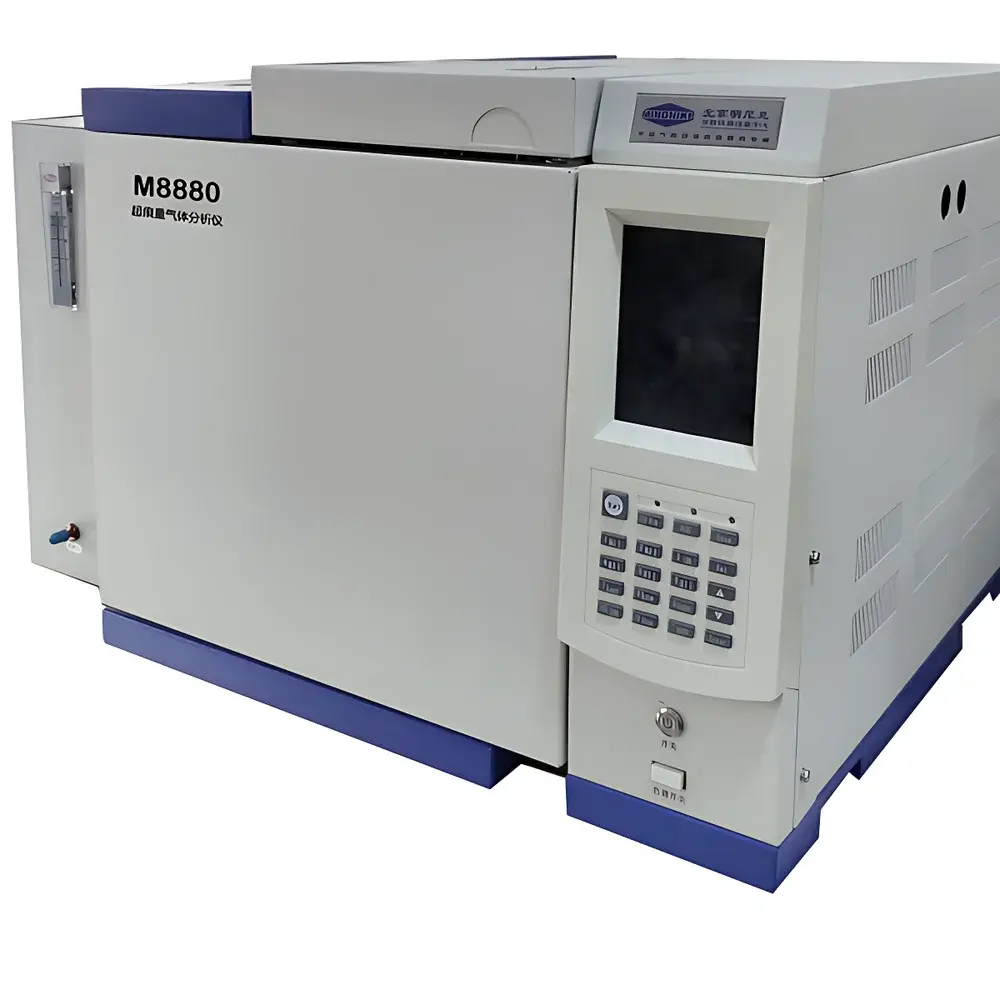
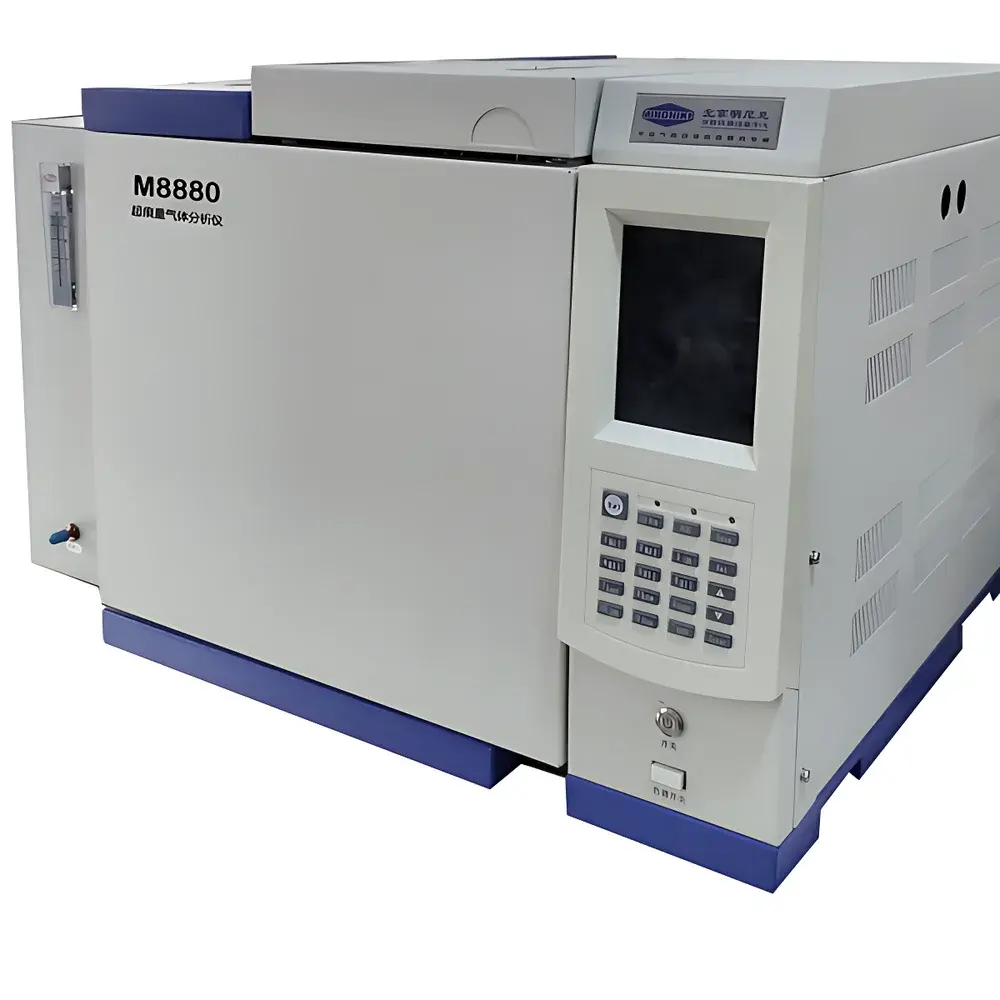
MNK M8880 Ultra-Trace Gas Analyzer
| Brand | MNK |
|---|---|
| Origin | Beijing, China |
| Model | M8880 |
| Instrument Type | Laboratory Gas Chromatograph |
| Application Domain | High-Purity Gas Analysis |
| Carrier Gas Options | Single selectable gas (e.g., He, H₂, or Ar) |
| Detector Configuration | Dual-detector, multi-column parallel architecture |
| Temperature Control | 8 independent zones, 20-step programmable ramping |
| Advanced Functionality | Built-in back-flush module enabling heart-cutting and column switching |
| Data System | Dedicated GC workstation with automated flammability triangle (CH₄–O₂–N₂) explosion hazard assessment |
| Detection Limits (v/v) | PDHID — H₂ (0.06 µL/L), CH₄ (0.08 µL/L), CO (0.08 µL/L), C₂H₆ (0.01 µL/L), CO₂ (0.09 µL/L), C₂H₄ (0.01 µL/L), C₂H₂ (0.01 µL/L), C₃H₈ (0.01 µL/L), H₂S (0.01 µL/L), C₃H₆ (0.01 µL/L), SO₂ (0.23 µL/L) |
Overview
The MNK M8880 Ultra-Trace Gas Analyzer is a purpose-built laboratory gas chromatograph engineered for quantitative and qualitative analysis of ultra-trace impurities in high-purity industrial gases. It operates on the principle of capillary or packed column gas chromatography coupled with dual parallel detection—employing both a pulsed discharge helium ionization detector (PDHID) and a thermal conductivity detector (TCD)—to achieve simultaneous high-sensitivity and broad dynamic range measurement across permanent gases, hydrocarbons, sulfur compounds, and reactive species. Designed specifically for petrochemical and coal chemical process environments, the system meets stringent requirements for purity certification (e.g., SEMI F57, ISO 8573-1 Class 1, ASTM D7610), where detection limits at sub-ppb (µL/L) levels are critical for catalyst protection, safety compliance, and product grade verification.
Key Features
- Dual-detector architecture: PDHID delivers sub-100 ppt sensitivity for C₁–C₃ hydrocarbons, H₂, CO, CO₂, H₂S, and C₂H₂; TCD provides robust quantification of major components (O₂, N₂) without calibration drift.
- Multi-column parallel flow path: Configurable with up to three analytical columns (e.g., molecular sieve 5A, PLOT Al₂O₃/KCl, and porous polymer) operating simultaneously under independent pressure and temperature control.
- 8-zone independent oven temperature management: Enables precise thermal optimization of injection, separation, and detection zones; supports 20-stage linear and nonlinear program ramps with ±0.1 °C stability.
- Integrated back-flush and heart-cutting module: Eliminates late-eluting interferences (e.g., heavy hydrocarbons) and isolates target peaks (e.g., C₂H₂ in ethylene streams) without manual intervention.
- Carrier gas flexibility: Compatible with helium, hydrogen, or argon as primary mobile phase—each selectable via software-controlled pneumatic modules with electronic pressure control (EPC) accuracy of ±0.01 psi.
Sample Compatibility & Compliance
The M8880 accepts gaseous samples delivered via standardized 1/8″ or 1/4″ stainless-steel tubing with VCR or Swagelok fittings. It supports direct sampling from high-pressure cylinders (up to 20 MPa), process lines (via pressure-reducing regulators), and ambient air monitoring manifolds. The system complies with IEC 61000-4 electromagnetic immunity standards and meets mechanical safety requirements per GB/T 13966–2013 (equivalent to ISO/IEC 17025 Annex A for GC instrumentation). All analytical methods are fully documentable for GLP/GMP environments, with audit trails, user access levels, and electronic signature support aligned with FDA 21 CFR Part 11 readiness.
Software & Data Management
The proprietary GC-Expert workstation provides method development, sequence scheduling, real-time chromatogram visualization, peak integration using iterative Gaussian deconvolution, and automated reporting per ISO 10723 or ASTM D1945 protocols. Critical safety functionality includes automatic calculation of the methane–oxygen–nitrogen flammability triangle (per NFPA 56 and CGA G-5.1), triggering visual and relay-based alarms when sample composition enters explosive regimes. Raw data files (.cdf) are stored with embedded metadata (instrument parameters, calibration history, operator ID), and export options include CSV, PDF, and LIMS-compatible ASTM E1394 format.
Applications
- Ultra-high-purity hydrogen and syngas qualification for PEM electrolyzers and ammonia synthesis loops.
- Trace acetylene and phosphine monitoring in semiconductor-grade silane and arsine delivery systems.
- Residual oxygen and moisture speciation in nitrogen blanketing streams for lithium battery electrode coating lines.
- SO₂, H₂S, and COS quantification in Claus tail gas and acid gas removal unit (AGRU) effluents.
- Hydrocarbon impurity profiling (C₁–C₄) in ethylene and propylene monomer shipments per ISO 13877 and GB/T 33646.
FAQ
What detection technologies are integrated into the M8880?
The system combines a pulsed discharge helium ionization detector (PDHID) for ultra-trace hydrocarbon and permanent gas analysis, and a high-stability thermal conductivity detector (TCD) for major component quantification.
Can the M8880 meet ISO 8573-1 Class 1 purity requirements for compressed air?
Yes—its PDHID detection limits for CO, C₂H₂, and H₂S are well below the 0.1 mL/m³ (100 ppb) threshold specified for Class 1, provided appropriate column selection and calibration traceability are implemented.
Is the back-flush function programmable per analysis sequence?
Yes—back-flush timing, pressure, and duration are fully configurable within each method, supporting unattended operation across heterogeneous sample sets.
Does the workstation support 21 CFR Part 11 compliance out of the box?
The software includes role-based access control, electronic signatures, and audit trail logging; full Part 11 validation requires site-specific IQ/OQ/PQ documentation and network configuration per organizational SOPs.
What carrier gas options are validated for PDHID operation?
Helium is the standard and most sensitive carrier for PDHID; hydrogen may be used with adjusted voltage settings and enhanced safety interlocks, per IEC 60079-10-1 zone classification guidelines.
Related Products





