
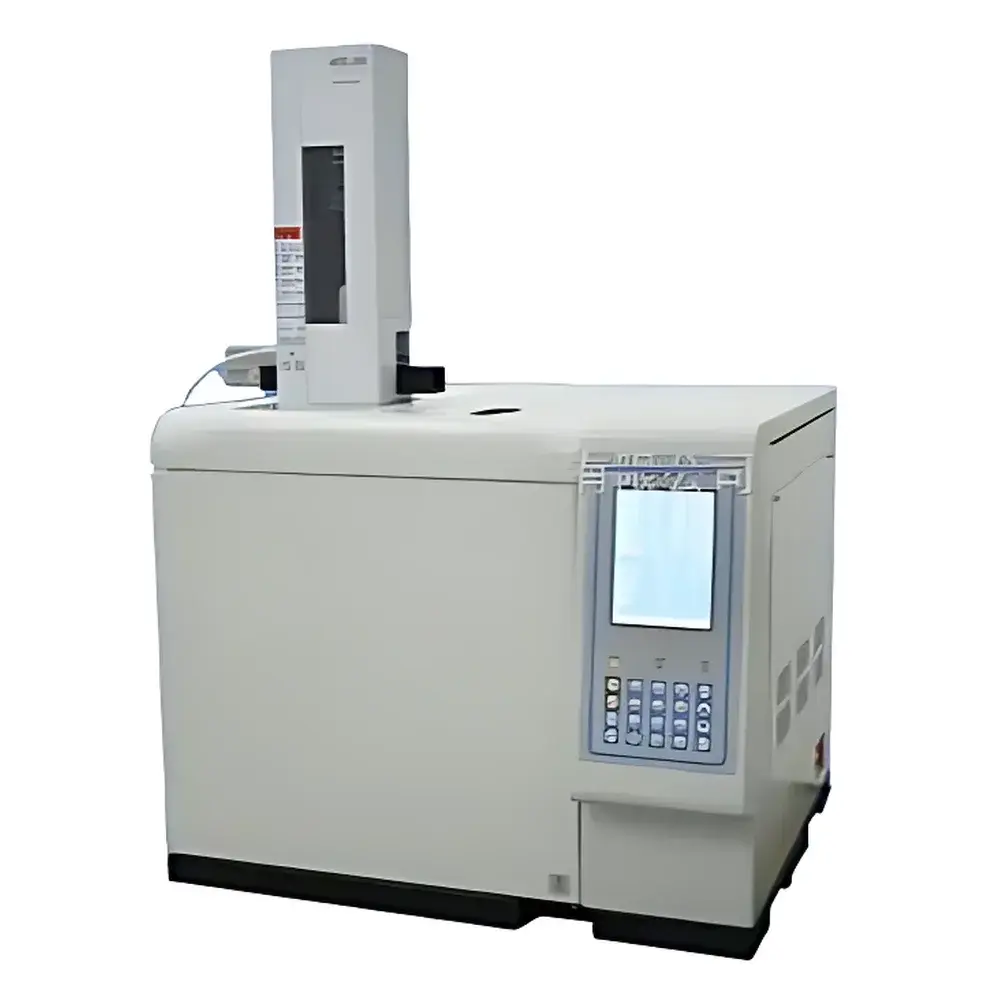
MNK GC8800 Series Multi-Detector Online Gas Chromatograph
| Brand | MNK |
|---|---|
| Origin | Beijing, China |
| Model | GC8800 Series |
| Instrument Type | Online Gas Chromatograph |
| Detector Configurability | Up to three simultaneous detectors (TCD, uTCD, FID, FPD, ECD, NPD, PDHID) |
| Injection Options | Packed column, split/splitless capillary, valve injection, 6-/12-position liquid auto-sampler, headspace autosampler, pyrolysis injector |
| Oven Temperature Range | +4 °C above ambient to 450 °C (1 °C increment) |
| Oven Temperature Stability | ±0.1 °C at 200 °C |
| Oven Programmable Stages | 16 temperature ramps |
| Cooling Rate | 260 °C to 50 °C in ~6 min |
| Temperature Zones | 8 independently controlled zones |
| Carrier Gas Control | Electronic Pressure Control (EPC), pressure resolution 0.01 kPa, flow resolution 0.01 sccm |
| Display | 5.7-inch color TFT touchscreen |
| Data Interface | Ethernet (IEEE 802.3), PC-controlled operation or standalone mode |
| Remote Capability | Network-enabled remote monitoring, unattended operation, distributed acquisition, centralized control |
| Multidimensional GC Support | Center-cutting and valve-switching configurations enabled |
| Software | Method-driven acquisition with full parameter storage and recall |
| Compliance | Designed for GLP/GMP environments |
Overview
The MNK GC8800 Series Multi-Detector Online Gas Chromatograph is an engineered platform for high-reliability, multi-analyte separation and quantification in continuous or batch-mode laboratory and process environments. Built upon a robust gas chromatographic architecture, it employs precise column oven temperature programming, high-fidelity electronic pressure control (EPC), and modular detector integration to deliver consistent retention time stability and peak area reproducibility. Unlike conventional benchtop GC systems, the GC8800 series is purpose-designed for online deployment—featuring sealed, vibration-dampened mechanical construction, redundant gas path integrity checks, and industrial-grade thermal management optimized for 24/7 operation. Its core analytical principle relies on differential partitioning of volatile and semi-volatile compounds across a stationary phase under controlled carrier gas flow, enabling compound identification via retention indexing and quantification through detector-specific response factors.
Key Features
- Eight independent temperature-controlled zones—including column oven, inlet ports, detector bodies, and valve manifolds—ensure thermal homogeneity and minimize carryover.
- Electronic Pressure Control (EPC) system delivers pressure resolution of 0.01 kPa and mass flow resolution of 0.01 sccm, critical for method transferability and retention time locking across instruments.
- Simultaneous mounting of up to three detectors from a validated set: TCD (thermal conductivity), micro-TCD (uTCD), FID (flame ionization), FPD (flame photometric), ECD (electron capture), NPD (nitrogen-phosphorus), and PDHID (pulsed discharge helium ionization).
- Flexible injection architecture supports packed columns, capillary columns (split/splitless), automated valve loops, 6- or 12-position liquid autosamplers, headspace sampling, and pyrolysis modules—enabling direct coupling to diverse sample introduction workflows.
- Column oven achieves rapid cooling (260 °C → 50 °C in ~6 minutes) without external cryogenics, reducing cycle time in high-throughput applications such as refinery gas analysis or environmental VOC screening.
- Integrated 5.7-inch capacitive touchscreen interface provides real-time chromatogram visualization, method editing, and diagnostics—operable standalone or synchronized with networked LIMS or SCADA systems.
Sample Compatibility & Compliance
The GC8800 accommodates gaseous, liquid, and solid-phase samples following appropriate preparation—ranging from refinery hydrocarbon streams and ambient air extracts to pharmaceutical residual solvents and food-grade flavor volatiles. Its configurable inlet and detector combinations meet ASTM D1945 (natural gas analysis), ISO 10156 (gas cylinder testing), USP (residual solvents), and EPA Method 8021B (halogenated organics). When operated with validated firmware and audit-trail-enabled software, the system supports compliance with FDA 21 CFR Part 11 for electronic records and signatures, as well as GLP/GMP documentation requirements for regulated laboratories. All pneumatic components conform to ISO 8573-1 Class 2 purity standards for carrier gas delivery.
Software & Data Management
Control and data acquisition are managed via MNK ChromaSuite—a Windows-based application supporting method development, sequence definition, calibration curve generation (linear, quadratic, or multipoint), and report templating. Raw data files adhere to ANDI/NetCDF format for cross-platform compatibility with third-party processing tools (e.g., OpenChrom, Chromeleon, Simplicity). The embedded Ethernet interface enables secure HTTP/HTTPS access for remote instrument status monitoring, method push/pull, and alarm notification via SMTP or SNMP. Audit trails record user actions, parameter changes, and run logs with timestamped digital signatures—configurable to retain history for ≥12 months per regulatory retention policies.
Applications
- Petrochemical QA/QC: Hydrocarbon group-type analysis (PIONA), sulfur speciation (mercaptans, sulfides), and permanent gas profiling (H₂, O₂, N₂, CO, CO₂, CH₄).
- Environmental Monitoring: Continuous emission monitoring (CEMS) of benzene, toluene, ethylbenzene, and xylenes (BTEX); soil and water extract analysis per EPA TO-17.
- Pharmaceutical Manufacturing: Residual solvent verification in APIs per ICH Q3C guidelines; excipient purity assessment.
- Food & Beverage Safety: Flavor compound profiling, ethanol quantification in spirits, pesticide residue screening in raw agricultural commodities.
- Power Industry: Dissolved gas analysis (DGA) in transformer oil per ASTM D3612 and IEC 60567.
- Academic & Government Research: Method development for novel stationary phases, kinetic studies of thermal degradation pathways, and hyphenated GC–MS library building.
FAQ
Can the GC8800 operate fully unattended for extended periods?
Yes—the system supports scheduled runs, automatic calibration injections, and fault-triggered shutdown protocols. With optional UPS integration and remote health monitoring, it is routinely deployed in无人值守 (unmanned) labs for 72+ hour sequences.
Is method transfer between GC8800 units straightforward?
Method portability is ensured by EPC-driven retention time locking, standardized column dimensions, and identical thermal ramp profiles—validated per ASTM E1510 and ISO 17025 inter-instrument precision criteria.
Does the GC8800 support multidimensional GC (MDGC) configurations?
Yes—its integrated valve manifold and dual EPC channels enable heart-cutting, comprehensive two-dimensional GC (GC×GC), and back-flushing setups when paired with compatible modulators and secondary columns.
What cybersecurity measures are implemented for network-connected operation?
The embedded Linux OS enforces TLS 1.2+ encryption, role-based access control (RBAC), disabled default credentials, and periodic firmware signature verification—all aligned with IEC 62443-3-3 for industrial control systems.
Are service and calibration support options available outside mainland China?
MNK maintains certified service partners in Southeast Asia, the Middle East, and Eastern Europe; field engineers are trained to ISO/IEC 17025 traceable calibration procedures using NIST-traceable gas standards.
Related Products






