
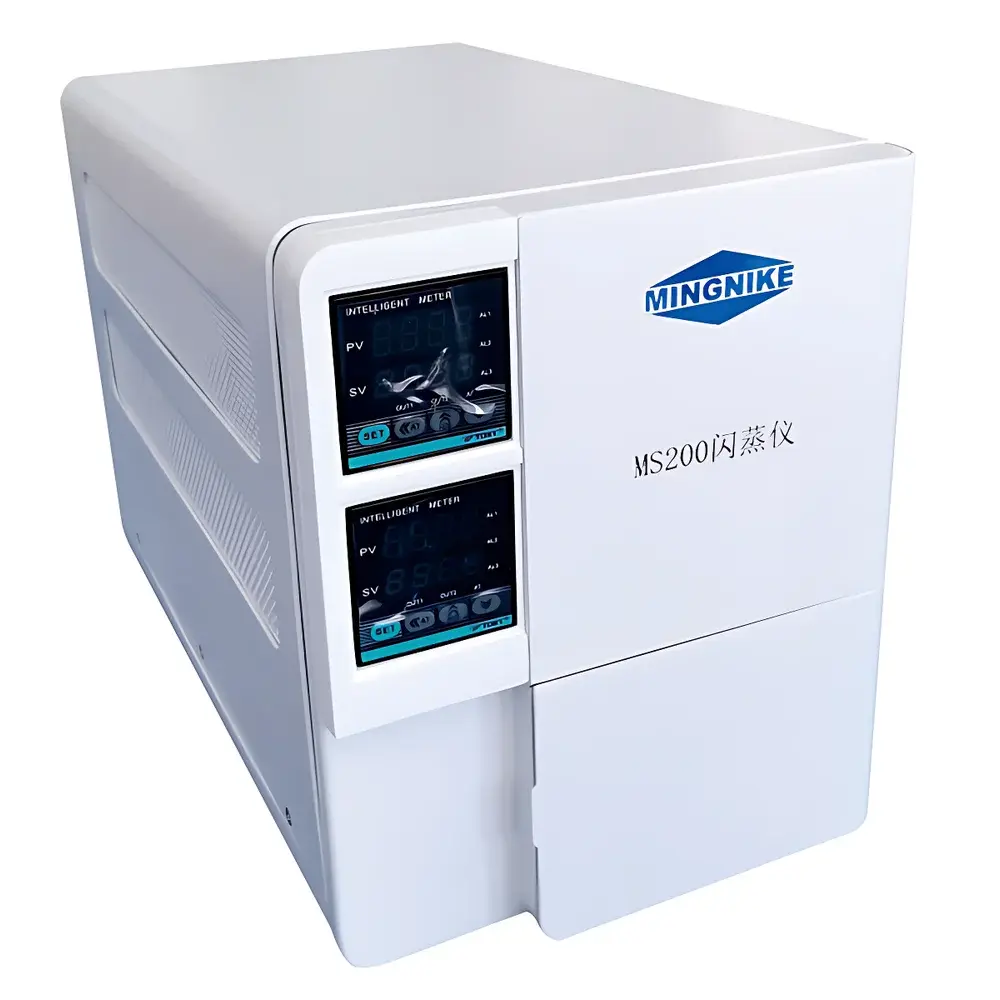
MNK MS200 Flash Vaporizer
| Brand | MNK |
|---|---|
| Origin | Beijing, China |
| Model | MS200 |
| Sample Inlet Pressure Range (Liquid) | 0.69–2.75 MPa |
| Sample Inlet Pressure Range (Gas) | ≤2.07 MPa |
| Vaporization Temperature Control Range | Ambient to 150 °C |
| Transfer Line Heating Range | Ambient to 150 °C |
| Operating Ambient Temperature | –18 °C to +65 °C |
| Power Supply | 220 VAC, 50 Hz, max. 3.0 A |
| Dimensions (H×W×D) | 230 mm × 190 mm × 350 mm |
| Compliance | Designed for integration with GC and GC-MS systems in petroleum refining and hydrocarbon analysis labs |
Overview
The MNK MS200 Flash Vaporizer is an engineered sample introduction system designed specifically for the controlled, reproducible vaporization of liquid hydrocarbon samples prior to gas chromatographic (GC) or gas chromatography–mass spectrometry (GC-MS) analysis. It operates on the principle of rapid, isobaric flash vaporization—where a pressurized liquid sample is introduced into a heated, thermally stabilized chamber maintained at precise temperature and pressure conditions, enabling instantaneous phase transition while preserving compositional integrity. Unlike conventional heated injectors or split/splitless inlets, the MS200 decouples vaporization from the GC inlet, eliminating thermal degradation, fractionation, and adsorption artifacts commonly observed with volatile or heavy-end hydrocarbons. Its architecture supports both liquid and gaseous sample introduction, making it suitable for standardized methods such as ASTM D7169 (high-boiling point petroleum fractions), ASTM D5134 (gasoline hydrocarbon analysis), and ISO 6974 series (natural gas composition). The unit is deployed in refinery QC laboratories, petrochemical R&D facilities, and custody transfer testing environments where compositional fidelity, repeatability, and regulatory traceability are critical.
Key Features
- Programmable flash vaporization chamber with PID-controlled temperature regulation from ambient to 150 °C, ensuring stable phase equilibrium and minimal thermal lag.
- Electrically heated, insulated transfer lines with independent temperature zoning and adjustable setpoint (ambient to 150 °C), preventing condensation of mid- to high-boiling hydrocarbons (e.g., C10–C30) during transport to the GC inlet.
- Dual-mode sample introduction capability: compatible with pressurized liquid feed (0.69–2.75 MPa) and pre-pressurized gas feed (≤2.07 MPa), supporting both liquid-phase sampling loops and gas cylinders.
- Automated system purge function using high-purity, elevated-temperature carrier gas (e.g., helium or nitrogen up to 150 °C), minimizing carryover between injections and reducing cross-contamination in high-throughput workflows.
- Compact benchtop footprint (230 mm H × 190 mm W × 350 mm D) with robust aluminum alloy housing, rated for operation in ambient environments from –18 °C to +65 °C—suitable for on-site deployment in mobile labs or field analytical units.
- Integrated safety interlocks including overtemperature cutoff, pressure relief monitoring, and real-time fault logging via front-panel LED indicators.
Sample Compatibility & Compliance
The MS200 is validated for use with a broad spectrum of petroleum-derived hydrocarbons—including naphthas, kerosenes, diesel fuels, vacuum gas oils, and liquefied petroleum gases (LPG)—without requiring derivatization or dilution. It maintains quantitative transfer of light ends (C1–C5) and suppresses preferential volatilization of heavier species (e.g., aromatics, cycloparaffins) through precisely balanced residence time and thermal gradient control. The instrument complies with mechanical and electrical safety standards per IEC 61010-1:2010 for laboratory equipment. While not certified as standalone analytical instrumentation under ISO/IEC 17025, its operational parameters align with method validation requirements outlined in ASTM D3606 (benzene/toluene determination), ASTM D5769 (aromatics in gasoline), and USP chromatographic system suitability criteria when integrated into validated GC platforms. Data integrity features support alignment with FDA 21 CFR Part 11 expectations when used with compliant chromatography data systems (CDS).
Software & Data Management
The MS200 operates as a stand-alone hardware module with manual setpoint configuration via front-panel membrane keypad and digital display. It does not include embedded firmware or network connectivity; however, it is fully compatible with third-party chromatography data systems (e.g., Thermo Chromeleon, Agilent OpenLab CDS, Waters Empower) via analog signal outputs (0–10 V or 4–20 mA) for synchronized start/stop triggering and status reporting. All temperature and pressure setpoints are manually logged and retained in laboratory notebooks or electronic lab notebooks (ELN) as part of method documentation. Audit trails for calibration, maintenance, and performance verification are maintained per GLP/GMP-aligned SOPs, supporting internal quality audits and regulatory inspections.
Applications
- Routine analysis of gasoline, jet fuel, and diesel composition per ASTM D6730 (simulated distillation), ASTM D6729 (detailed hydrocarbon analysis), and IP 360.
- Quantitative speciation of liquefied natural gas (LNG) and associated gas streams, particularly for C2–C5 olefin/paraffin ratios.
- Stability assessment of synthetic crude blends and Fischer–Tropsch liquids under simulated pipeline transport conditions.
- Calibration standard delivery for online GC analyzers deployed in continuous process monitoring applications (e.g., FCC unit overheads, hydrotreater feedstocks).
- Method development for high-resolution GC×GC analysis of heavy distillates where conventional injection leads to column overload or inlet contamination.
FAQ
What types of samples are compatible with the MS200 Flash Vaporizer?
Liquid and gaseous hydrocarbon samples within specified pressure and boiling point ranges—primarily petroleum fractions, refinery streams, and natural gas condensates.
Can the MS200 be integrated with autosamplers?
Yes—when equipped with external TTL or relay-trigger inputs, it synchronizes with commercial liquid or gas autosamplers (e.g., CTC PAL, Gerstel MPS) for unattended operation.
Is the MS200 suitable for ASTM D7169 analysis?
It serves as a validated alternative to traditional high-temperature injection systems in D7169 workflows, provided vaporization temperature and line heating are calibrated per method requirements.
Does the unit require routine calibration?
Temperature sensors and pressure transducers should be verified annually against NIST-traceable references as part of laboratory quality assurance protocols.
What maintenance is recommended for long-term reliability?
Quarterly inspection of heater insulation integrity, periodic cleaning of sample pathway O-rings with fluorocarbon-compatible lubricant, and annual verification of purge gas flow consistency.




