
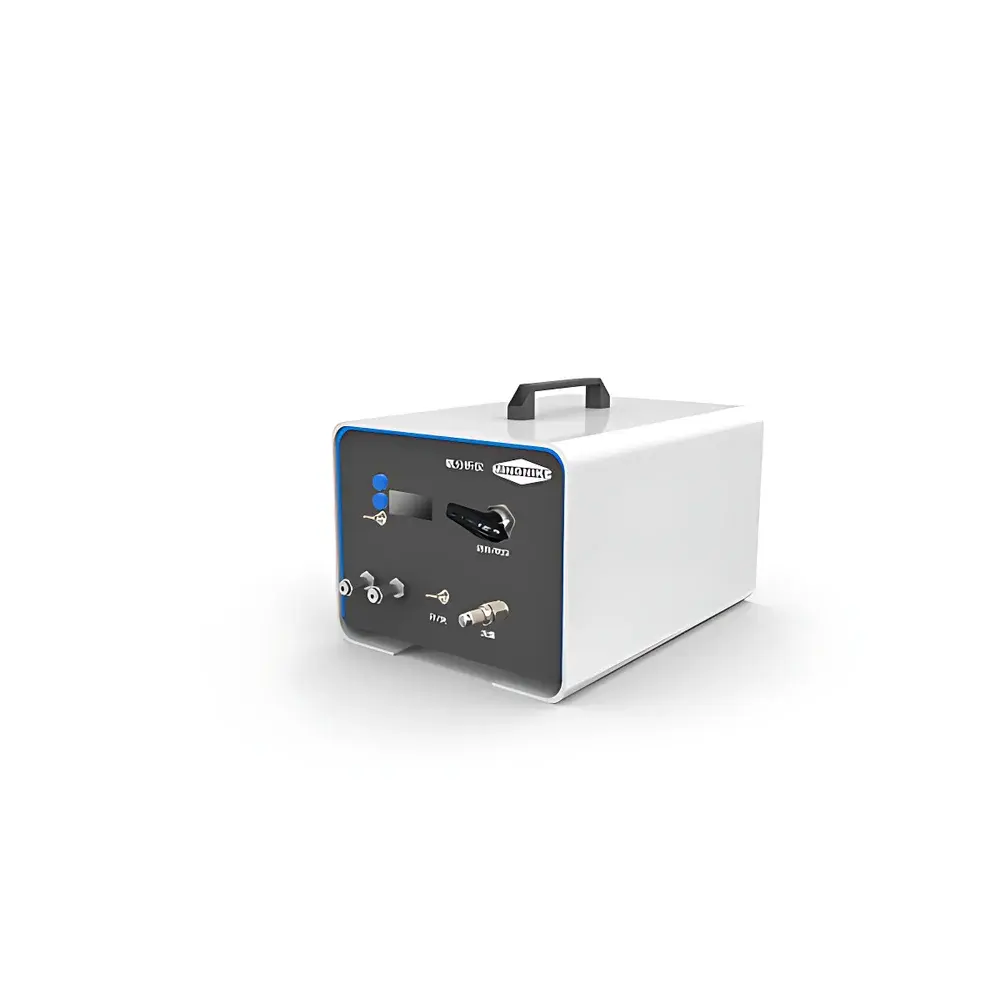
MNK MY501 Electrochemical Oxygen Analyzer
| Brand | MNK |
|---|---|
| Origin | Beijing, China |
| Model | MY501 |
| Measurement Principle | Potentiometric Electrochemical (Fuel Cell) |
| Range Options | 0–10 ppm, 0–100 ppm, 0–1000 ppm, 0–1 %, 0–25 % O₂ |
| Accuracy | ≤1 % FS (for 0.00–10 ppm range) |
| Repeatability | ≤±1 % FS |
| Response Time (t₉₀) | ≤30 s |
| Resolution | 0.1 ppm |
| Sample Flow Rate | 1000 mL/min |
| Inlet Pressure | 0.05–0.1 MPa |
| Output Signals | 4–20 mA / 0–1 V / 0–10 V DC (selectable) |
| Operating Temperature | –5 °C to +45 °C |
| Relative Humidity | ≤90 % RH (non-condensing) |
| Sensor Lifetime | 24 months (at 25 °C, 1 atm, avg. [O₂] < 1000 ppm) |
| Power Supply | DC 12 V |
| Dimensions (W×H×D) | 212 × 290 × 194 mm |
| Weight | ~2 kg |
| Enclosure Fitting | 1/8″ OD compression fitting |
| Calibration Gas | N₂-based standard with 80 % of full-scale O₂ concentration |
| Compliance | Designed for industrial process monitoring per IEC 61000-6-2/6-4 EMI immunity & emission standards |
Overview
The MNK MY501 Electrochemical Oxygen Analyzer is a high-stability, field-deployable trace oxygen measurement system engineered for continuous in-line monitoring of oxygen concentration in inert, reducing, and ultra-high-purity gas streams. It employs a solid polymer electrolyte (SPE) fuel cell sensor — a galvanic electrochemical transducer that generates a current proportional to the partial pressure of molecular oxygen diffusing across a selective membrane. Unlike paramagnetic or zirconia-based analyzers, this sensor operates without external bias voltage or heating elements, delivering inherently low power consumption, rapid thermal equilibration, and immunity to flow-rate fluctuations within its specified sample delivery envelope. The analyzer is optimized for applications where background gas composition varies significantly — including H₂, N₂, Ar, He, and forming gases — and where oxygen levels span six orders of magnitude (from sub-ppm to 25 % v/v). Its architecture prioritizes long-term baseline stability, minimal zero drift, and robustness against transient condensation or minor particulate ingress, making it suitable for integration into nitrogen generation skids, sintering furnace purge loops, semiconductor fab gas cabinets, and metallurgical off-gas monitoring points.
Key Features
- Imported electrochemical fuel cell sensor with ≥24-month operational lifetime under typical industrial conditions (≤1000 ppm average O₂ exposure at 25 °C, 1 atm)
- Multi-range configuration support: five user-selectable full-scale ranges (0–10 ppm to 0–25 %) with automatic range scaling and seamless switching
- Integrated temperature compensation algorithm using dual-point thermistor feedback to eliminate ambient thermal drift across –5 °C to +45 °C operating envelope
- High-resolution 320 × 240 pixel monochrome LCD display with backlight, supporting real-time O₂ concentration, status flags, alarm thresholds, and calibration history
- Configurable analog outputs (4–20 mA, 0–1 V, or 0–10 V DC) with isolated circuitry for noise-free transmission over distances up to 500 m
- Two programmable relay outputs for high/low limit control — setpoint adjustable anywhere within the selected measurement span
- Low-pressure sample interface (0.05–0.1 MPa inlet) with 1/8″ OD stainless steel compression fittings and internal flow restriction calibrated to 1000 mL/min
- DC 12 V power input enables direct integration with UPS-backed control panels or solar-powered remote installations
Sample Compatibility & Compliance
The MY501 is validated for use with non-corrosive, dry, particle-free gas matrices. It is explicitly rated for hydrogen-rich environments (e.g., high-purity H₂ used in annealing or reduction processes), provided total sulfur, phosphorus, and acidic contaminants (e.g., HCl, HF, SO₂) remain below detection limits — as such species irreversibly poison the alkaline electrolyte membrane. Sample lines must be constructed from electropolished 316 stainless steel or oxygen-cleaned copper; PTFE is acceptable only for non-trace (<1 ppm) applications. For measurements below 1 ppmv, line dead volume must be minimized (<1 mL), and all fittings must conform to ISO 8573-1 Class 1 particulate and Class 2 moisture specifications. While the instrument itself does not carry CE or UL certification, its electrical design complies with IEC 61000-6-2 (immunity) and IEC 61000-6-4 (emission) requirements. When deployed in regulated environments (e.g., pharmaceutical nitrogen utilities or semiconductor gas delivery systems), the MY501 supports 21 CFR Part 11–compliant data logging when paired with validated third-party SCADA platforms featuring electronic signature and audit trail functionality.
Software & Data Management
The MY501 operates as a standalone hardware analyzer with no embedded firmware-based data storage. All configuration, calibration, and alarm parameters are retained in non-volatile EEPROM and survive power cycles. Configuration is performed locally via front-panel keypad navigation; no PC software or proprietary drivers are required. However, analog output signals are fully compatible with industry-standard PLCs (Siemens S7, Allen-Bradley ControlLogix), DCS historians (Emerson DeltaV, Honeywell Experion), and cloud-based IIoT gateways (Ignition Edge, Siemens MindSphere). For traceability-critical deployments, users may integrate the 4–20 mA output into a validated data acquisition system that records timestamped values, operator actions, and calibration events in accordance with GLP or GMP Annex 11 principles. Optional external USB-to-serial adapters enable ASCII protocol readout for custom scripting or periodic CSV export.
Applications
- On-stream purity verification of on-site nitrogen generators (PSA/VSA) supplying blanketing gas to chemical reactors and storage tanks
- Real-time monitoring of protective atmospheres in vacuum sintering furnaces for NdFeB, SmCo, and soft magnetic alloys
- Leak detection and integrity validation of gloveboxes and inert gas manifolds in battery electrode coating and R&D labs
- Process gas quality assurance in float glass production, where dissolved oxygen in tin bath cover gas affects ribbon optical homogeneity
- Final-stage verification of ultra-high-purity hydrogen (≥99.9999 %) prior to feeding fuel cell test stands or epitaxial deposition tools
- Off-gas analysis in secondary aluminum remelting to optimize flux injection and minimize dross formation
FAQ
What gas matrices are compatible with the MY501? Why is H₂ compatibility emphasized?
The MY501 uses an alkaline fuel cell sensor specifically formulated for stable operation in strongly reducing environments. Unlike metal oxide sensors, it remains insensitive to H₂ cross-sensitivity and exhibits negligible signal drift during prolonged exposure to >99.999 % H₂. However, it must not be exposed to halogenated, sulfurous, or acidic impurities.
Can the MY501 measure oxygen in compressed air or ambient air?
No. Its lowest full-scale range is 0–10 ppm, and exposure to atmospheric oxygen (~210,000 ppm) will saturate and permanently degrade the sensor. It is strictly intended for trace-level measurement in purified or inert process streams.
How frequently should calibration be performed?
Initial calibration is required before first use. Subsequent calibration intervals depend on application severity: every 3 months for critical pharmaceutical nitrogen systems; every 6 months for general industrial furnace purge monitoring. A two-point calibration (zero and span) using certified N₂/O₂ standards is recommended, with span gas concentration set to 80 % of the active range.
Why is stainless steel tubing mandatory for sub-ppm measurements?
All common polymers and elastomers exhibit measurable oxygen permeability. At trace levels (<1 ppmv), even minute diffusion through tubing walls or seal interfaces introduces positive bias. Electropolished SS-316 reduces surface adsorption/desorption hysteresis and eliminates outgassing, ensuring metrological integrity over extended measurement campaigns.
Does the MY501 support digital communication protocols such as Modbus RTU or HART?
No. It provides only analog outputs (4–20 mA / 0–1 V / 0–10 V) and relay contacts. Digital integration requires external analog-to-Modbus converters or PLC analog input modules.



