
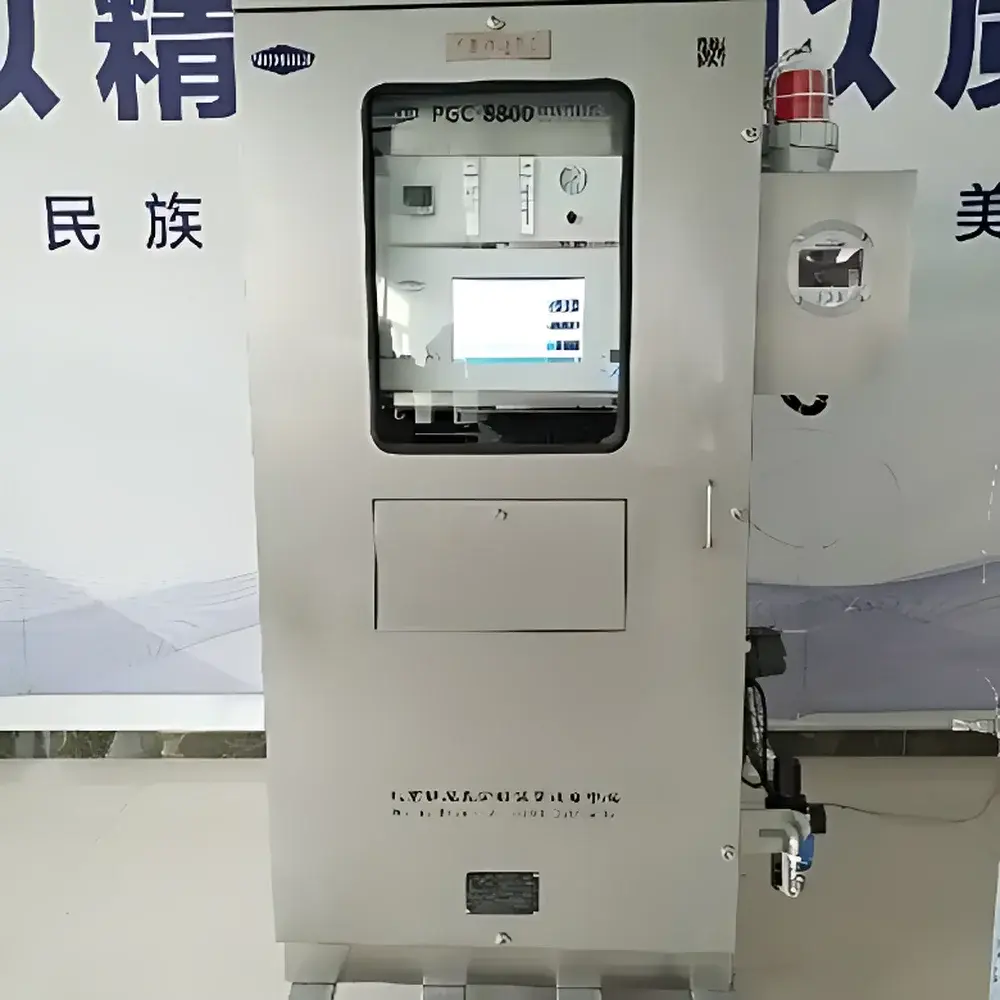
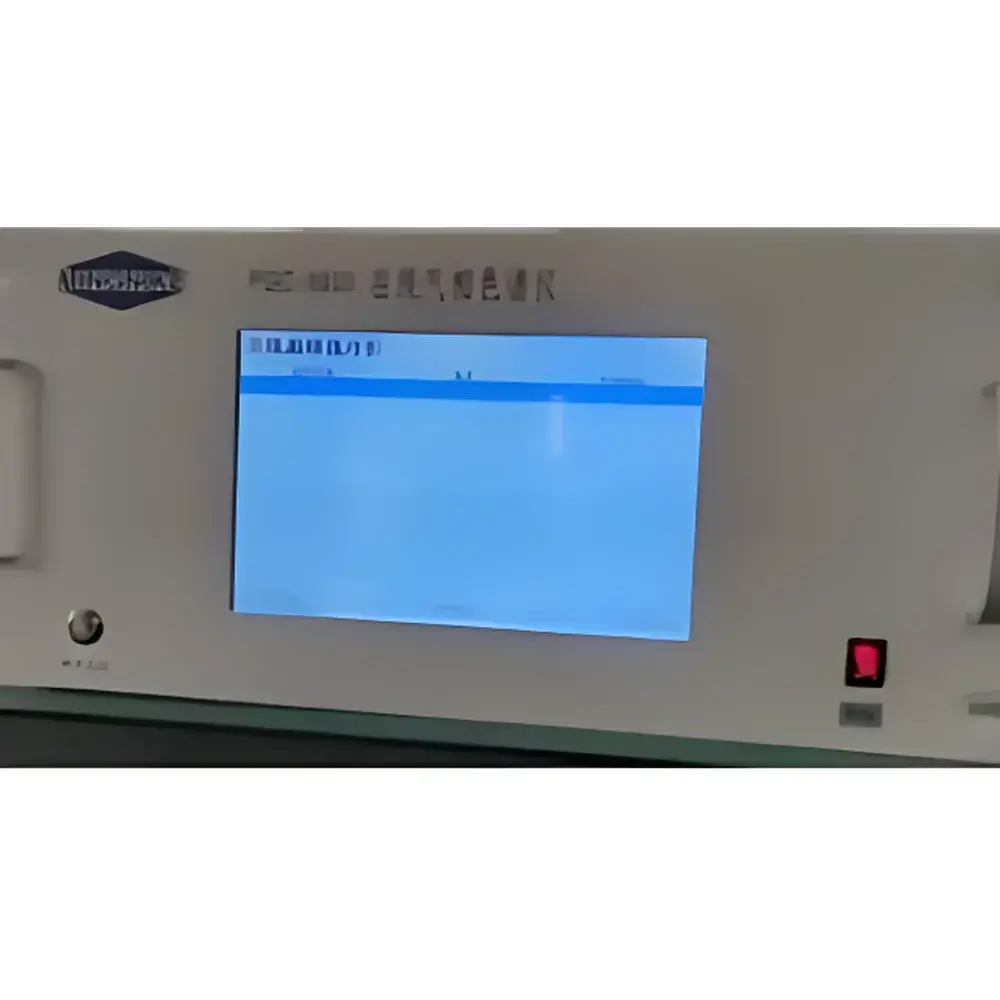
MNK PGC-8800 Online Gas Chromatograph
| Brand | MNK |
|---|---|
| Origin | Beijing, China |
| Model | PGC-8800 |
| Instrument Type | Online Gas Chromatograph |
| Application Field | High-Purity Gas Analysis |
| Detectors | PDHID, TCD, FID |
| Detection Limits (ppb) | H₂ (5), He (5), O₂ (10), N₂ (10), Ar (10), Ne (10), CO (25), CO₂ (5), CH₄ (5), CF₄ (10), C₂F₆ (20), SO₂ (20), F₂ (20), C₃F₈ (20) |
| Temperature Control Accuracy | ±0.01°C |
| Baseline Noise | ≤0.1 mV |
| Analog Outputs | 5–12 channels of 4–20 mA |
| Communication Interfaces | 1× Ethernet, 1× RS-232 (expandable) |
| Display | 10.1″ high-resolution capacitive touchscreen |
| Enclosure | Standard 5U rack-mount chassis (482 × 432 × 222 mm) |
Overview
The MNK PGC-8800 Online Gas Chromatograph is a purpose-engineered analytical platform designed for continuous, unattended gas composition monitoring in critical industrial and ultra-high-purity process environments. Utilizing gas chromatography separation principles—where gaseous samples are partitioned between a mobile phase (carrier gas) and a stationary phase (capillary or packed column)—the system delivers quantitative analysis of permanent gases, noble gases, hydrocarbons, fluorinated compounds, and reactive impurities. Its architecture supports real-time, multi-component quantification across complex matrices, with particular optimization for high-purity gas production, semiconductor-grade electronic gas certification, SF₆ quality assurance in power transmission, and natural gas calorific value determination. The instrument operates under strict isothermal or temperature-programmed conditions, ensuring retention time stability and peak resolution required for regulatory-grade reporting.
Key Features
- Modular detector configuration supporting simultaneous deployment of pulsed discharge helium ionization detection (PDHID), thermal conductivity detection (TCD), and flame ionization detection (FID), enabling broad-spectrum sensitivity across electronegative, non-ionizable, and organic species.
- Ultra-low detection limits down to 5 ppb for H₂ and He, validated per ISO 6142 and ASTM D1945 methodologies; optimized column oven temperature control with ±0.01°C stability ensures reproducible retention times over extended unattended operation.
- Internally passivated gas pathways—including electropolished stainless-steel tubing, inert valve manifolds, and deactivation-treated capillary columns—to minimize surface adsorption, catalytic decomposition, and memory effects, especially critical for trace-level O₂, SO₂, F₂, and moisture-sensitive analytes.
- Integrated forced-air cooling system maintains thermal equilibrium across detector electronics and oven compartments, reducing baseline drift and enhancing signal-to-noise ratio during long-term monitoring cycles.
- 10.1-inch industrial-grade capacitive touchscreen interface with intuitive HMI navigation; supports external USB mouse/keyboard input and on-screen calibration logging compliant with GLP audit trails.
- Rack-mount 5U enclosure (482 × 432 × 222 mm) engineered for panel integration in control rooms or analyzer shelters, featuring IP20-rated front panel and CE-compliant EMC shielding.
Sample Compatibility & Compliance
The PGC-8800 is validated for direct interfacing with pressurized gas streams ranging from 0.1 to 1.0 MPa, including but not limited to hydrogen, helium, nitrogen, argon, neon, krypton, xenon, oxygen, methane, carbon monoxide, carbon dioxide, sulfur hexafluoride, and fluorinated ethers. It meets essential requirements for ISO/IEC 17025-accredited laboratories performing purity verification of electronic specialty gases (SEMI F63, SEMI F57), ASTM D7606 for high-purity helium, and IEC 60480 for SF₆ reclamation testing. All firmware and data handling routines support ALCOA+ data integrity principles, with optional 21 CFR Part 11-compliant user authentication, electronic signatures, and immutable audit logs when integrated with validated LIMS or SCADA systems.
Software & Data Management
Embedded firmware provides real-time chromatogram visualization, peak integration using tangent skim or valley-to-valley algorithms, and automated calibration curve generation via external standard injections. Data export supports CSV, XML, and Modbus TCP protocols for seamless integration into DCS or MES platforms. The system records full raw acquisition data—including detector voltage traces, oven temperature profiles, and valve timing sequences—for retrospective reprocessing. Optional PC-based ChromaView™ software enables advanced spectral deconvolution, method transfer validation, and trend analysis aligned with ISO 10012 measurement management standards.
Applications
- Continuous monitoring of trace impurities (e.g., CO, CO₂, CH₄, H₂O, O₂) in bulk hydrogen produced via PEM electrolysis or steam methane reforming.
- In-line verification of electronic-grade Ar, N₂, and He for semiconductor CVD and etch tool supply lines, meeting SEMI F21 specifications.
- Decomposition product surveillance in SF₆-insulated switchgear (SO₂, HF, S₂F₁₀, F₂) per IEEE C37.122.3 guidelines.
- Real-time BTU calculation for pipeline natural gas via compositional analysis of C₁–C₅ hydrocarbons and inert diluents.
- VOC emission tracking from chemical reactor off-gas streams using FID-coupled cryo-focusing for sub-ppb benzene/toluene/xylene detection.
FAQ
What carrier gases are compatible with the PGC-8800?
Helium, hydrogen, and argon are supported as primary carrier gases; selection depends on detector type and required resolution—hydrogen is recommended for rapid TCD analysis of light gases, while helium offers optimal PDHID sensitivity.
Can the system be configured for hazardous area installation?
The base unit is rated for Class 1, Division 2 (Zone 2) environments; ATEX/IECEx-certified explosion-proof variants with purged enclosures are available upon request.
Is remote diagnostics and firmware update capability supported?
Yes—via secure TLS-enabled Ethernet connection, authorized engineers can initiate health checks, download diagnostic logs, and deploy validated firmware patches without on-site intervention.
How is calibration traceability maintained?
Certified gas standards traceable to NIST or BIPM reference materials are used during initial commissioning and periodic verification; all calibration events are timestamped, user-logged, and stored with associated chromatograms.
Does the system support automated valve sequencing for multi-stream sampling?
Standard configuration includes a 6-port rotary valve; optional 10-port or multiplexed sequential sampling modules enable unattended analysis of up to 12 independent process lines.





