
Molecular Devices Paradigm TUNE Wavelength-Tunable Filter-Based Detection Module
| Brand | Molecular Devices |
|---|---|
| Origin | Austria |
| Manufacturer Type | Manufacturer |
| Origin Category | Imported |
| Model | Paradigm TUNE |
| Function Type | Multimode |
| Automation Level | Fully Automated Microplate Reader |
| Assay Modes | Endpoint, Kinetic, Scanning |
| Curve Fitting | SoftMax Pro Software (supports standard curve types including linear, 4PL, 5PL, log-log, spline) |
| Detector Types | Fluorescence Intensity, Time-Resolved Fluorescence, Luminescence, Absorbance |
| Wavelength Range | 360–850 nm |
| Absorbance Range | 0–4.0 Abs |
| Absorbance Linearity | 0–3.0 OD |
| Plate Read Time (96-well) | 12 seconds |
| Absorbance Precision | <0.001 OD |
Overview
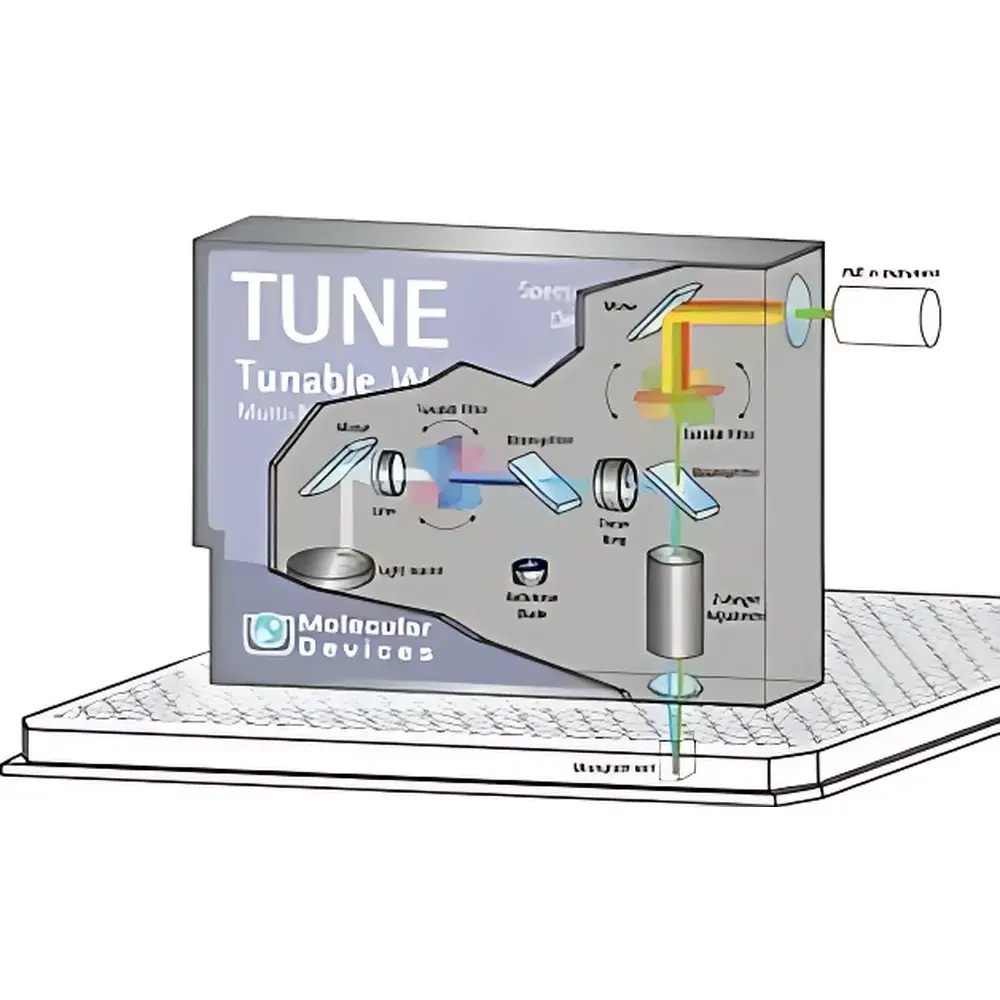
The Molecular Devices Paradigm TUNE Wavelength-Tunable Filter-Based Detection Module is a modular optical engine designed exclusively for integration with the SpectraMax Paradigm multimode microplate reader platform. Engineered to overcome the classical trade-off between spectral flexibility and signal intensity, the TUNE module employs a hybrid optical architecture that merges the broad tunability of monochromator-based systems with the high photon throughput and signal-to-noise ratio characteristic of interference filter-based detection. At its core, the module utilizes a patented tunable bandpass filter technology—distinct from traditional grating or acousto-optic tunable filters (AOTFs)—that enables precise, software-controlled selection of both excitation and emission wavelengths across a continuous 360–850 nm range. This architecture supports top- and bottom-read configurations, critical for adherent cell assays and heterogeneous immunoassays. The system incorporates high-output, thermally stabilized LEDs with digitally adjustable intensity control, ensuring optimal excitation energy delivery without photobleaching or thermal drift. Designed for GLP-compliant laboratories, the TUNE module delivers traceable, reproducible optical performance validated per ISO/IEC 17025 principles and aligned with ASTM E2759-20 (Standard Practice for Performance Verification of Multimode Microplate Readers).
Key Features
- Hybrid wavelength selection: Combines tunable filter precision with filter-grade optical efficiency—no moving parts in the optical path ensures long-term alignment stability.
- Dual-read capability: Independent top- and bottom-detection optics optimized for suspension vs. adherent cell assays, including 384- and 1536-well microplates.
- Multi-detection modality support: Simultaneous configuration for fluorescence intensity (FI), time-resolved fluorescence (TRF), luminescence (LUM), and absorbance (ABS) within a single assay protocol.
- Dynamic LED power control: Six independently controllable LED sources (365, 405, 450, 485, 520, 570, 600, 630 nm options) with 0.1% intensity resolution for assay-specific excitation optimization.
- Rapid plate interrogation: Full 96-well absorbance read in ≤12 seconds; kinetic sampling intervals as short as 50 ms for real-time enzyme kinetics or calcium flux assays.
- Low-noise detection electronics: Photomultiplier tube (PMT) and silicon photodiode detectors with auto-gain switching and background subtraction algorithms compliant with FDA 21 CFR Part 11 audit trail requirements.
Sample Compatibility & Compliance
The TUNE module is compatible with standard ANSI/SBS-formatted microplates (96-, 384-, and 1536-well), opaque and transparent-bottom plates, and specialized assay formats including cell culture inserts and low-volume wells. It meets ISO 15197:2013 (in vitro diagnostic devices), IEC 61010-1 (safety requirements for laboratory equipment), and EU Directive 2014/30/EU (EMC compliance). All optical calibrations are traceable to NIST-certified standards. For regulated environments, SoftMax Pro Software v7.1+ provides full 21 CFR Part 11 compliance—including electronic signatures, role-based access control, and immutable audit trails—validated per GAMP 5 guidelines.
Software & Data Management
Controlled exclusively via SoftMax Pro Software, the TUNE module leverages an integrated Spectral Optimization Wizard that automates excitation/emission spectrum acquisition, peak identification, and bandwidth selection based on user-defined signal-to-background criteria. Raw data is stored in vendor-neutral .smx binary format with embedded metadata (wavelengths, gain settings, plate map, timestamps). Batch processing supports parallel analysis of multiple kinetic runs, normalization to internal controls, and export to CSV, Excel, or XML for LIMS integration. Advanced analysis modules include Z’-factor calculation, dose-response modeling (4PL/5PL), and kinetic parameter derivation (Vmax, Km, t1/2) with confidence interval estimation.
Applications
- cAMP quantification using HTRF or AlphaScreen formats
- Real-time monitoring of cell migration (scratch/wound healing) and proliferation (resazurin/CFSE)
- Cytotoxicity assessment via LDH release, ATP content (luminescent), or caspase-3/7 activity
- Fluorescent nucleic acid quantification (Qubit-style assays) and dsDNA/ssDNA discrimination
- ELISA development and validation—both fluorescent (e.g., DyLight-labeled antibodies) and chemiluminescent (e.g., luminol-HRP)
- G-protein coupled receptor (GPCR) signaling assays using β-arrestin recruitment or cAMP biosensors
- Neurotransmitter transporter kinetics (e.g., dopamine uptake in synaptosomes)
- Protease activity profiling with FRET-quenched substrates
- Quantitative fatty acid metabolism assays (QBT platform)
- Reporter gene assays (luciferase, GFP, RFP) with multiplexed dual-reporter normalization
FAQ
Is the TUNE module field-upgradable to existing Paradigm readers?
Yes—the module is mechanically and electronically compatible with all Paradigm base units manufactured after Q3 2015 and requires only firmware v3.2.1 or later.
Does the TUNE module support polarization measurements?
No—polarization detection requires the optional Polarization Module; TUNE focuses exclusively on wavelength agility and intensity optimization.
Can I perform simultaneous dual-emission detection (e.g., FRET) with TUNE?
Yes—using sequential excitation and dual-bandpass acquisition, supported by SoftMax Pro’s kinetic multiplexing workflow.
What is the minimum detectable fluorescence signal (LOD) under standard conditions?
Instrumental LOD (S/N = 3) for fluorescein in 96-well format is ≤0.5 pM (2 fmol/well), measured at 485/520 nm with 1 sec integration.
Are calibration certificates provided with each unit?
Yes—each shipped module includes a factory calibration report with wavelength accuracy (±1.5 nm), absorbance linearity verification (0–3 OD), and PMT dark current characterization.
Related Products




